
It is the week before graduation, and students at Community College of Philadelphia (CCP) are lined up at the Grad Fair waiting to pick up their caps and gowns. They put on the regalia, head outside, and are immediately drawn to the large bronze lion statue for a photo. Or maybe they opt to take that photo in front of the large “P” logo statue.

Commencement is an exciting time of year, the culmination of a lot of hard work. Providing students with branded environmental spaces to help them commemorate that moment, as well as many other moments along the journey, instills in them a sense of pride in the institution. Those branded spaces also help enforce a college’s identity and elevate its prestige within the community.
This article is part of a monthly series provided by the National Council for Marketing & Public Relations, an affiliated council of the American Association of Community Colleges.
At CCP, student satisfaction surveys showed that students did not feel they were getting the same campus experience as at a four-year institution. When the college rebranded in 2024, it took a more holistic approach, not just changing the colors or getting a new logo and tagline, but also by including environmental graphics and creating branded moments and spaces to help build a better campus experience.
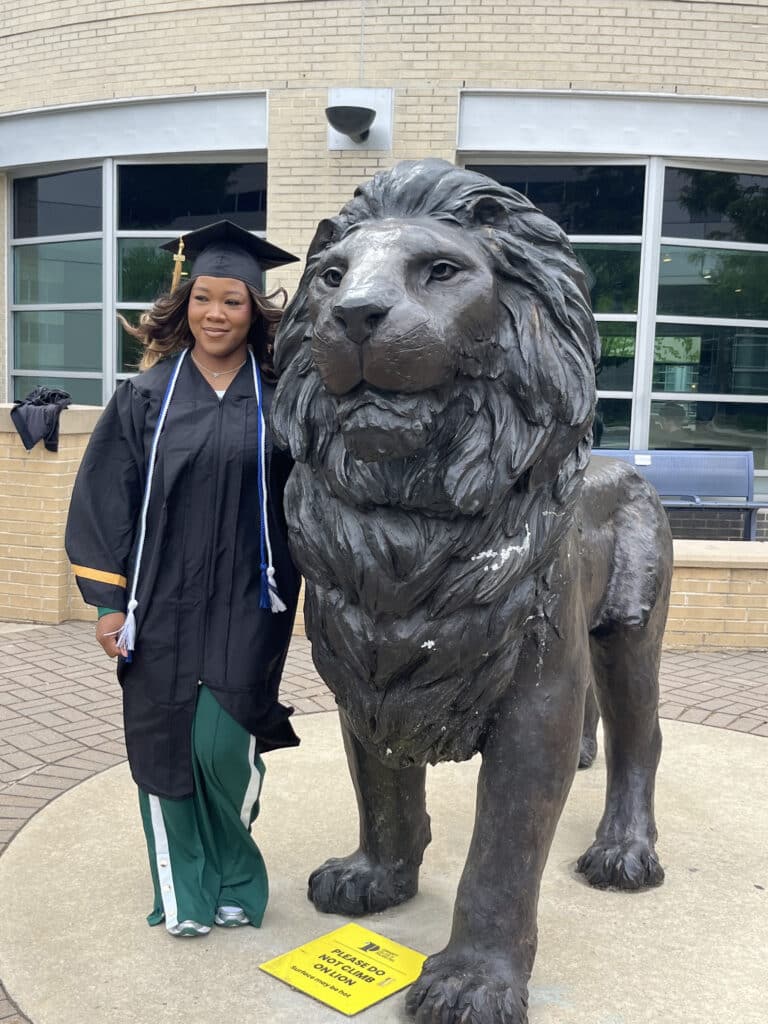
Before the rebrand, the college environment was generic with no cohesion of colors, branded interior spaces or statues on campus. CCP used the principles of environmental psychology in designing branded spaces that encouraged positive student behaviors, increased engagement and built school pride. Now the college showcases the brand with statues, interior walls in brand colors, a neon logo sign in the student center and large logos on walls.
The changes are helping: Students are starting to feel that pride and school spirit.
“The new branding shows CCP is competing with top universities,” said Kamal Rhodes, a 2025 CCP graduate. “It makes us proud to wear our gear. People recognize the quality of education we’re getting.”
The changes also helped CCP reinforce the value of community colleges, said Shannon McLaughlin Rooney, CCP’s vice president for enrollment management and strategic communications.
“The old stigma around two-year education just has no validity in 2026 against the backdrop of the student debt crisis,” she said.
Show how much the college values students
When the creative services team at Community College of Baltimore County (CCBC) transformed its Honors College branding, that branding went from a collection of inconsistent, multi-use spaces to a cohesive, intentionally branded environment that reflected the program’s quality and identity, said Jodi Neal, who was the director of creative services during the change. The redesigned space spotlighted student achievements, transfer success and aspirational storytelling, and incorporated engaging, student-centered design elements that made the area feel welcoming and relevant.
The impact was immediate: Prospective students were impressed, applications increased and current students actually wanted to spend time there. They began to take pride in a space that finally matched the rigor of their work.
The project underscores the broader importance of environmental graphics in higher education. By turning a previously tired and undefined space into a branded experience, CCBC strengthened the Honors College identity, reinforced its value and fostered a greater sense of belonging among students.
These spaces serve as powerful storytelling tools, Neal said. They communicate prestige, community and opportunity before a single conversation takes place; and they can play a critical role in both recruitment and student connection.
Like many projects in higher education, it took some convincing to get leadership on board due to cost and necessity. But Neal championed this project along with the Honors program director and convinced leadership that the changes weren’t just about aesthetics — they would support recruitment and showcase Honors as one of the college’s premier academic programs.
“It sent a message that the college valued the program and the students in it. That’s important,” said Neal, who is currently the executive director for brand and creative at Montgomery College in Maryland. “When you invest in a space, you’re telling students that what they’re doing matters.”
Show leadership what’s possible
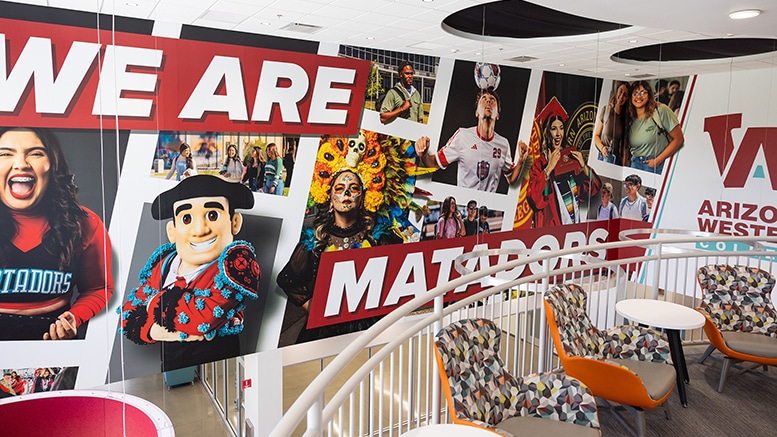
At Arizona Western College (AWC), the marcom team turned a blank canvas inside the new Matador Activity Center into a defining campus feature through large-scale environmental branding.
The student hub — home to retail, gathering spaces, classrooms and services — was architecturally modern but lacked visual identity when it opened, said Mandy Heil, AWC’s dean of marketing and communications. Recognizing an opportunity, the college installed a massive, multi-story wall graphic visible from both the main floor and an upper balcony. Centered on the message “We Are Matadors,” the installation uses photography of students to celebrate campus life and reflect the diversity and energy of the college community.
The project was pitched by AWC’s creative director, Luis Landeros, who mocked up the design in the space. This helped leadership visualize the transformation and understand its impact.
“Sometimes people don’t realize what’s missing until they can see what’s possible,” Heil said.
The project has quickly become one of the building’s most recognizable and engaging elements. Students gather around it, take photos and even spot themselves and their peers featured in the design, creating a personal connection.
The installation extends beyond decoration, telling the college’s story and what it means to be part of its community.