
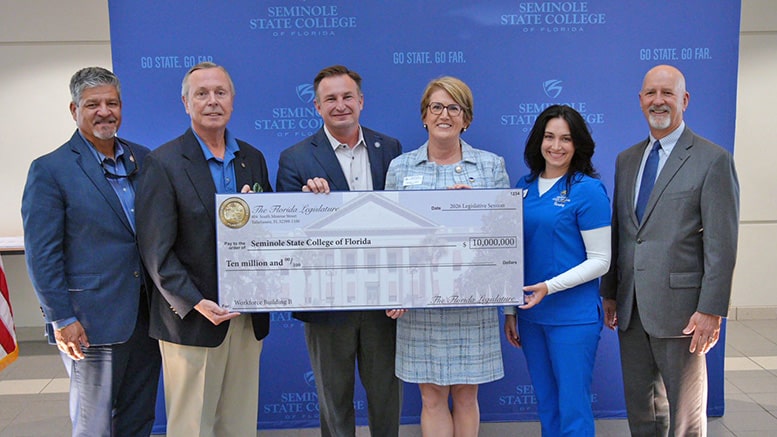
Seminole State College of Florida will receive $10 million in state funding to use toward a new Workforce, Science and Technology Center at the college’s healthcare-focused Altamonte Springs Campus, as well as $600,000 for training in advanced manufacturing. The funding is part of newly announced $13 million in state funding to support civic education and workforce development.
Seminole State will also receive $600,000 in state funds for its Amplify@SSC initiative, which will expand college-credit and non-credit programming in advanced manufacturing. That funding will support training in high-demand disciplines, including robotics and automation, artificial intelligence, networking and connectivity, additive manufacturing and 3D printing, and welding.
The center will be a new 108,136-square-foot facility featuring workforce classrooms and laboratories, designed to address critical regional and statewide workforce shortages, particularly in nursing and other health sciences.
* * *
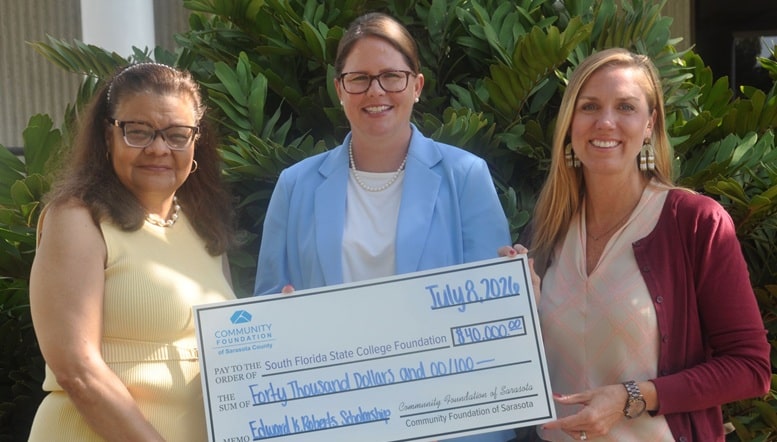
Also in Florida, South Florida State College‘s foundation (SFSC) has received $40,000 from the Community Foundation of Sarasota County to support county residents part-time students and parenting students. The grant comes from the Edward K. Roberts Community College Fund, which was established by Roberts as a legacy to support Florida’s community colleges and other charitable organizations.
SFSC’s grant funds are designated to aid students who attend college part-time and may not qualify for other forms of financial aid and students who are parents, whether single or married. The grant covers tuition, housing, books, childcare, transportation and needs that would otherwise prevent students from attending college.
“For a part-time student balancing work and family, or a parent going back to school, a single unexpected expense can be the reason they don’t make it to graduation,” said Emily Dabolt, SFSC executive director of institutional advancement. “This grant helps make sure that doesn’t happen, and we’re honored to carry that mission forward for the students who need it most.”
Iowa
Iowa Lakes Community College has received an in-kind donation from POET Bioprocessing – Emmetsburg to support the powersports and power equipment technology program on the Emmetsburg Campus. The donation of a 2024 Can-Am Defender, valued at $15,000, provides the program with a recent-model-year platform for hands-on student learning.
Iowa Lakes’ three-term powersports and powersports equipment technology program provides students with industry training in diagnosing, repairing and maintaining motorcycles, snowmobiles, personal watercraft and outdoor power equipment.
Michigan
Washtenaw Community College (WCC) will help prepare students for careers in the growing microelectronics sector, thanks in part to a $200,000 grant. WCC is a sub-awardee on a National Science Foundation (NSF) grant project led by Michigan State University (MSU).
Through the MSU and Fraunhofer partnership, WCC participants can experience semiconductor manufacturing and emerging technologies firsthand while building skills relevant to Industry 4.0 careers. The broader NSF-funded project also explores advanced semiconductor technology using lab-grown diamond, an emerging material with the potential to improve performance in electronics and energy systems.
This summer, the first cohort of WCC students, faculty and adult learners participated in workshops at MSU and Fraunhofer USA’s facility in East Lansing. They gained experience with wafer fabrication, machine learning, data cleaning and analysis. Participants also earned an official Fraunhofer USA certificate validating their knowledge of industrial AI deployment and semiconductor quality control.
Montana
Miles Community College (MCC) has received a $125,000 Future at Work Grant from the Montana Office of the Commissioner of Higher Education (OCHE) to launch a new pre-nursing pathway for rural eastern Montana high school students.
The new pathway will provide a regional cohort of 20 high school students with dual-enrollment opportunities that connect early college coursework with healthcare career preparation. Beginning in fall 2026, participating students will have the opportunity to earn 15 college credits while in high school, complete nursing assistant/CNA preparation, explore healthcare careers and build a foundation for continued education in nursing and allied health programs.
“This grant allows MCC to bring healthcare career preparation directly to rural students earlier, more intentionally and closer to home,” said Dimitria Harding, MCC vice president of academic affairs.
New York
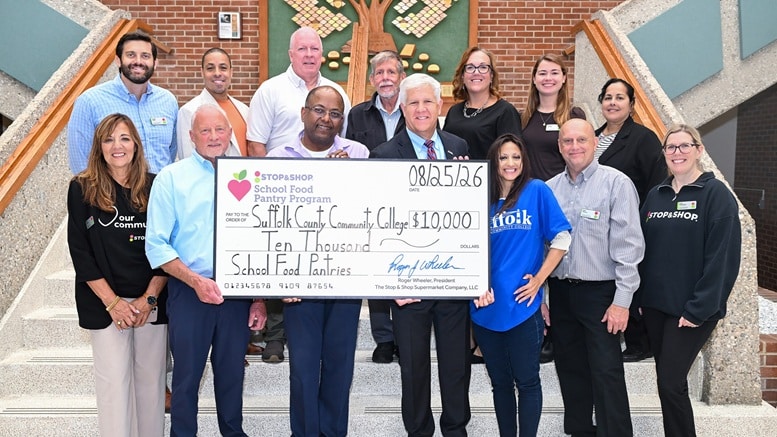
Stop & Shop has donated $10,000 to Suffolk County Community College through its Stop & Shop School Food Pantry Program. The donation, provided through gift cards, will support the college’s three food pantries.
The New York college serves approximately 26,000 students across its three campuses, with nearly 37% of students receiving Pell grants. The college’s food pantries provide a safety net for students facing food insecurity.
The college’s commitment to addressing food insecurity stretches back decades. Its pantry located on the Michael J. Grant Campus in Brentwood was the first college food pantry established in New York State and has been serving students since the 1970s.
Palau
Palau Community College (PCC) has received a $3,000 donation from Globus Trading Company for the PCC Endowment Fund. This follows a $5,000 donation the company made earlier this year to the endowment fund.
Globus Trading invests in various schools throughout Palau, according to PCC, helping to ensure that the schools can continue to offer quality education and resources for many years ahead.
Texas
The Abell-Hanger Foundation has committed $7 million to support construction of Midland College’s new Applied Technology Complex, an investment that will expand access to career and technical education (CTE) programs.
The facility will create modern learning environments designed to meet the needs of students and employers. It will include three additional buildings for welding technology, diesel technology, petroleum technology, automation and natural gas compression. Once completed, the expansion will allow Midland to serve more than 700 additional applied technology students annually.
“Midland is a place of great opportunity,” said Abell-Hanger Foundation CEO Mark Palmer. “But we must ensure that the institutions that fuel that opportunity have the resources to continue growing and serving our community.”
In addition, as existing programs move into the expanded facility, Midland will gain additional space to grow health sciences offerings. The expansion is expected to allow the college to serve approximately 300 additional students in high-demand health sciences programs.
Virginia
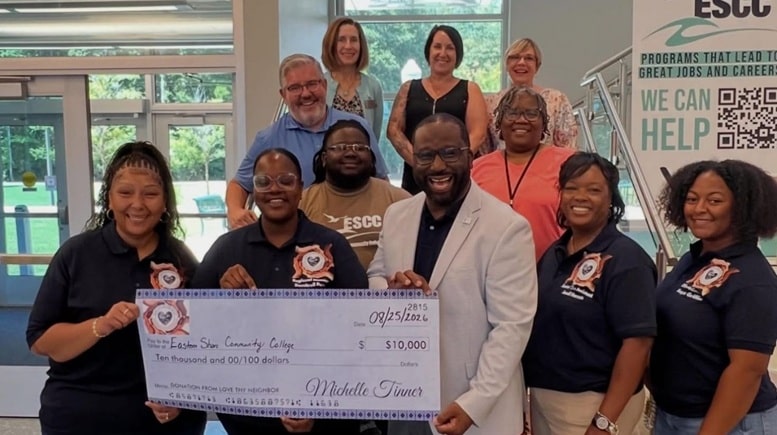
Nursing students at Eastern Shore Community College (ESCC) will benefit from a recent gift. Michelle Tinner, owner of Love Thy Neighbor Home Health Care, donated $10,000 to the ESCC Foundation for the Michelle Tinner Nursing Scholarship.
This is the second year of Tinner’s $50,000 scholarship commitment over five years to support ESCC nursing students.
Tinner, a registered nurse working toward her nurse practitioner degree, started the scholarship to pay forward the support she received that enabled her to overcome obstacles and complete her degree.
* * *
Old Dominion Electric Cooperative (ODEC) and Gas South have committed a total of $200,000 to support Southside Virginia Community College’s (SVCC) Power Line Worker Training School.
“As a founding supporter of the Power Line Worker Training School, ODEC’s renewed commitment helps ensure the communities we serve have the skilled labor to maintain the grid we all depend on,” said ODEC President & CEO Chris Cosby.
Over the past decade, more than 700 people have graduated from the 11-week program, and SVCC currently has a waiting list for people trying to enroll in the program.
The Virginia Community College System, seeing the program’s success, is expanding the program to additional locations across the state.