
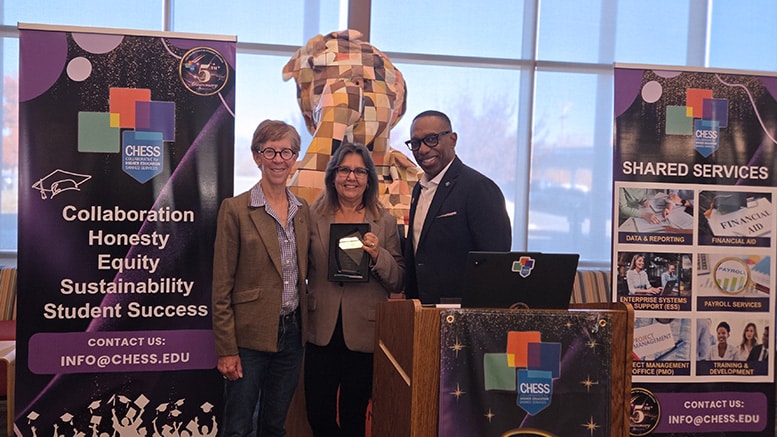
As community colleges nationwide grapple with enrollment shifts, rising costs and staffing challenges, six New Mexico institutions are demonstrating how collaboration can improve efficiency while preserving local control.
Through the Collaborative for Higher Education Shared Services (CHESS), the colleges share administrative systems, technology infrastructure and professional expertise through a common cloud-based platform. The consortium serves approximately 48,000 students and 7,000 employees statewide.
A major milestone is approaching as CHESS implements a shared student information system that leaders say will simplify admissions, financial aid, registration and other student-facing processes. The six institutions also became the first in the nation to jointly implement Workday technologies for finance, human resources and payroll.
“We are sharing technology, expertise and solutions while redesigning processes around the needs of our students and employees,” said Tracy Hartzler, president of Central New Mexico Community College (CNM), the largest member institution with about 19,300 enrolled students.
CHESS members include CNM, Santa Fe Community College, Clovis Community College, San Juan College, Luna Community College and Northern New Mexico College.
Good signs
According to a recent case study, New Mexico lawmakers increasingly view the initiative as a successful example of voluntary collaboration, easing concerns that a centralized statewide college system might be necessary to achieve efficiencies. Shared financial aid and compliance expertise has helped reduce audit findings by roughly 50%, while common payroll, technology support and human resources systems have increased efficiency and made it easier to share expertise across campuses, according to college leaders. Also, a shared help desk now supports institutions that previously lacked that service.
“We’ve now gone live on a number of shared functions, and we are continuing to add new features and updates. The system is improving at every stage, and we’re seeing how this type of collaboration can pay off — even in ways we weren’t predicting,” said Becky Rowley, president of Santa Fe Community College, a partnering institution that serves about 5,000 students.
The greatest benefits may still lie ahead, leaders say. Once the student information system is fully implemented, students should be able to more easily access information, complete routine tasks and navigate college processes through modern self-service tools. Faculty, advisors and staff also will have better data to identify challenges earlier and provide more targeted support.
Related article: CHESS prepares move toward one, shared system
The case study concluded that trust among institutional leaders and a commitment to maintaining local autonomy were key to CHESS’s success. The report recommends that colleges pursuing similar collaborations focus on clear governance structures, frequent communication, secure funding and broad campus buy-in.
“Ultimately, the value of CHESS will not be measured by the technology we install,” Hartzler said. “It will be measured by whether we make college easier for students to navigate, give employees better tools to serve them, and use our collective resources more effectively.”
Internal details
Formed in early 2021, CHESS now has 45 staffers and a board comprising college presidents who meet twice monthly. Member colleges share some costs equally and some based on college size, while the state kicks in funds for specific projects.
Some staff members are hired as contractors, including several who are retired higher education professionals, while others are administratively tied to member colleges to retain access to benefits, Rowley said. She noted that some college employees were concerned that shared services might lead to job losses or outsourcing, but CHESS leaders emphasized the importance of transitioning staff to “more student-facing and higher-value work that was aided, not replaced, by technology and systems improvements.”
Rowley, Hartzler and CHESS CEO Shawn McAltmont offered a review of CHESS’s progress at a session during the American Association of Community Colleges annual convention in April.
“With the creation of CHESS, these institutions became the first in the nation to jointly implement Workday technologies for finance, human resources and payroll,” their presentation noted. “A shared enterprise resource planning and student information system (ERP/SIS) provides an integrated platform to streamline administrative processes and align student services across colleges.”
After a review of several platforms, CHESS leaders, as their first major decision, selected Workday to replace what were often old, highly customized and often underused legacy systems.
“At CNM, Workday is already supporting our finance and human resources operations,” Hartzler said. “We have streamlined workflows, reduced manual processes and improved employees’ access to timely, consistent information. That matters because better systems free our faculty and staff to spend less time navigating administrative processes and more time supporting students.”
