
“Without stable shelter, everything else falls apart,” Princeton University sociology professor Matthew Desmond wrote in his Pulitzer Prize-winning book “Evicted: Poverty and Profit in the American City.”
Campus leaders know this all too well. It’s why a growing number of community colleges are adding housing insecurity to the list of barriers they hope to eliminate by providing stable, safe and affordable housing options for students.
The number of community colleges that offer student housing is on the rise. Many colleges are building living spaces on campus; as of 2023, nearly three in 10 public community colleges (28.1%) offered on-campus housing, up from 22.8% in 2010, according to an analysis of federal data by the American Association of Community Colleges (AACC).
This article is an excerpt from the new issue of AACC’s Community College Journal.
Others have taken more creative approaches by partnering with outside organizations to house students, such as four-year colleges, housing placement services and even local hotels.
Regardless of the model, campus leaders note that stable housing is something many of their students need for success.
“If you don’t have safe and affordable housing and utilities, it will be hard for you to learn and persist in college,” said Christie Curtis, director of basic needs outreach for Austin Community College District (ACC) in Texas.
Providing on-campus housing
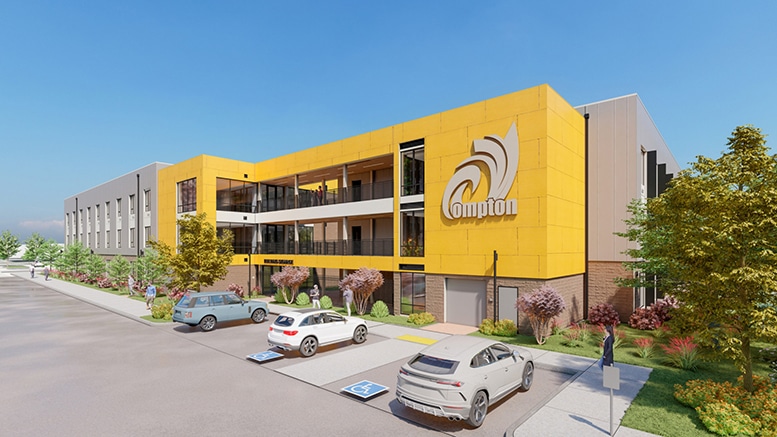
Compton College in California is building prefabricated student housing consisting of interconnected, three-story structures that will feature 151 one-and two-bedroom units, providing living spaces for up to 251 homeless and low-income students. The $80.3 million project is being funded by a state grant program supporting campus housing.
The project grew out of survey data showing housing was a basic need for Compton students, said President Keith Curry. It’s part of a larger strategy to support students’ basic needs, such as by providing one meal per day at the Everytable Café, $20 vouchers for a weekly farmers market, laptops, Wi-Fi hotspots, calculators and public transportation passes.
“We’re trying to do what’s right for our students,” Curry said. A 2024 report from the California Legislative Analyst’s Office concluded that more than half the state’s community college students had faced housing insecurity in the prior year — and about a quarter had experienced homelessness.
Related article: Creative approaches to house students
Construction on the housing units began in 2024, and they’re expected to be completed in time for the 2027-28 school year.
The buildings will include social lounges and study rooms, a kids’ play room and a landscaped courtyard with barbecue seating areas and a playground.
To support student housing on campus, the college has also created a new director of student development and housing position.
Building micro homes
Campus-based housing options don’t have to be traditional dormitory-style housing or apartment units. Wallace State Community College in Alabama has received $2.5 million in federal appropriations from Rep. Robert Aderholt (R-Alabama) to fund the Lions Village, a planned collection of micro homes designed for student families.
The project will be located across from campus and will include up to 20 micro homes, with a childcare center and a playground in the middle. The development will also feature wraparound services such as mental health counseling and a food pantry. The college already has three traditional residence halls that accommodate about 180 students.
“As we looked at the challenges facing adult learners and student parents, affordable housing and access to reliable childcare were common themes,” Wallace State President Vicki Karolewics said. “We also recognized that many of our students are working to break cycles of generational poverty while balancing school, work and family responsibilities.”
Campus leaders considered a number of different housing models. They said the microhome model offered a unique opportunity to create affordable, family-friendly housing while maximizing the impact of available funding.
“The village concept also allows us to build a supportive community where student parents can connect with one another and access services already offered through the college,” Karolewics said. “Rather than simply providing housing, we wanted to create an environment designed to help students persist, graduate, and ultimately improve outcomes for their families.”
Teaming with a university
Instead of building their own living complexes, some community colleges have leveraged partnerships with four-year institutions to offer housing for students.
For instance, Oakland Community College (OCC) in Michigan has partnered with nearby Oakland University (OU) to provide housing at the OU campus, which is only a few minutes away, and students can ride the bus between the two campuses free of charge.
“Our proximity to the university made this an ideal program,” said OCC Vice Chancellor of Student Services Kimberly Hurns.
OCC’s sports programs attract many athletes from outside the community who needed housing. Initially, campus leaders saw this partnership as a way to meet their needs. Yet, it turns out that most of the students taking advantage of this option did so because they wanted more of a traditional college experience, Hurns said.
By living on the OU campus, they have access to the university’s library, gym, dining halls, cultural programs and other amenities.
The partnership is a win for both institutions, as OU had experienced a decline in the number of students living on campus after the pandemic. Not only is it seeing more occupancy in its dorms, but OU officials anticipate that more OCC students will earn a bachelor’s degree with the university if they’re already living on the campus.
To make this transition even easier, the two schools have been working to make the transfer process as seamless as possible with an early acceptance program.
While it’s too early to tell if living in the OU dorms makes it more likely that students will ultimately attend the university, OCC has seen its own persistence rate increase since implementing this housing option, Hurns said.
Using local hotels
York County Community College (YCCC), located on the coast of Maine, has turned to the local hospitality industry for help in housing students.
Because it’s a popular destination spot, “this area has a huge housing shortage, and finding rentals is next to impossible,” said Chris Burbank, dean of student experiences and strategy.
A few years ago, the college was starting an athletics program, and officials noticed that even its academic programs were drawing students from all over.
“Suddenly, we were getting students from Connecticut, and we even had a student from Idaho,” Burbank said.
To house these non-commuters, the college partnered with a local Hampton Inn. The college’s students take up a portion of one floor.
“The students’ rooms are adjacent,” Burbank said, “so they can develop relationships with each other. They have access to a pool, free breakfast, and housekeeping services once a week.”
The college runs a shuttle to its campus a mile away.
The hotel gives students a discounted rate to stay. The college pays the hotel directly and bills students so their housing costs are eligible for financial aid.
Even while offering a discounted rate, the hotel makes out well in the deal, as it has a guaranteed occupancy during the quieter winter months.
This creative solution offers housing for about three dozen students. But college officials kept hearing from local businesses that they needed more employees.
In conversations with community partners, officials realized that building campus housing could draw more students to the area — and when students go home for the summer, these units could be rented to traveling nurses, lifeguards, and other seasonal employees who struggle to find a place to stay.
A concept study confirmed what college leaders were thinking, and this year the college secured $6.5 million in federal funding to help build on-campus housing with at least 160 beds. The goal is to open the facility in time for the 2028-29 school year.
“Bringing more people to the region is a win for everybody,” YCCC President Michael Fischer said.