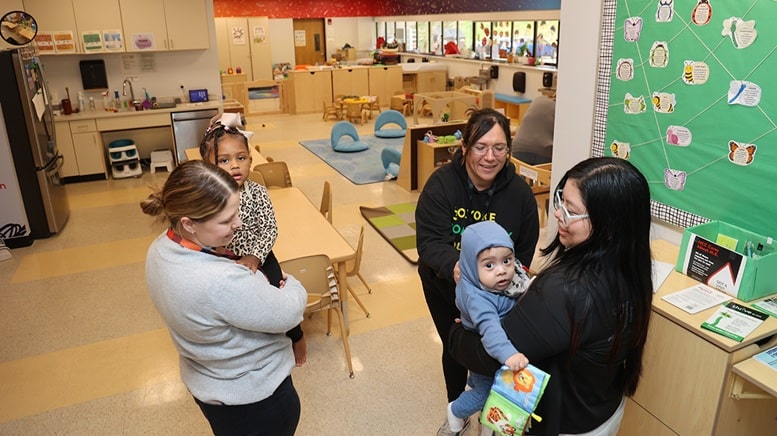
In Massachusetts, Holyoke Community College (HCC) will use a federal grant worth nearly $1.25 million to expand services at its on-campus Itsy Bitsy Child Watch program and provide subsidies for student parents who might require additional off-campus childcare.
The four-year Child Care Access Means Parents in School (CCAMPIS) grant comes from the U.S Education Department, in partnership with the U.S. Department of Health and Human Services.
Itsy Bitsy Child Watch is available as a drop-in center for student parents on the main HCC campus. The student childcare subsidy program will add on-campus childcare seats by freeing up more “as-needed” capacity for students who need short-term care. The subsidies will help address the long waitlist, according to an HCC press release.
“Since it opened, Itsy Bitsy Child Watch has provided free, intermittent care for more than 225 HCC families,” said Emily Webber, the program’s director. “Now we will have the ability to connect students with community-based childcare that can support longer care needs.”
Kentucky
Bluegrass Community and Technical College (BCTC) has received a $20,000 Safety Net Funding Community Impact Award from United Way of the Bluegrass to strengthen the college’s food pantry and expand resources for students experiencing food insecurity.
The award will support BCTC’s “Changing Lives in the Heart of the Bluegrass” project, an initiative to reduce barriers that can interfere with students’ ability to remain focused on their education and achieve their academic goals.
The funding will allow the Heart of the Bluegrass food pantry to increase the number of students it serves to at least 350 within one year. The pantry is located in at the college’s Lexington campus but provides services for all six campus locations.
Grant funds will help keep the pantry stocked with essential food, hygiene and cleaning supplies throughout the year. The funding also will support the purchase of additional shelving and freezer storage, increasing the pantry’s capacity to offer a wider variety of items.
Michigan
With the help of a $630,876 state grant, Washtenaw Community College (WCC) will launch a new maritime welding program to help train workers for the high-demand maritime, shipbuilding, defense and advanced manufacturing workforce.
The grant, from the Michigan Department of Labor and Economic Opportunity-Workforce Development (LEO-WD), will allow WCC to expand its welding technology program with the addition of robotic welders, hands-on training and development of the proposed new Marine Structural Welding and Ship Repair Certificate.
According to LEO-WD, the U.S. Navy anticipates needing more than 140,000 skilled maritime and advanced manufacturing workers over the next decade to support its long-term shipbuilding plans, including submarines and other vessels critical to national defense.
The first cohort of students in the new program is expected to enroll in fall 2027, with the new program ultimately serving 60 to 100 students annually.
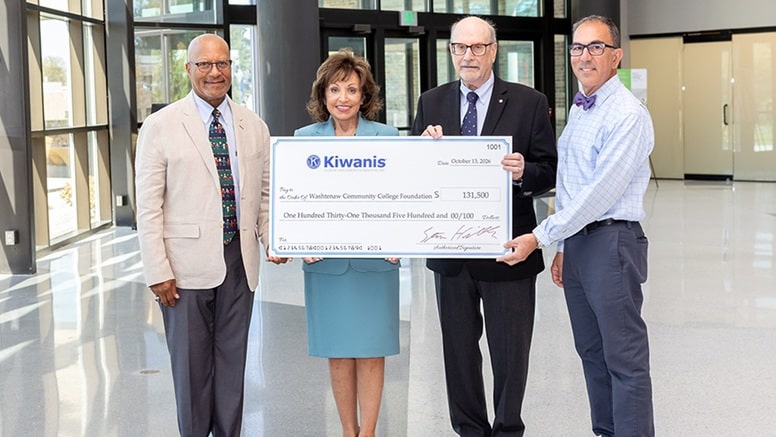
Washtenaw Community College also recently celebrated a $131,500 donation from the Kiwanis Club of Ann Arbor. The donation supports the Kiwanis Finish Line Scholarship, which helps students overcome financial barriers and stay on track toward completing their education.
The endowed scholarship covers tuition and books for a full academic year for full-time students, an approximate value of $3,500 annually. Recipients can renew the scholarship for up to three years by maintaining a 2.0 grade point average and making satisfactory progress toward completion.
In 2018, the Kiwanis Club designated the WCC Foundation as the sole recipient of its annual college scholarship budget. That first gift totaled $70,000, and the organization’s annual contribution has increased every year since.
New York
Several community colleges are among the recipients of State University of New York’s (SUNY) Outdoors for All grants.
The program aims to provide more students, and New Yorkers of all ages and from all backgrounds, with opportunities to enjoy the state’s natural beauty. A total of 14 campuses are receiving grants of up to $8,000 to invest in improvements or activities that promote sustainability, accessibility, inclusivity, wellness and community development.
Cayuga Community College, for example, will incorporate its Auburn Campus trail areas and Fulton Campus walking routes into self-guided wellness experiences. These routes will create easy opportunities for students to engage with outdoor spaces between classes and throughout the academic year.
Tompkins Cortland Community College will transform a furnished structure into an intentional outdoor learning environment through wayfinding, identity signage, classroom reservation designation and a mural.
And Clinton Community College will install ADA-accessible ramps at two existing gazebos, make improvements and updates to existing signage, and place Adirondack chairs for additional seating to create more inviting environments.
“Receiving this grant is an affirmation of the work being done across our institution to provide students with access to quality experiences that uplift their educational environment,” said Clinton Community College President Ken Knelly.
* * *
Borough of Manhattan Community College’s (BMCC) Early Childhood Center has received a $1.9 million Child Care Access Means Parents in School (CCAMPIS) award to support childcare and support services for student parents over the next four years.
The funding will support the Early Childhood Center’s Student-Parent Achievement, Retention and Completion (SPARC) project, which provides childcare and other services designed to improve persistence, retention and graduation rates among student parents.
The grant also will support the operation of four classrooms, creating additional childcare slots for children of BMCC students, and will fund a family resource coordinator/licensed mental health professional, professional development initiatives for staff and an accreditation specialist consultant.
With the expanded resources, the center expects to increase the number of families it serves by 16%.
BMCCC also announced a $456,657 grant from the National Science Foundation (NSF) to provide Research Experiences for Undergraduates (REU) over a three-year period.
The new program will have students working directly with faculty mentors on hands-on research in plant chemical biology, including experimental and computational projects, while gaining experience with advanced research instrumentation. It’s intended to reach community college students who have limited access to research opportunities.
Over three consecutive summers, 24 students will participate. They also will participate in professional development workshops, scientific presentations, field trips and networking activities.
The student researchers will present their findings at the BMCC Annual Research Symposium (BARS), which showcases the work of students who have completed research throughout the academic year.
* * *
Bronx Community College has earned a $500,000 NSF grant to enhance the way students learn mathematics and biology through project-based approaches.
The three-year project will engage students in collaborative investigations of open-ended, real-world problems using authentic data. Instead of relying only on lectures, traditional laboratory activities and routine problem sets, students will work together to formulate questions, analyze data, communicate findings and defend their conclusions.
“Our students are entering a workforce being reshaped by artificial intelligence. By helping them connect classroom learning to real-world problems, we prepare them not just to pass a course, but to think, collaborate, lead and gain the skills employers value – the ones generative AI cannot easily replace,” said Bronx Community College President Larry D. Johnson, Jr.
The initiative will focus on foundational mathematics and biology courses, where many students begin their academic journey and where many stall. Faculty from both disciplines will collaborate to create interactive learning experiences that encourage inquiry, teamwork and deeper understanding.
The project will produce freely available, openly licensed teaching resources that educators across the country can adapt for their own classrooms.
Texas
A total of $3.7 million in Perkins Leadership Grants was awarded to 13 two-year Texas colleges for the development of career and technical education (CTE) programs.
“Texas’ skilled workforce is critical to our state’s economic success,” Gov. Gregg Abbott said. “With these grants, community and technical colleges can develop or redesign programs for in-demand occupations and recruit and retain instructors to train the next generation of the workforce.”
Colleges received grants in three categories:
- Emerging and current high-demand credentials
- Recruitment and retention of CTE educators in postsecondary education
- Prison education – preparing for Rreentry
Among the grant recipients is El Paso Community College, which will use its nearly $300,000 grant for an initiative to attract more qualified healthcare professionals into teaching by providing supplemental compensation, onboarding, professional development and more.
Virginia
Patrick & Henry Community College (P&HCC) is establishing a paid internship program thanks in part to a $802,750 grant from The Harvest Foundation. The program aims to place 100 interns over three years in fields such as advanced manufacturing and healthcare.
“Too often, students complete their education without meaningful professional relationships with employers in the area. By the time they graduate, they may already be pursuing opportunities outside of Martinsville and Henry County because they have not built any connections here,” said P&HCC President Greg Hodges. “Talent retention must begin before graduation through early, real-world experience. Internships are one of the most effective tools we have to address this talent challenge.”
The funds from the foundation will allow P&HCC students to participate in paid internships with employers in Martinsville and Henry County. State funds from InternshipsVA will reimburse employers up to one-half of the intern’s wages, or up to $7,500 per intern.
“Alleviating this financial burden for local employers will increase the number of students that are able to participate in paid work experiences and ultimately lead to more investment in the local workforce,” said Colin Ferguson, P&HCC assistant vice president for workforce and technical programs.