For decades, quantum science has held theoretical promise but remained largely the realm of university and government lab researchers. In recent years, however, the commercial potential of quantum — which holds the promise to drastically increase and speed up computing power, create more accurate industrial sensors, and lead to crisper, more reliable communications — has been approaching an inflection point, with promise for fields like healthcare, cybersecurity, artificial intelligence and climate change solutions.
As a result, and as quantum-related companies have begun to set up shop, community colleges are undertaking their part in training workers for this new economy. They’re standing up everything from programs that provide course tracks and certificates aimed toward the technical aspects of quantum, to more academic pathways leading to a bachelor’s degree and potentially beyond.
Bootcamp and more
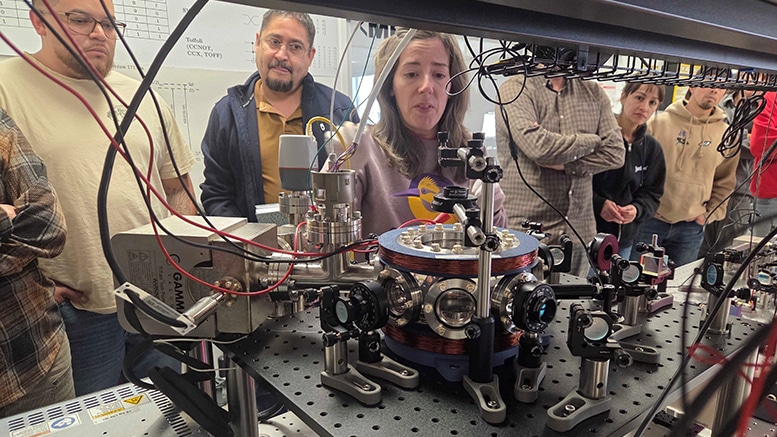
Among the colleges jumping in with both feet is Albuquerque-based Central New Mexico Community College (CNM), which has partnered with Sandia National Labs to construct a quantum science laboratory and develop a 10-week quantum technician bootcamp.
Launched last September, the program focuses on optics — lasers, mirrors and lenses — as well as vacuum systems for airless chambers needed to hold and manipulate subatomic matter and energy inherent in quantum, says quantum instructor Brian Rashap. When CNM and Sandia first connected, they discussed “how that industry was moving out of the labs into commercialization,” he says. “We collectively saw a need for a technician workforce.”
The partners brainstormed what skills the bootcamp should teach and decided to focus on atomic quantum systems, one of several quantum modalities, in which Sandia has expertise and nearby industries like semiconductor manufacturing, energy and defense use. They then visited with other community colleges and quantum companies around the country, Rashap says.
“Those skill sets have been validated in that we’re getting a reasonably good employment rate,” he says, with entry-level positions that typically pay $75,000 to $85,000 per year. And students are getting hired quickly. Within three days of this year’s May 1 graduation, students had found work in companies focused on satellite defense, quantum networking and quantum sensing.
Multiple options
Delivered 40 hours per week for 10 weeks, the bootcamp does not require any math or science prerequisites, although a lot of math and science are taught in the class, Rashap says. “CNM’s mission is to create accessible education for all New Mexicans,” he says. “It’s very important to us that we don’t put up barriers.”
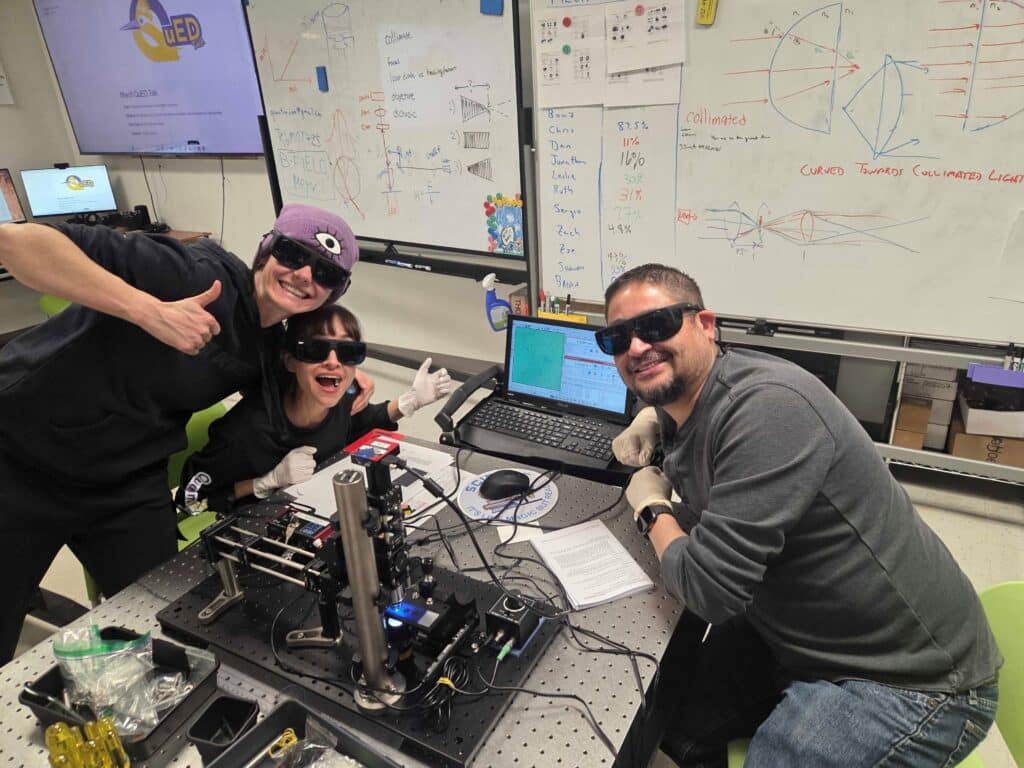
While intended mostly to train for manufacturing roles, Rashap says graduating technicians also can find work in research and development and potentially in back offices, as a technical buyer, for example. He estimates that the class is about 85% hands-on learning and 15% lecture, with employers coming in and out to observe and meet the students, who range in age from 21 to 60 and probably average mid-30s.
“We’re right on the beginning of the curve of the inflection point,” he says. “If you go back two years or so, there probably wasn’t any quantum industry in New Mexico. There were the national labs, which were a draw for quantum companies.” He adds companies have indicated that “the workforce programs at CNM give them confidence they will be able to hire employees as they need, as they grow their footprint.”
In August, CNM will begin offering a more traditional academic certificate skilled-trades program, for which the college “essentially sliced up the 10-week program into traditional three- and four-credit classes,” and the bootcamp material will comprise about 60% of the overall curriculum, Rashap says.
“Some of them will want to become technicians,” he adds. “But the 10 weeks is not for everyone. The college is making sure that we have a pathway that works for multiple life situations. Some of the folks that do the academic program will continue with their education and go on to get a bachelor’s degree.”
Also this fall, Emily Griffith Technical College in Denver will begin a version of Central New Mexico’s program, and in June, CNM will spread the quantum gospel to other schools by hosting a month-long immersion for educators around the country in the bootcamp’s curriculum, Rashap says. The college also has been partnering with three state research universities and a nearby quantum venture studio to help recruit quantum companies to the state, he says.
Quantum Innovation Center
Another community college that’s building its quantum bona fides is Palm Beach State College in Florida, which in February announced a federal grant of more than $2 million to support creation of the college’s Quantum Innovation Center, on top of nearly $5 million previously awarded by the state’s Job Growth Grant Fund.
Developed in partnership with the Business Development Board of Palm Beach County and Quantum Coast Capital, the Quantum Innovation Center aims to become a regional workforce training hub.
“We have tried to always align ourselves with the opportunities presenting themselves within our community,” says Ava Parker, president of Palm Beach State. “To bring quantum computing companies and businesses to our community, we understood we had a need to build the ecosystem so those businesses would have people they could hire.”
Related article: CCIC finalist team focuses on quantum science
Rather than wait to build programming until the sector already had arrived, she says, the college worked alongside the Business Development Board as it attempted to attract businesses.
“We said, ‘Let’s get in on the front end of this and find ways to train students to work in this sector and be ahead of the curve, so they’re here to get the jobs as the companies are coming into the community,’” Parker adds.
The new center will occupy a building in downtown West Palm Beach, with space for the certificate program for students as well as an incubator “so that new thought leaders in the industry, trying to start new companies and develop new ideas, will have a space within the quantum innovation center where they can work,” Parker says.
“We’re planning to help those businesses with information on how they can apply quantum technology in the most efficient, profitable way,” adds Luis Pentzke, associate dean of computer science. “The facility is going to have sensing, measurement and simulation equipment.”
The certificate program will be open to Palm Beach State students and others in the community, and like the Central New Mexico bootcamp, there will be no prerequisites for math or science.
“Instead, we’re going to teach it in a project-based, non-traditional way,” Pentzke says, with a series of hands-on modules culminating a final project that incorporates the material in all of them.
Related article: Workforce incubators for the next technology revolution
The Palm Beach State will offer its certificate program in spring 2027, a rapid timeline that will prompt the college to be very responsive to its community, Parker says. The next steps are to train faculty, purchase equipment and renovate the space, she says.
Then in fall 2028, Palm Beach State plans to offer a 60-credit associate degree that the technician program will articulate into, and the college has had discussions with Florida Atlantic University about articulating the associate degree into a bachelor’s, Pentzke says.
Palm Beach State has also met with the Palm Beach County School District to discuss offering quantum-related programs at the high school level.
“Students come with physics and mathematical concepts, ready to jump into an associate degree program,” Pentzke says. “Or they could decide to take that technical training and then articulate half of that into an associate degree.”
Upcoming technical program
Prince George’s Community College (PGCC) in Maryland already had considered a quantum information science program because it foresaw impacts in fields like cybersecurity, advanced manufacturing, artificial intelligence and defense, says Mohammed Ali, chair and professor of technology, engineering and construction.
Then, PGCC received a $1.8 million federal grant to expand quantum-based education and training, purchasing equipment and providing stipends. So the college created a pathway within engineering this past school year, similar to a certificate program (although it doesn’t end in a specific certification), but the grant will provide the opportunity to build that into an associate degree program for technicians that’s transferable to a four-year school, Ali says.
“We thought we had an opportunity to go after it and make sure that our students were prepared … for an emerging career,” he says. “With this grant, we can ensure we develop pathways. The community college’s approach has been focused on accessibility and workforce readiness. We are not trying to replicate programs at the University of Maryland or George Mason University in Virginia. We are trying to develop one for technicians that is transferable to a four-year institution.”
Prince George’s hopes to do so by the fall of either 2027 or 2028, Ali says. “Our goal is to ensure that students are not left behind in the next technological revolution,” he says. “We want them to be participants in the quantum economy, not just observers.”