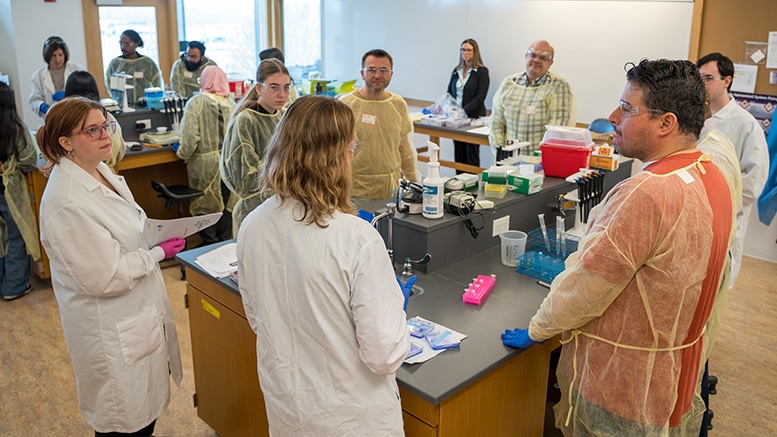
When Donna Barron applied to MentorLinks in 2023, she wanted help adding cell and gene therapy lessons to the biotechnology curriculum at Hudson Valley Community College (HVCC). The reason: Regeneron, one of the largest employers near Albany, New York, had a gene therapy product in clinical trials. Barron thought if HVCC students had those skills, it would position them for careers in this emerging field.
With the help of her MentorLinks mentor, Margaret Bryans, a biochemist with expertise in cell and gene therapy, Barron added cell and gene therapy modules to HVCC’s curriculum. Barron is a professor at HVCC and faculty coordinator of the biotechnology program. Bryans is a biotechnology professor and coordinator of the biotechnology program at Montgomery County Community College in Pennsylvania.
After the modules were in place, Bryans guided Barron and Julie Friot, an associate professor biology at HVCC, in the creation of introductory biotechnology and biomanufacturing courses aligned with industry skill standards.
“Through MentorLinks, we were able to get that into our program and show Regeneron that we were being proactive rather than reactive,” Barron said.
Like a great chemical combination, other positive outcomes have evolved since Barron was selected by the American Association of Community Colleges (AACC) to be a MentorLinks mentee from October 2023 to 2025.
AACC offers MentorLinks with support from the U.S. National Science Foundation’s (NSF) Advanced Technological Education (ATE) program to help community colleges revamp or start new science, technology, engineering or math (STEM) technician education programs. MentorLinks provides mentoring from a two-year college STEM expert, funding for faculty professional development, travel and technical resources for two years.
Multiple NSF grants
During Barron’s first year in MentorLinks, she wrote two successful NSF grant proposals.
In 2024, HVCC received a $499,157 grant from the Innovation in Two-Year College in STEM Education (ITYC) program to add mentored and course-based research experiences to the college’s natural and applied science degree programs. Now, all natural science majors at the college participate in at least one course-based research experience; students can also do mentored research at nearby universities.
Last fall, HVCC received a $468,000 ATE grant for the Raising Awareness and Creating Pathways to the Biotechnology Workforce project. Barron has used that grant to offer Biotech Connect sessions where adults are introduced to biotechnology concepts and learn skills that prepare them to take an exam for an entry-level industry credential. Other outreach initiatives to inform the community about biotechnology career opportunities include lunch-and-learn events with career advisors, camps for secondary school students and enrichment programs for families.
Building on a relationship
Last September, Regeneron leaders formalized the company’s partnership with HVCC with a $500,000 gift to HVCC’s foundation. The donation will help create the Regeneron Biomanufacturing Lab, construct the Applied Technology Education Center and expand STEM-based workforce initiatives.
Earlier in 2025, Regeneron initiated a co-op program with a request to Barron that she help Regeneron employees develop a program that places biotech and biology majors in paid summer internships and fall semester part-time jobs at the company.
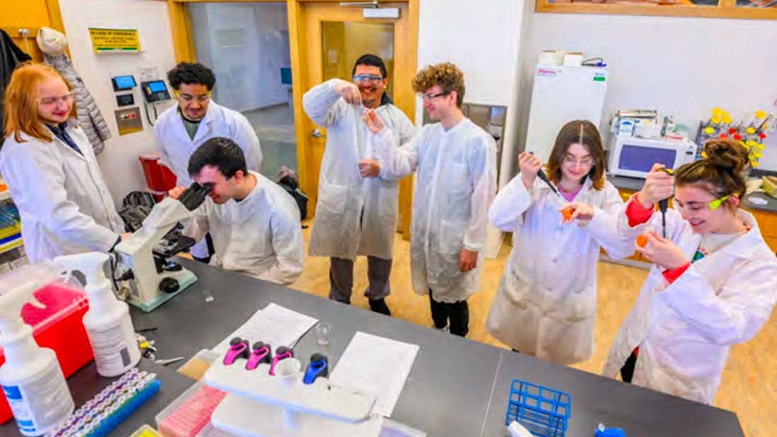
Three HVCC biotech students were in the first cohort. One is now working full-time at Regeneron, one has been offered a job after completing courses in the fall, and the third person is transferring to a university with plans to become a biotech researcher.
This summer’s cohort of seven co-op students includes five HVCC students, a student from SUNY Adirondack Community College, and a student from SUNY Schenectady County Community College. The expansion to two other State University of New York (SUNY) community colleges is the initial phase of a regional biomanufacturing consortium.
Alexander Steele, director of university relations at Regeneron, said the company is focused on two outcomes: building a reliable early‑career talent pipeline and expanding access to high‑quality, biotech careers in the Albany area.
“We want students to see that entry into biomanufacturing is achievable with an A.S. degree, while HVCC benefits from industry‑aligned programs that can support enrollment and student success,” he said.
He noted that Regeneron and HVCC have collaborated for more than a decade and that the formal partnership extends beyond the biotech program.
“HVCC’s proximity to our Industrial Operations and Product Supply (IOPS) campus and its strong technical programs make it a strategic early‑talent partner across biotech and related disciplines,” he said.
This year, Barron is using a portion of Regeneron’s gift to add a bioreactor and hire a lab technician to reconfigure the college’s lab to match industry lab operations and further enhance students’ understanding of good manufacturing practices.
“The Biotech Associate of Science stands out because Donna’s team aligns coursework with current, good-manufacturing-practice workflows, so graduates are prepared for roles like drug product manufacturing associate and can ramp up quickly,” Steele said.
Dmitry Zhmurkin, senior manager of university relations at Regeneron, said the company was pleased with the pilot in 2025, which lead it to expand the group to its second cohort of seven. The co-op program was designed so that HVCC students majoring in biotech could see first-hand how their education applies to an industry setting. Following year one at the college, the students spend the summer with Regeneron and participate in the same eight-to-10 weeks of manufacturing training that new full-time employees receive. They also can make connections to establish networks and learn about the company during their time.
“They then build on that experience as they continue to work part-time when they return to school for the fall. We designed the HVCC co‑op to mirror our real manufacturing onboarding so students graduate job‑ready,” Zhmurkin said.
Mentoring impact
Barron said she is grateful that Bryans suggested that she apply to MentorLinks in 2023. At that time, Bryans was informally mentoring Barron and other community college educators as part of her duties as principal investigator of the Northeast Biomanufacturing Center and Collaborative (NBC2). The center was funded from 2010 to 2022 with ATE grants to Montgomery County Community College. NBC2 also offered professional development workshops, which Barron and her colleagues attended.
“Maggie is by far the most influential person in our program. And her opening up the door to MentorLinks — being our mentor to that and showing us the world of ATE — has had profound effects that I think are going to have ripple effects in our ecosystem for years and years to come,” Barron said.
Barron explained that being selected for MentorLinks on the basis of AACC’s eight-page application gave her the confidence to write NSF grant proposals. The lessons she learned from Bryans as well as her recommended connections and resources have also helped with Barron’s proposal writing and project execution.
After their first MentorLinks meeting, Bryans and Barron attended the 2023 ATE Principal Investigators Conference. There, Bryans introduced Barron to other community college educators, who have since become ongoing sources of advice to her. Those people include the leaders of Mentor-Connect, who encouraged Barron to apply for their project’s leadership development and proposal-writing workshops. The combination of information she learned through MentorLinks and Mentor-Connect helped her devise the biotech outreach events and career pathways project proposal.
Steele also gave kudos to MentorLinks’s impact.
“Donna [Barron] has been instrumental in tailoring the biotech curriculum to incorporate the ever-changing landscape of our industry. The MentorLinks program, and the support from the NSF, will continue to enhance this effort and provide even more opportunities for prospective students,” Steele said.