A Michigan task force is recommending a major shift in how the state finances dual enrollment, urging lawmakers to create a dedicated reimbursement system that would remove much of the financial burden currently borne by local school districts and expand access to college courses for high school students.
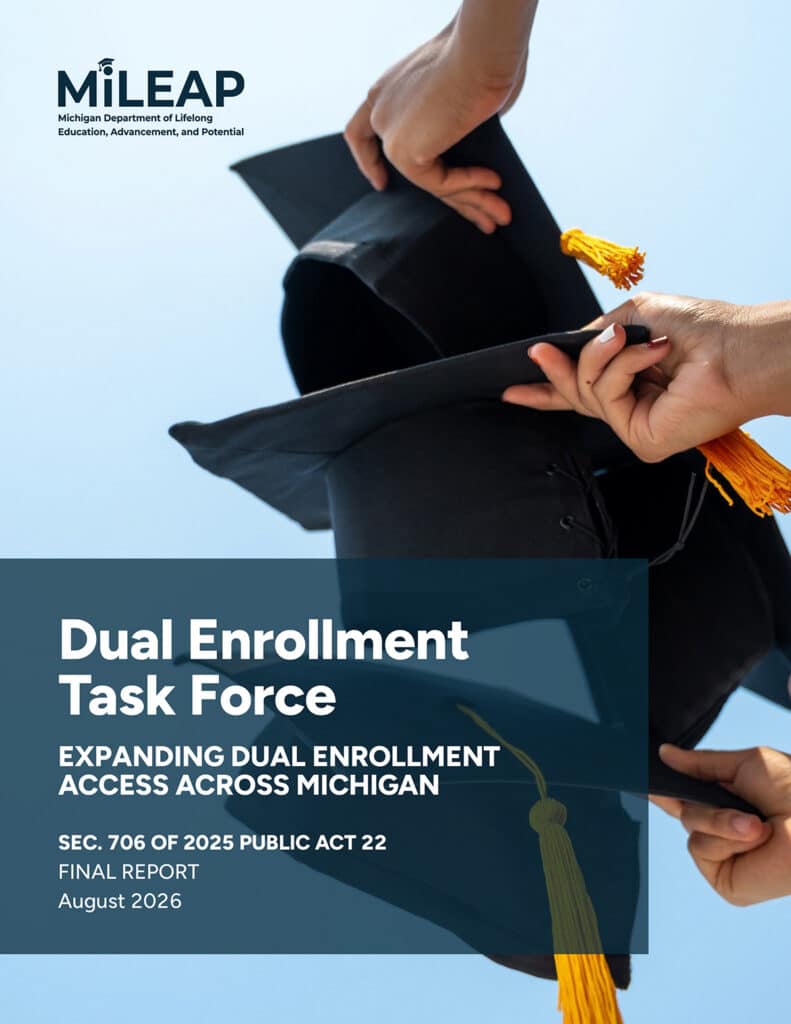
The recommendations are outlined in the final report of the Michigan Dual Enrollment Task Force, which was convened in 2025 to address barriers to participation and develop policies to better connect high school students with postsecondary education opportunities. The report argues that Michigan’s current funding structure has contributed to the state’s relatively low dual-enrollment participation rates.
Just 7% of Michigan public high school students participate in dual-enrollment programs, placing the state in the bottom tier nationally, according to the report released Tuesday by the Michigan Department of Lifelong Education, Advancement and Potential (MiLEAP). Dual-enrollment students account for only 15% of Michigan community college enrollment, compared with a national average of 21%. The report notes that neighboring states, including Ohio, Iowa and Indiana, report much higher levels of participation.
“We recognize that creating stronger connections between K-12 and higher education systems will require sustained leadership, collaborations and, in some cases, significant structural change,” MiLEAP Executive Director Beverly Walker-Griffea, a former president of Mott Community College (Michigan), wrote in the report’s opening. “Not every recommendation will be easy to implement, and progress may not happen all at once. But the difficulty of work cannot become a reason to delay it. The students who stand to benefit from these opportunities cannot afford for us to wait.”
At the center: reimbursement
The recommendations come as Michigan strengthens its support of dual enrollment, including a $40 million appropriation in the fiscal year 2027 state budget to reimburse eligible school districts for dual-enrollment costs. The task force said the state should establish a permanent line item in the budget for those costs. Under current law, districts must pay tuition expenses out of their per-pupil foundation allowance, forcing many districts to choose between supporting dual-enrollment opportunities and funding other educational priorities.
The task force said a state reimbursement model would provide districts with greater financial certainty and remove a key disincentive to expanding dual enrollment. The report recommends that annual appropriations be large enough to cover actual reimbursement requests and states that students should not lose access to dual-enrollment opportunities if state funding is exhausted.
The report also proposes creating a reimbursement program for eligible nonpublic school students through a dedicated General Fund appropriation. To provide fiscal predictability, lawmakers would establish annual funding levels and reimbursement caps.
In addition, the task force recommends creating a statewide payment infrastructure to administer reimbursements for both public and nonpublic school students.
To control costs, the group proposes reimbursement ceilings tied to community college tuition rates and the state’s foundation allowance. Community college courses generally would be reimbursed at the lesser of the applicable tuition rate or one-twelfth of the foundation allowance, while current reimbursement provisions for four-year institutions would remain in place.
Other student expenses
Beyond tuition, the task force recommends expanding reimbursable expenses to include costs that often prevent students from participating, such as transportation, parking, books, required course materials and campus access fees. If funding is insufficient, priority would be given to students from high-poverty school districts and those participating in rural and remote communities.
The report further recommends amending state law to prevent districts from requiring families to repay dual-enrollment costs when students fail or withdraw from a course.
Task force members said the recommendations are intended to support Michigan’s broader goal of increasing educational attainment. The report cites state data showing that 77.1% of dual-enrollment students enroll in postsecondary education within a year of graduating from high school, compared with 55.8% of students who did not participate in dual enrollment.
The recommendations now move to state policymakers, who will decide whether to pursue the legislative and budget changes needed to implement the proposed reforms.