America’s shipbuilding needs are growing faster than the skilled workforce required to fulfill them — and community colleges are rising to meet this challenge by scaling up short-term training programs in response to the demand.
Changing demographics, an aging fleet of commercial and military boats, and rising global competition are combining to create a perfect storm that threatens national security and commerce, experts say.
According to global research firm McKinsey & Company, the nation will need as many as 250,000 additional maritime employees in the next decade to replace retiring workers and fill vacancies in its shipbuilding workforce. More than a quarter of current U.S. maritime workers are age 55 or older.
At the same time, the U.S. Navy is looking to expand and modernize its fleet of surface ships and submarines in response to growing maritime competition, particularly from China. However, the existing shipbuilding industry has struggled to deliver vessels on schedule.
The Navy’s inflation-adjusted shipbuilding budget has nearly doubled since 2004, the U.S. Government Accountability Office reports. In 2023, private industry delivered seven battle-ready ships to the Navy, but the organization needs an average of 13 ships per year over the next 30 years to meet its optimal fleet-size goal.
The demand for shipbuilding workers isn’t limited to military vessels. The United States has lost considerable ground in commercial shipbuilding to international competitors such as China, South Korea and Japan.
In the 1970s, the U.S. produced about 5% of the world’s commercial ships. Today, less than 1% of new commercial ships are built in the U.S., the February 2026 White House America’s Maritime Action Plan reports. To reverse this trend, the federal government is increasing its investment in the shipbuilding industry.
This is where community colleges come in. With the help of federal funding, colleges from Maine to Alabama are scaling up short-term workforce training programs to meet the demand for shipbuilders and other maritime employees.
In Maine, the state’s community colleges have supported the shipbuilding industry with workforce training programs for decades — and a $5 million contribution from the U.S. Navy funded creation of the Maine Defense Industry Alliance in 2024 to help step up these efforts. The Maine Community College System (MCCS) is building the workforce pipeline for defense contractor Bath Iron Works (BIW) to construct and maintain DDG 51 Arleigh Buke-class destroyers for the Navy, among other vessels.
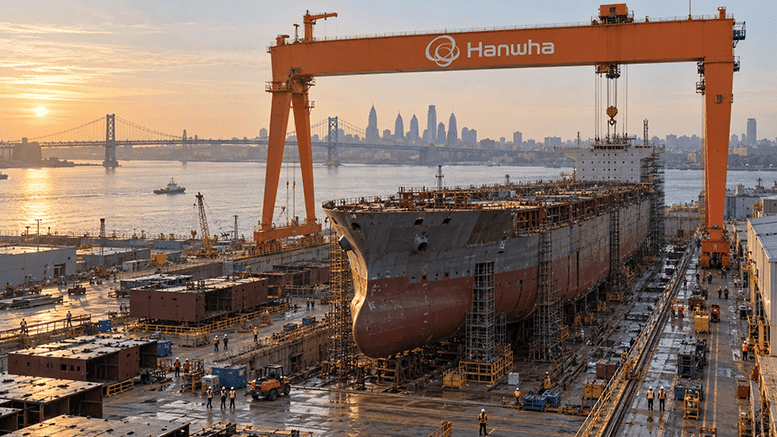
In Pennsylvania, Delaware County Community College (DCCC) signed a partnership agreement with South Korea-based Hanwha Ocean earlier this year. Through the agreement, DCCC will help train the employees needed for Hanwha Philly Shipyard Inc. (HPSI) — which operates out of the Philadelphia Naval Shipyard — to fulfill nearly $3 billion in U.S. government contracts to build ships and tracking vessels.
And in Alabama, the U.S. Navy announced in March that it would provide $30 million to the Alabama Community College System (ACCS) to modernize and expand maritime workforce training at four south Alabama community colleges, including Bishop State Community College in Mobile.
“We like to say we train giants to build giants,” said ACCS Regional Workforce Director Jennifer Hall.
Types of skills needed
To build and maintain commercial and military vessels, companies need employees with a broad array of skills.
“People assume shipbuilding is all about welding,” said DCCC President Marta Yera Cronin. Although welders make up a large percentage of the shipbuilding workforce, “it’s about much more than that.”
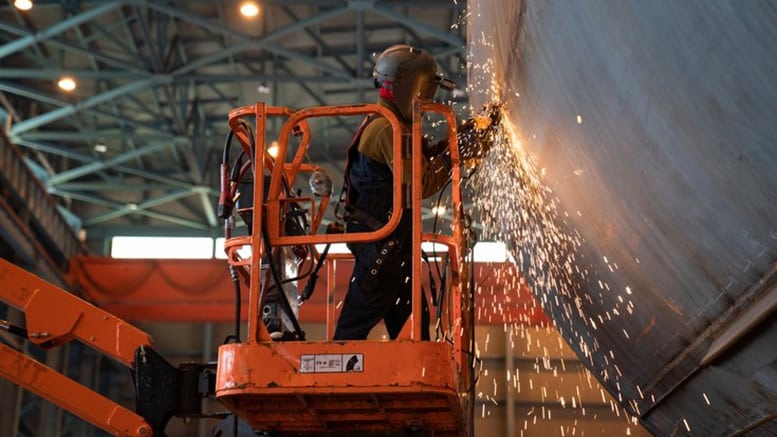
Machinists and fabricators are essential to the shipbuilding industry. They’re responsible for the precision fabrication, installation, maintenance and repair of a ship’s mechanical systems. While welders construct the hull and structural framework, machinists ensure that everything that moves, rotates or handles fluid operates with microscopic precision.
Structural fitters, or ship fitters, align and assemble the structural steel components that form a ship’s hull, decks and bulkheads. They must be skilled at reading blueprints; measuring and marking reference lines on steel plates and beams to show where cuts, bends and joins need to occur; using industrial tools like torches, plasma cutters and grinders to cut and shape steel parts to exact specifications; positioning massive sub-assemblies using cranes, jacks and wedges and making sure they align perfectly within tight tolerances; and applying temporary, small welds to hold these heavy steel structures in place before production welders finish the permanent seams.
According to McKinsey & Company, the U.S. shipbuilding industry needs as many as 20,000 welders, cutters and solders; 16,000 assemblers and fabricators; 7,000 machinists; 7,000 structural fitters; and 11,000 production supervisors by 2033.
Pipe fitters also are essential. These employees fabricate, install, test and maintain the complex networks of pipes and tubing that carry vital fluids, gases and power throughout ships and submarines.
But shipbuilding requires employees who are skilled at electrical work, insulation and other areas as well. As MCCS President David Daigler observed: “You’re building a high-tech city inside a steel hull. Imagine everything that goes with that.”
What’s more, the assembly and production processes for today’s ships require increasingly sophisticated electronics and technology.
“We’re not just trying to keep up with the demand for new vessels; we’re also modernizing the shipbuilding workforce,” Cronin said. This requires training workers with Industry 4.0 skills such as robotics and data analytics.
Short-term training programs in these areas can lead to high-paying jobs. A three-week Welding Academy training program that MCCS created in partnership with BIW leads to jobs with a starting salary of $31 an hour at the company, with opportunities for rapid advancement.
Cronin noted that the skills students are learning in these training programs apply within a variety of careers beyond shipbuilding.
The programs “open so many opportunities,” she said. “Students will have highly transferrable skills they can use in other industries.”
Keys to success
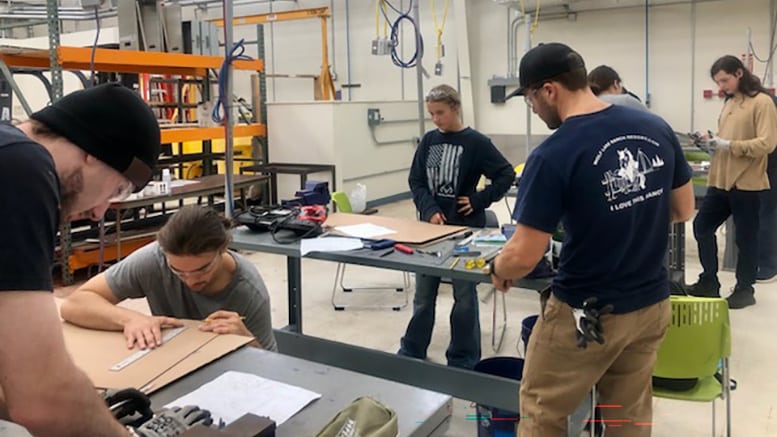
Creating training environments that mimic the conditions students will face on the job as closely as possible is one of the keys to training the future shipbuilding workforce successfully.
“Welding inside a steel tube is not for everyone,” Daigler pointed out. If workers are at all claustrophobic, they won’t last long in those positions. Replicating the actual workplace environment as closely as possible makes it less likely that students who go on to accept positions with employers will leave the job within a few months.
Bishop State Community College in Alabama currently has 160 welding booths to train structural welders on its campus. Thanks to a $3 million grant from the Navy, the college is building a new Gulf Coast Maritime Institute, a world-class training facility for learning how to build surface ships and submarines.
The curriculum will follow the Navy’s Maritime Industrial Base standards, and cutting-edge equipment in the new facility will include welding robots and 3D metal printers.
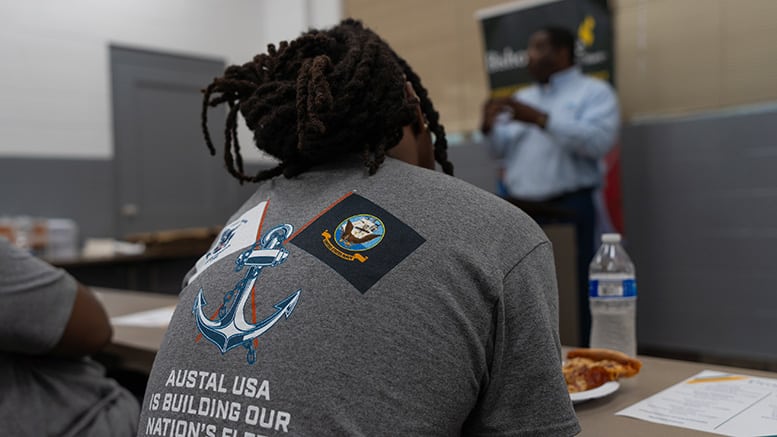
Bishop State has created 10-week Class B (entry-level) programs that train students in ship fitting, pipe fitting and marine electrical skills. Students who graduate from these programs and pass their Class B exam can work at Austal USA, a Mobile-based manufacturer of submarine modules for General Dynamics Electric Boat.
Participants in these short-term training programs are paid a daily stipend to attend, and this is another key to the programs’ effectiveness. MCCS has seen success with a similar approach, offering participants in its three-week Welding Academy program $500 per day, underwritten by BIW.
“Many of our students don’t have the income needed to support themselves during the training,” Daigler explained. “We’ve demonstrated to the Navy that the cost of training is actually lower when we provide a stipend, because attrition is lower.”
Maine has 12,000 students who graduate from high school every year, about 4,000 of whom don’t go on to college. That’s who MCCS is targeting with programs such as the Welding Academy and an eight-month program to become a marine designer.
These efforts are part of a broader initiative to transform the state’s workforce with help from the Harold Alfond Center for the Advancement of Maine’s Workforce, created with a $75 million gift from the Harold Alfond Foundation.
As with other workforce training programs, listening to industry partners and adapting to their needs is critical.
“We try to stay in lockstep with our industry partners,” said Akareem Spears, dean of workforce development at Bishop State. “We talk with Austal about their needs at least weekly. As new techniques in manufacturing emerge, such as digital twins and robotic welding, we want to make sure we have the right equipment that students will encounter in the workplace. We want to stay ahead of the game.”
Being highly flexible and adaptable to changing workforce needs has allowed ACCS to earn the trust of its shipbuilding partners like Austal, the Navy and the Coast Guard.
“Their needs shift quickly,” Hall said. “One thing we’ve heard consistently from our shipbuilding partners is that they like working with us because our answer is always yes. We lead with ‘yes,’ and then we figure out how to make it happen.”