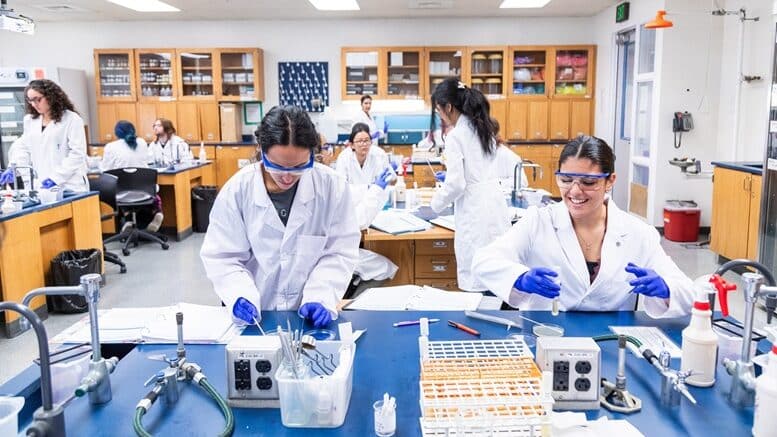
Seminole State College of Florida has received a $440,217 National Science Foundation (NSF) grant through the Improving Undergraduate STEM Education (IUSE) program. The goal of the grant is to build student and faculty capacity in data-driven undergraduate research while strengthening STEM workforce preparation.
“Conducting research turns a student’s curiosity into capability,” said Maya Byfield, professor of biological science and principal investigator on the grant. “This project is a dual effort, expanding research opportunities for students while empowering faculty to serve as mentors who challenge students to achieve more than they thought possible.”
The grant will establish a faculty community of practice focused on undergraduate research, mentoring, research skills and integration of research experiences into courses. Seminole State’s eLearning department and the Faculty Center for Teaching and Learning will help develop and support the community.
Colorado
A $1 million gift from the Schoen Foundation will create a permanent endowed scholarship for Front Range Community College (FRCC) students. The “Keep on Truckin’” Endowment for Social Sciences will fund nine scholarships each year for social science students.
The donation includes an additional $57,000 to support scholarships for the current academic year.
The gift was championed by Schoen Foundation board member Bill Schoen, who taught sociology at FRCC from 2010 to 2018. He chose FRCC because he has seen firsthand how community colleges change lives.
“I loved Front Range because our students got all the same material I was teaching in my intro classes at a four-year university,” he recalls. “But the classes were so much smaller, and my students had so much access to their professors.”
Illinois
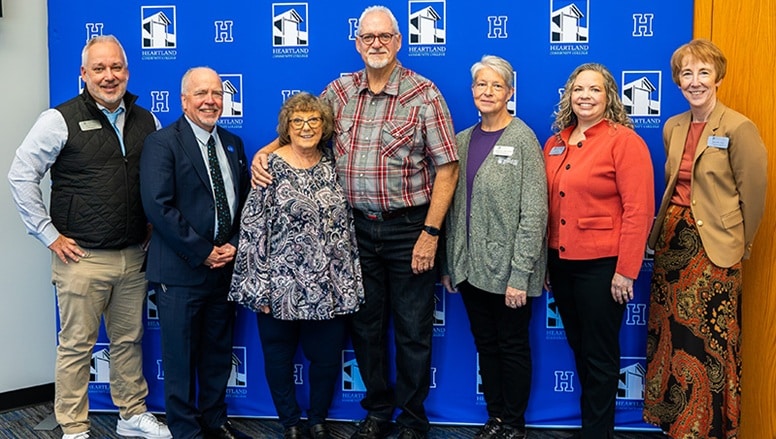
The Heartland Community College Foundation has received a $1.2 million planned gift from the estate of Bud and Fran Davis, one of the largest gifts from a single donor in the college’s history.
The gift will create the Bud & Fran Davis Nursing Scholarship and support health sciences resources at Heartland. The donation was inspired by the care the couple received from Heartland graduates. Heartland nurses and nursing assistants cared for Bud and Fran Davis, and their family chose to honor that care by investing in the students who will become the region’s next generation of caregivers.
“My parents, Bud and Fran, were highly impressed by a nurse working at their physician’s office, who was a Heartland nursing graduate. Later, during a hospital visit, they met a young woman who was working full-time in the hospital while raising two children and taking courses in the HCC nursing program,” said Jim Davis. “It touched their hearts to hear of the challenges she was facing to fulfill her responsibilities and complete her nursing training, so Bud and Fran amended their wills to include the HCC nursing program in their planned giving.”
Kentucky
Greater Clark Foundation (GCF) and Clark County Community Foundation (CCCF) have joined to commit $300,000 to Bluegrass Community and Technical College in support of its James A. and Martha R. Brown Regional Workforce Training Center.
GCF will provide $200,000 over two years with CCCF providing $100,000 over four years. A portion of the foundations’ commitments will be tied to matching support from business and industry partners.
The center is part of BCTC’s continued expansion in Winchester. It will feature new labs, classrooms and flexible learning spaces to support advanced manufacturing, industrial maintenance, skilled trades, nursing and healthcare training.
The foundations’ joint commitment builds on broader community investment already supporting the center. The Winchester and Clark County Industrial Development Authority contributed $200,000 during the project’s planning phase, and BCTC continues to develop public and private partnerships to advance the center.
Maryland
Montgomery College (MC) has received nearly $1.9 million to establish a Center of Excellence for Veteran Student Success, providing student veterans with a single point of contact for academic, financial, health and career support.
The three-year award from the U.S. Department of Labor builds on the college’s existing Combat2College program. The new center will coordinate veteran services across MC’s three campuses and the East County Education Center.
“Veterans bring a wealth of experience and skills to Montgomery College, and we want to make sure they have the support they need to reach their goals,” said Montgomery College President Jermaine F. Williams.
MC enrolled 495 student veterans during the 2024–2025 academic year. This project aims to increase that statistic by more than 10% and serve at least 545 student veterans annually. Objectives include strengthening veteran recruitment, developing a comprehensive support network and mentorship program, expanding career pathways and creating a sustainable model that continues beyond the grant period.
Massachusetts
Quinsigamond Community College (QCC) will use a $1.9 million federal Child Care Access Means Parents in School Program (CCAMPIS) grant to fund its Parent Success at QCC (PSQ) program, which will provide access to childcare for eligible students.
PSQ is a collaborative initiative that brings together many areas of QCC, such as Parenting Student Support Services, the Children’s School: Early Childhood Education Lab School and various other departments of the college. The program will also work with licensed childcare providers in the community to subsidize care for eligible students.
With the grant funding, the PSQ program will use a case management approach to connect students with community resources, build peer support networks and provide workshops covering topics, such as child development and time management.
According to Associate Director of Parenting Student Support Michelle Brennan, services will be integrated to benefit the entire family, supporting both parents and children to foster educational success and financial security.
“When we run a workshop on a topic such as financial literacy, children will have a parallel activity and then come back together for a family conversation on the topic. We’re helping them build the skills to plan for their families together,” Brennan said.
Oregon
The Oregon Higher Education Coordinating Commission (HECC) will use a $4.1 million federal Basic Needs for Postsecondary Students Program grant to expand the state’s capacity to address basic needs insecurity among community college students.
With participation from all 17 Oregon community colleges and leadership from HECC, the project will expand critical supports across Oregon’s urban, rural and frontier communities, ensuring that students receive timely, effective and connected services. The work will build on the state’s network of postsecondary and workforce programs that connect people with essential supports through benefit navigators, industry‑aligned credentials and meaningful career opportunities.
The grant supports a number of activities, including implementing a benefits screening tool at scale across Oregon public institutions, strengthening the system’s service infrastructure to best assess student need, connecting activities such as benefit navigators with education and workforce programs, and expanding referral pathways across the state. The grant project also will lead to strengthened pathways toward workforce‑relevant credentials and wll support artificial intelligence skills to prepare learners for high‑demand fields.
“Identifying a student’s needs is only the first step. We also need to make sure they can connect with resources that help them keep moving forward,” said Adam Mennig, Portland Community College’s (PCC) director of STEP and Pathways to Opportunity. “This partnership brings basic needs support and career pathways closer together, making those connections a more intentional part of the student experience.”
PCC is a key partner in the effort. The college will coordinate project activities among community colleges and statewide organizations.