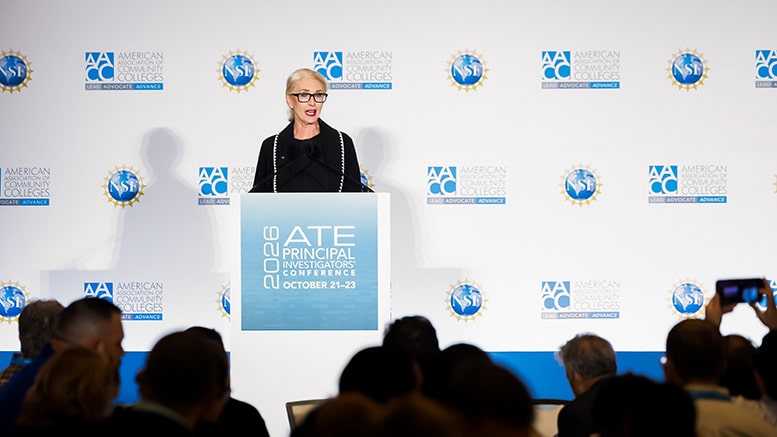
Representatives from five federal agencies presented information about funding opportunities for community colleges during the 2026 ATE Principal Investigators’ Conference.
“Each partner brings a distinct perspective along with the valuable resources, programs and opportunities that truly complement the important work already happening across the ATE community,” said Olga Pierrakos, lead program director of the Advanced Technological Education (ATE) program at the U.S. National Science Foundation (NSF), who invited the officials.
The annual conference is convened by the American Association of Community Colleges (AACC) with NSF support.
Holly Miller, federal liaison for NASA’s Office of STEM Engagement, said the federal space agency has strategically shifted to address shortfalls in the technical aerospace workforce by directing resources to community colleges and career and technical education programs. NASA recently awarded $10.5 million to seven institutions to create NASA State Hubs that will lead cross-sector initiatives. Miller encouraged community college educators to contact nearby hubs and explore collaboration opportunities.
“There are fantastic opportunities to solve the problem,” she said.
Related article: State Hubs: Opening doors for technical students
Brad R. Conrad, an education and workforce development manager at the National Institute of Standards and Technology (NIST) Office of Advanced Manufacturing, shared information about the training the agency offers to job seekers through its ACE and METAL programs. He urged community college educators who teach robotics to tap resources at RoboticsCareers.org that include articles, lists of training opportunities, jobs and internships.
Conrad also highlighted data on jobs expected to be available in the next five years across 18 technology areas, along with a competency framework that could inform curriculum development. He said he is available to confer with community college faculty and administrators and encouraged people to reach out to him through the agency’s website. He said his goal is “helping students see their future.”
Nebiat Solomon, a technical manager in the Office of Critical Minerals and Energy Innovation at the U.S. Department of Energy (DOE), directed attention to the career maps and workforce reports on the agency’s website. DOE resources for community college students include internships and information about registered apprenticeship programs. She encouraged faculty to join the network of DOE-funded Industrial Training and Assessment Centers (ITACs) and apply for targeted DOE funds through Partnership Intermediary Agreements and prizes.
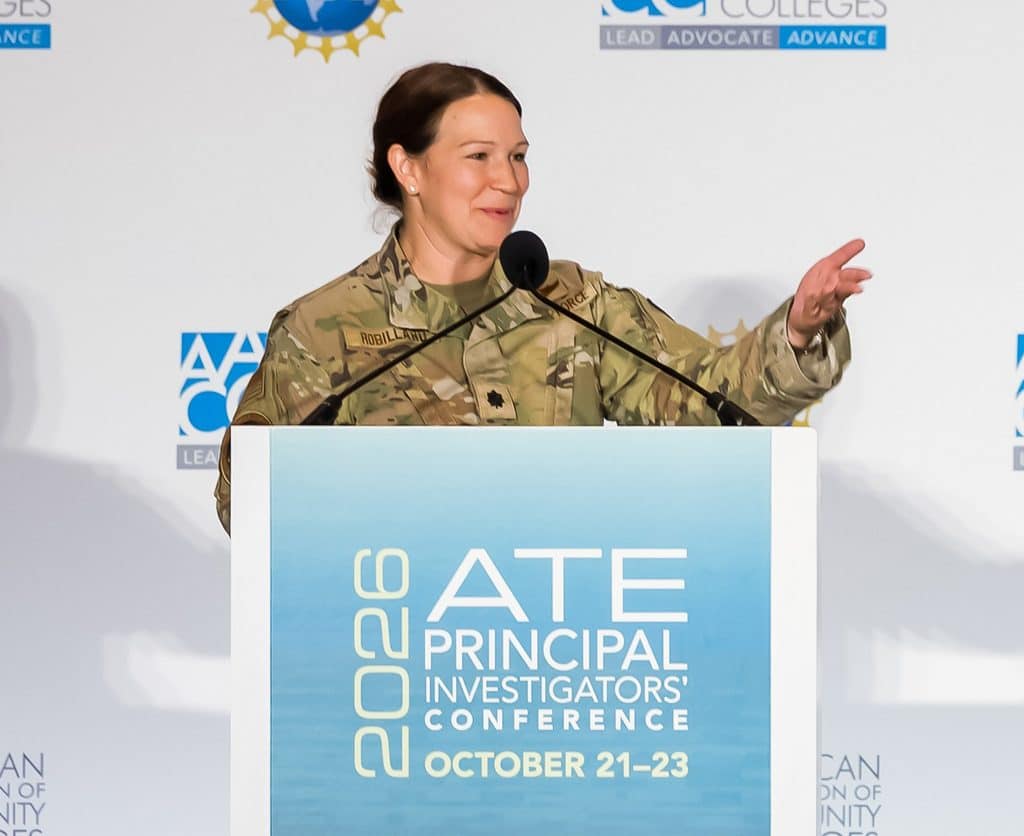
Lt. Col. Lauren Robillard, of the U.S. Department of the Air Force’s Office of the Chief Data and AI Officer, said the military’s focus is on recruiting, retaining and training individuals with skills in artificial intelligence. She said the goal is to “build graduates who can turn AI and data into decision advantage, readiness, resilience and operational speed.” She urged community college educators to review the Air Force’s AI Strategy and the Department of War’s AI Strategy for details on how the military uses AI to its strategic advantage.
Kimberly Vitelli, an administrator in the Office of Workforce Investment (OWI) within the Employment and Training Administration at the U.S. Department of Labor, explained that about $3 billion of the $4.9 billion OWI distributes annually goes to the states for use by their workforce development boards and job centers. DOL also provides about $1.4 billion annually in Perkins funds for career and technical education at secondary and postsecondary institutions.
Vitelli noted that DOL recently awarded $65 million in Strengthening Community College Training Grants to community college-led consortia in seven states to develop high-quality, short-term programs that qualify for Workforce Pell funding. She encouraged community college educators and students to use the following DOL online resources: My Next Move, Industry Sector Competency Models and Registered Apprenticeship Academy.
Related article: New SCCTG awards focus on Workforce Pell efforts