Knowledge and skills gained through hands-on learning and problem-solving are what four alumni of community college programs — that received grants from the National Science Foundation’s (NSF) Advanced Technological Education (ATE) program — say have served them especially well in their high-tech careers.
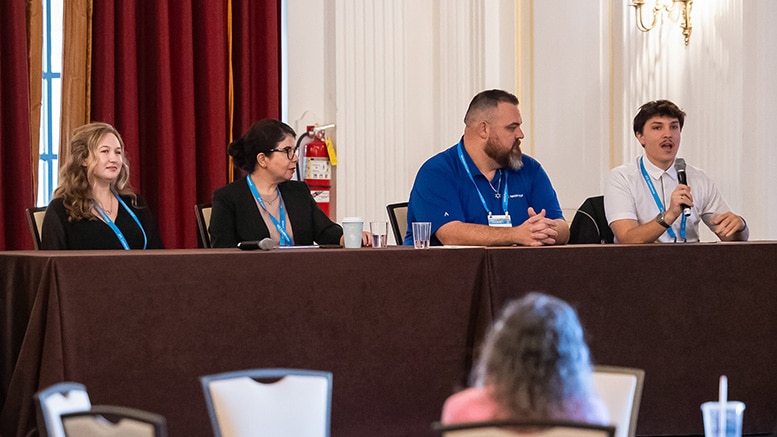
During a panel discussion at the 2026 ATE Principal Investigators’ Conference on Thursday in Washington, D.C., the alumni discussed their community college experiences, the advanced technologies they use on the job, entrepreneurial contributions they have made in their workplaces and recommendations for technical educators. The American Association of Community Colleges convenes the annual three-day ATE conference with NSF support.
Teaching the next generation
Paola Jaramillo Cienfuegos, associate professor at the U.S. Naval Academy in the Department of Weapons, Robotics and Control Engineering, earned her associate degree in engineering science from Norwalk Community College, a long-time partner institution of ATE-supported advanced manufacturing programs.
“The biggest contribution that the community college had in my life has been that problem-based learning that I have the opportunity now of imparting to my students. And doing that really impacts the way that you think in the sense that it’s not only logical, problem-solving oriented, but also it really allows you to become a lifelong learner,” Cienfuegos said.
She said the foundational science and math she learned helped her excel at the University of Hartford where she earned two bachelor’s degrees in biomedical engineering and mechanical engineering. She also earned a master’s degree in mechanical and aerospace engineering from Rutgers University.
Before and after enrolling at Rutgers, Cienfuegos returned to the Connecticut State College of Technology as an employee. She worked for Karen Wosczyna-Birch, executive director of the ATE National Center for Next Generation Manufacturing, who moderated the panel. Birch said that while Cienfuegos was staffing a conference booth for the center, a Virginia Tech faculty member encouraged her to continue her graduate studies there.
Cienfuegos earned her doctorate in mechanical engineering from Virginia Tech. Her focus on linear and adaptive controls in biological systems led the Naval Academy to invite her to interview for a faculty opening.
“I love the environment. I love making a difference and teaching the future naval officers,” said Cienfuegos, who along with personnel at the U.S. Coast Guard Academy has received a patent for a modular system to repair ships.
“In my current setting, where I am working on dynamic models for insulin and glucose regulation to develop this digital twin and physical AI (artificial intelligence), then I turn around in the classroom and I am working with a differentially driven vehicle, implementing the control system with the students, allowing them to discover, allowing them to fail, allowing them to pivot and change and consider what they are doing.
“That is something that I have seen as a faculty [member] for the past 11 years that changed when Covid happened. And I think that if there is something that everybody that is involved in education should focus on, it is that type of learning, on the ability for somebody to learn by themselves, to be able to dissect the problem and to be able to look at it and find those solutions.”
Incorporating a 3D idea
Sean Belleau is an alumnus of Gateway Community College in Connecticut who went on to earn a bachelor’s degree in engineering from the University of New Haven. He said the hands-on lessons of his associate degree program and the soft skills he gained through a grant-funded internship at the Connecticut State College of Technology sharpened his problem-solving skills and his ability to work with difficult people.
Now a strategic client executive with Trimech, Belleau said that what he learned about 3D printing from professor Flynn at Gateway has helped him with engineering sales to C-suite-level executives.
“So knowing how to understand who you are, how you act, what are your strengths, what are your weaknesses when it comes to your behavioral style, and also how to deal with difficult people … and just be out there, is very helpful,” Belleau said.
At his suggestion, the company created special packages that combine their 3D scanners and the training they offer with other vendors’ computers.
“We package everything together and we’re able to get that out there to our clients and kind of be that consultant, that trusted advisor to our clients for everything,” he said.
Bioreactors and technical sales
Natalie Trautt earned a bachelor’s degree in biomanufacturing from California’s MiraCosta College, which was a partner of Bio-Link and InnovATEBIO, the former and current national ATE biotechnology centers, respectively.
“I loved that it was more niche than just biology … before I graduated, I had two job offers, either to work in a lab doing specialized stem cell treatments for animals or work in technical sales and selling bioreactors. So I chose the sales because I wanted to travel and work in many different labs,” she said.
“In my bachelor’s degree, I got to work with bioreactors or fermenters and I thought, ‘Oh, well, I’m not creating the whole process. I’m just following the SOP [Standard Operating Procedure]. How much is this really going to help me in my career?’”
As a salesperson for Distek, Inc., she draws on those experiences daily and has earned three promotions since she completed her degree in spring 2025. She is now the company’s national account manager.
“What I was doing with the bioreactors was actually preparing me very, very well for my career. And now I go, and I talk to senior scientists that have been at huge top 10 biotech companies for their entire career, and I can have total conversations with them, and I can go toe-to-toe with them,” she said.
Trautt also works with colleges. Talking with one community college professor who was directed to create a biotech program despite having no bioreactor experience was a turning point for Trautt.
“That kind of spurred me to create an academic package that goes along with our controller and our vessel. So I created this package that has SOPs, batch records, assignments, presentations, some test questions and things. And because I had gone through a community college program, I knew what would actually be helpful for me to know and was able to kind of leave the things out that maybe didn’t need to be taught,” she said, adding the package of academic materials has received positive responses from numerous instructors.
Trautt’s mother, Tammy Trautt, was in the audience during the panel discussion and said she is proud of all that her daughter has accomplished before turning 25. She is the family’s first college graduate. Tammy Trautt noted that some of her friends’ children went far from home for college but had to return during Covid and were still paying tuition to attend school remotely. Several of those young people cannot find work in their degree fields and are underemployed.
Cutting-edge auto technology
Zane Kays earned an associate in applied sciences degree in automotive service management technology at Florida State College of Jacksonville (FSCJ); the college has received ATE grants in addition to the one that strengthened its automotive technology programs.
Kays is now a command center supervisor for Beep, Inc., an autonomous vehicle company. He finds it inspiring to work on the company’s free, public autonomous vehicle system in Jacksonville.
“It’s been such a great opportunity to be able to see this kind of technology being used firsthand. And I really appreciate FSCJ for teaching me a lot of the problem-solving skills that I actually learned. One of the things I really appreciate that I learned from there is the hands-on opportunities that we got to actually work with the vehicles, work in the shop.
“I mean, you have your desks right here and then right there to your left we have lifts, everything you would need to be a technician. So being able to just go from the classroom directly into the vehicles and get that hands-on experience has been amazing, and it’s really changed my future,” Kays said.
He describes his job as “very innovative” and intertwined with understanding that many people are not comfortable riding in autonomous vehicles or sharing the road with them.
“One of the ways we try to really help with that is we just really demonstrate the technology a lot with all these deployments … this technology evolves and it expands, you’re going to see a lot more. A lot of people don’t realize that even your newer, just the regular cars you drive, Camry or whatever, has levels of autonomy to it,” he said, adding that having an entrepreneurial mindset is an expectation at his workplace. He has helped develop a training program for one software program and improved a vehicle monitoring system.
“We’re always trying to find ways to improve the processes inside of our building. Anything we can do to try and make these deployments run smoother and smoother,” he said.