
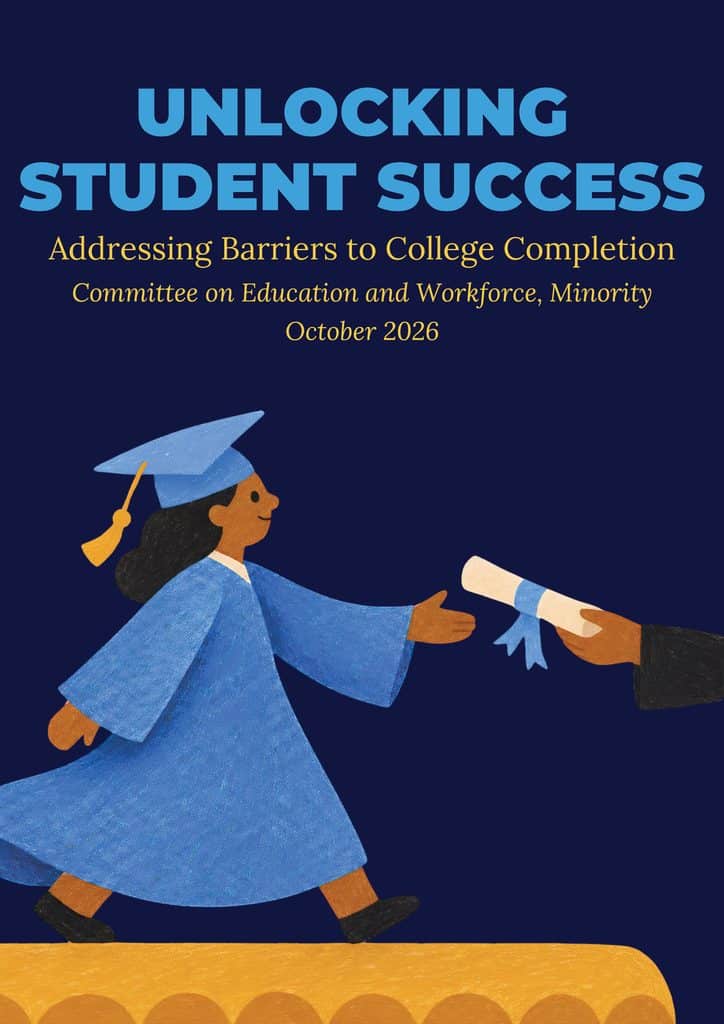
A new report from Democrats on the House Education and Workforce Committee focuses on academic, financial and personal barriers that prevent students from completing credentials, with many of the recommended strategies tying to community colleges.
The report examines challenges ranging from academic preparation and transfer obstacles, to housing insecurity, food insecurity, mental health concerns and childcare needs. It also highlights evidence-based practices that have helped students stay enrolled and graduate.
At the same time, the report criticizes actions by the Trump administration and congressional Republicans that it says have reduced federal support for higher education and student success initiatives. With mid-term elections around the corner, it provides insight into committee Democrats’ potential priorities and areas of interest if Democrats regain control of the House, particularly if they pursue a comprehensive reauthorization of the Higher Education Act.
A focus on transfer
Nationally, more than one-third of students who start college do not complete a credential within six years, according to the report. In addition, millions of adults have some college credit but no degree, presenting colleges with an opportunity to re-engage former students and help them finish their programs.
For community colleges, transfer remains a major challenge. Although most public two-year college students say they intend to transfer to a four-year institution, only a fraction ultimately earn a bachelor’s degree. Eighty percent of community college students plan to transfer to a four-year college, but less than one-third end up transferring within six years and only 13% ultimately receive a bachelor’s degree with in six years, according to research.
The report points to credit loss during transfer as a major hurdle and recommends stronger articulation agreements, transfer advising and reverse-transfer policies.
Community college students need tailored resources to prepare for the transfer process. Many community college students looking to transfer to a four-year college struggle with a variety of administrative and academic challenges in addition to credit transfer.
For example, students must understand new requirements, select the right courses and meet particular transfer deadlines.
Transfer applicants must also understand their new colleges’ credit and course requirements. Improving student guidance must involve providing thorough advising services that focus on navigating the transfer process. This could include creating comprehensive transfer guides, developing online transfer reference software, providing transfer counselors, and disseminating data to students regarding transfer requirements and opportunities.
Scaling up wraparound supports
The report also emphasizes the importance of wraparound student supports. It points to holistic advising models that address not only academic issues but also financial, personal and basic-needs challenges.
“Evidence-based practices that provide comprehensive academic, career, financial, and basic needs support services have been proven to address these barriers and improve college completion rates,” the report says. “Congress should provide resources to scale up these practices to support the modern student.”
Among the examples cited is the City University of New York’s Accelerated Study in Academic Programs (ASAP), which combines advising, career guidance, developmental education and financial supports. The report notes that participants have achieved significantly higher graduation rates than comparable students outside the program and that many continue on to bachelor’s degree programs, though it is an expensive approach.
Related article: Ohio ASAP shows success beyond completion
Increasing investments
The report also calls attention to the growing impact of non-academic barriers on student success. Housing costs, food insecurity, mental health challenges and limited access to childcare can all disrupt students’ educational progress, particularly among community college students balancing work and family responsibilities.
To address those challenges, the report calls on Congress to increase investments in programs such as TRIO, GEAR UP, Pell grants, childcare assistance and the Postsecondary Student Success Grant program. It also recommends greater federal support for minority-serving institutions and improvements to higher education data systems to better identify and address completion gaps.
“By developing a national student-level postsecondary data system, the federal government can better target resources towards effective practices that improve college completion and will have enhanced oversight of how federal student aid is used,” the report says.