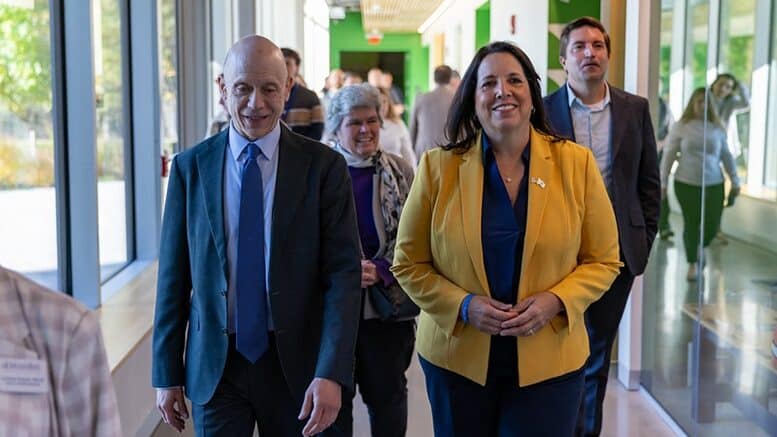
Massachusetts Gov. Maura Healey announced recently $1.5 million in workforce training grants to all 15 Massachusetts community colleges to help more than 500 unemployed and underemployed adults gain the skills they need to pursue good-paying jobs.
Lt. Gov. Kim Driscoll joined state, education and workforce leaders last week at MassBay Community College to announce the Training Resources and Internships Network (TRAIN) grants.
“Our community colleges are doing incredible work to connect people with opportunities and help local businesses find the workers they need,” Driscoll said. “Here at MassBay and at community colleges across Massachusetts, we’re helping adults build new skills, pursue rewarding careers and create better futures for themselves and their families.”
The TRAIN grant program supports community colleges in providing industry-specific workforce training and support services for adults entering or returning to the workforce.
As part of the statewide awards, MassBay will receive $131,250 to provide training to learners for careers as certified nursing assistants and behavioral health technicians, helping address critical workforce needs in the healthcare industry.
Arkansas
The University of Arkansas – Pulaski Technical College (UA-PTC) has received a nearly $3 million Strengthening Institutions Program (SIP) grant from the U.S. Education Department (ED) to expand regional healthcare training capacity, create simulation facilities and enhance student retention services.
The competitive federal grant supports higher education institutions in strengthening academic quality, institutional management and fiscal stability. With the funding, UA-PTC will develop and launch a new physical therapist assistant program, modernize facilities and equipment and implement targeted student supports. The college also aims to strengthen faculty capacity, align curriculum with employer needs and establish sustainable institutional structures beyond the grant cycle.
“By expanding our academic programs, modernizing learning environments, and providing wrap-around student support, we are preparing high-caliber healthcare professionals for high-demand careers,” said UA–PTC Chancellor Summer DeProw.
Maryland
A $2.38 million federal grant will help launch the Maryland Rural Pathways to Prosperity Network (MD Pathways). The Maryland Higher Education Commission has selected nine Maryland colleges and universities for the initiative. They include Allegany College of Maryland, Carroll Community College, the College of Southern Maryland, Cecil College, Harford College and Wor-Wic Community College.
MD Pathways will expand access to internships, apprenticeships and clear degree pathways for students to enter careers in healthcare, cybersecurity, aerospace, high-tech agriculture and education.
Institutions will work with regional employers to establish apprenticeships, internships and training programs for students to gain workforce experience and earn industry-recognized credentials. Participating colleges and universities also will create clear pathways connecting certification programs to associate and bachelor’s degree programs for students to seamlessly continue their education.
Statewide, the initiative aims to serve more than 1,000 rural students, partner with at least 50 regional businesses and launch 25 new workforce credential pathways over the next four years.
New York
The Manhattan Educational Opportunity Center (Manhattan EOC), hosted by the Borough of Manhattan Community College and funded by the State University of New York University Center for Academic and Workforce Development, announced the renewal of its federal TRIO Educational Opportunity Center (TRIO EOC) grant. The five-year award of nearly $1.3 million will support eligible adult residents of Manhattan and the Bronx as they pursue postsecondary education, workforce training and opportunities for career advancement.
Through the TRIO EOC project, College Connections, participants receive individualized support with college exploration, postsecondary applications, enrollment planning and financial aid applications.
The renewal of this funding enables the Manhattan EOC to expand access to postsecondary education for individuals who have traditionally been underrepresented in higher education.
* * *
Rockland Community College (RCC) has received $3 million through the federal Strengthening Institutions Program (SIP). The grant supports a five-year initiative to strengthen teaching and learning, workforce readiness and student success through artificial intelligence (AI).
The Artificial Intelligence for Momentum (AIM) initiative will strengthen AI literacy, professional development and instructional innovation, and will support the use of AI-enhanced technologies to support students’ academic progress, persistence and completion.
“Artificial intelligence is transforming how we learn and work, and our students must be prepared for this changing landscape,” said RCC President William P. Mullaney. “Through the AIM initiative, we are advancing innovation and preparing graduates with the skills to succeed in an increasingly technology-driven workforce.”
North Carolina
A $1,000 donation will provide scholarship assistance to law enforcement students at Brunswick Community College.
The donation came from Blue Knights – North Carolina XVII, a motorcycle club made up of active and retired law enforcement officers. A community scholarship will be created to support students enrolled in the college’s basic law enforcement training program.
* * *
Guilford Technical Community College (GTCC) will use a $3 million federal SIP grant to improve the student onboarding and advising processes for those seeking degrees in high-demand, high-skill career pathways through the college’s guided pathways programs.
“Our number one goal at GTCC is student success,” said GTCC President Anthony Clarke. “These funds will allow us to hone in on our Guided Entry Programs with a goal of improving processes and systems for advising, integrating career assessments into advising, and establishing an advising model based on best practices for student success and completion.”
GTCC’s Guided Entry Programs include several healthcare programs, including nursing, dental hygiene, radiography and emergency medical science. GTCC will implement early assessments to ensure that students interested in these programs have the aligned aptitudes and skills to succeed.
Ohio
Sinclair College has secured two grants totaling $10 million to expand college access and career readiness services.
As part of a $6.25 million grant, Sinclair will be the lead institution for the central-west Ohio region of a statewide Talent Search initiative administered through the Ohio Department of Higher Education. The funding will support services for 3,500 students.
Sinclair also has received renewed funding totaling $3.75 million for all three of its current federal TRIO Talent Search grants. The five-year awards will allow Sinclair to continue serving 1,500 students annually at Dayton Public Schools and Northridge Local Schools.
Across these grant efforts, Talent Search provides academic tutoring and advising, college and career planning, financial aid assistance, campus visits and connections to dual enrollment, workforce credentials and apprenticeship opportunities.
Texas
Amarillo College (AC) will be able to support more parenting students thanks to a $1.3 million federal Child Care Access Means Parents in School (CCAMPIS) grant.
The grant is expected to help at least 50 student parents during the four-year period. AC previously administered a CCAMPIS grant from 2020 to 2024 and will build on that experience through CampusRoots, which helps eligible student parents access childcare so they can persist and complete their education.
Specifically, CampusRoots will help student parents find available care through licensed childcare providers in the community. AC is also exploring partnerships with providers in Dumas and Hereford to extend assistance to student parents in those communities.