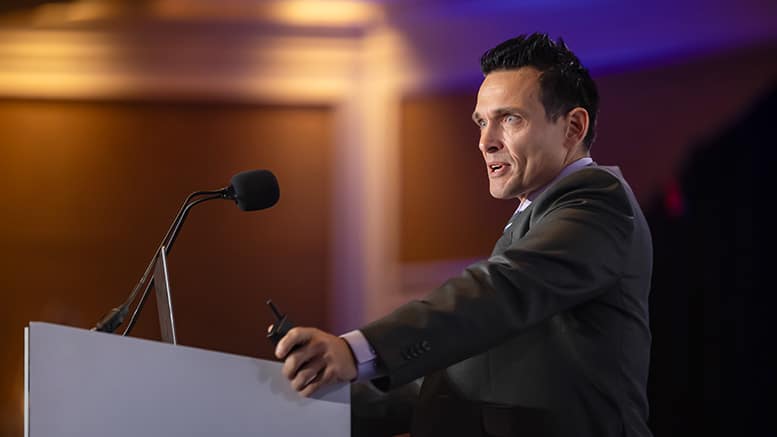
Jason Spyres, CEO of Training All People (TAP), stated plainly that he is not the “perfect messenger” for advocating that everyone deserves a second chance and that education should be accessible to all.
However, it is how he has dealt with cerebral palsy, his parents’ drug addictions, his bad decisions as a teenager and prison system obstacles that made his message of resilience through change compelling at the closing plenary of the 2026 Advanced Technological Education (ATE) Principal Investigators’ Conference.
Spyres’s determination to change himself, learn on his own and attain college credentials was critical to all that he has accomplished since being paroled in 2017.
The American Association of Community Colleges (AACC) convenes the conference annually for the ATE principal investigators and their teams with funding from the Advanced Technological Education program of the U.S. National Science Foundation (NSF).
In the personal stories Spyres shared Friday in Washington, D.C., there were two people — his father after attaining sobriety and a prison education administrator — who showed up consistently for him and provided essential support that helped Spyres become a productive adult.
A conviction to change
When he was 19, Spyres was sentenced to 30 years in an Illinois prison for non-violent, cannabis-related felonies. Being convicted of possessing more than 5,000 grams of cannabis, a drug that now can largely be bought at state-licensed dispensaries, led to a Class X prison designation that excluded him from the education programs available to many other felons.
Spyres sent letters to every Illinois state legislator and newspapers throughout the state about the unintended consequences of the Class X designation that became law during the war on drugs. The newspaper letters attracted attention, but he made no headway changing the state’s policies. His appeal to reduce his sentence also failed.
“I realized that this was still my life to live. The prison just got to pick my location,” he said, explaining he decided not to put additional limitations on himself and to behave in prison so he would be eligible for parole after serving 15 years.
“They never said I couldn’t walk into that prison library and read textbooks. Doing it that way might not be as easy as if I had a teacher to teach me, but doing it without a teacher was better than doing nothing at all. So, I picked up my library card, and I grasped my first weapon of power. I had a pencil, a Bible, a notebook, book of stamps and a library card. And I picked that card up in my hand and that became the thing that I held onto.”
His dad visited him every other weekend and, after Spyres was learning in earnest, his dad told him about a paralegal program he saw advertised on television. He offered to pay the fees for the correspondence courses. In addition to studying, Spyres had to find a proctor for four exams.
Max Greer, an education administrator at the prison, agreed to proctor the exams. But after the first exam, he was told by a prison official that he could not assist Spyres during the hours he was being paid by the state. So Greer proctored the last three exams in his office on Saturdays when he was not scheduled to work.
A college on the outside
After being released from prison, Spyres got a job in a pizza shop and enrolled at Illinois Central College. He earned a 4.0 GPA, applied to several large universities and was accepted to Stanford University.
Spyres said that as a Stanford student his life changed “instantly” and lawmakers who did respond to his letters advocating for prison reforms met with him in person. While saying he could not take credit for the prison reforms that happened, Spyres reported that in 2020 Illinois changed every problematic policy he had identified while incarcerated.
“Whether I did it or not, the argument got won. And two years later, they were able to show the recidivism rates had dropped. So, I think the world is a better place for it,” he said, noting there are still people serving long prison sentences for non-violent drug offenses who should not be forgotten.
After graduating from Stanford in 2021 with a degree in computer science, Spyres worked in New York City in a “big fancy tech job.” He left it to create Training All People, he said, because society “should not be prioritizing and not letting some people go to school. I believe all people can be trained to live the best lives available to them.”
His company’s clients include community colleges, nonprofits and industry.
Be like Max Greer
Spyres said he liked spending time with educators at the ATE conference because they see their jobs the way he sees his: “Our job is to take out the bottlenecks that stand between that person who wants to become a smarter person and make a bigger impact and get them to the life that we know that they can have.”
Spyres challenged educators to be like Max Greer, the prison educator who helped him.
“Whether you have the funding or not, you can still do something. Max Greer didn’t have a budget for me, but he had Saturday mornings with an office … Max Greer has no idea that I’m standing here today. He doesn’t know that the kid he proctored those exams for made it to Stanford. He doesn’t know that that kid built a company that’s trained thousands and thousands of people and knows for a fact 892 of them are making a higher living with a higher wage,” he said.
“Sometimes in life you don’t get to see your own ripples. You just have to be Max Greer and not know the outcome. And you don’t do it because you’re going to see the result. You do it because you’re the one who can … Go be somebody’s Max Greer. They will never forget it even if you never know it.”