
If you’ve experienced a workplace printer malfunction or become a little too irritated when a coworker didn’t return a stapler, scenes from the 1999 movie “Office Space” likely flashed through your mind.
The snarky classic, shot in Austin, Texas, by writer and director Mike Judge left an indelible mark on pop culture. Its main character, Peter Gibbons (Ron Livingston), is unhappy with his corporate conformity at the Initech Company and seeks authentic, meaningful work outside his fluorescent-lit cubicle. Despite staying in the cultural conversation for over 25 years, the film was not a box office success, perhaps because, at the time, it was a little weird.

Also in 1999, the Instructional Technology Council (the American Association of Community Colleges’ only council commissioned with the professional development and subject-matter expertise in distance ed) held a conference at Austin Community College (ACC) entitled “Telelearning ’99 Education in Transition.” The theme was on point.
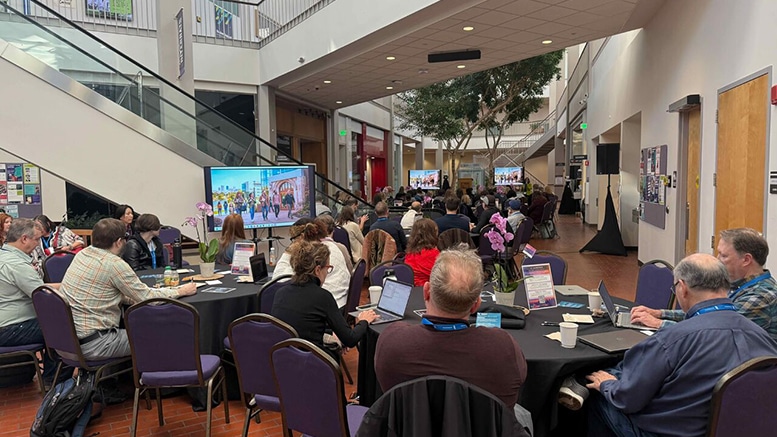
Fast-forward to March 2026, the Instructional Technology Council (ITC) returned to ACC’s Highland Campus for its annual eLearning Conference themed “Keep eLearning Weird.”
By “weird,” we mean beautifully, stubbornly unconventional. Design for eLearning means architecting spaces both invisible and visible where learning happens without the usual signals for time, place or presence, but with tremendous need for all three. We design and study learning experiences that are simultaneously real and intangible. And that’s pretty weird.
This article is part of a monthly column provided by the Instructional Technology Council, an affiliated council of the American Association of Community Colleges.
Not your typical conference
If Peter Gibbons were real, I wonder what he would have thought of ITC’s 2026 eLearning Conference. There were no hotel ballrooms and no convention centers. Instead, our attendees found themselves inside a former shopping mall that ACC had transformed into a thriving campus with former retail storefronts reimagined as tutoring centers, student clubs and collaborative learning spaces.
ITC’s board of directors made a deliberate choice several years ago to host our conferences directly at community colleges, moving away from traditional corporate venue contracts. It means our attendees talk about eLearning innovation as they walk through it. We have infused details of authenticity throughout the conference. Our National Excellence in eLearning Awards are beautiful and 3D-printed by students at Rowan College of South Jersey’s Innovation Studio. Students at Pikes Peak State College‘s Innovation Lab custom-designed 3D-printed items for our centerpiece decorations to match our conference theme for the past two years.
We still have breakouts and keynotes, but some of our quirks are worth sharing. We host a lively afternoon Team Trivia and a session called the “Grand Debate,” which pits two opponents against each other on a provocative question about educational technology.
This year’s edition may have been our weirdest yet. It featured Reed Dickson of Pima Community College debating an AI video avatar, created with the help of HeyGen, on the question, “AI: Savior or Overlord?” Reed argued for “savior,” while the avatar argued for “overlord.” The audience served as judge and jury and found it to be “helpfully disorienting!”
If you’re wondering who won, so are we. The image of a room full of eLearning professionals watching a human make the case for artificial intelligence while the AI warned them against itself, that’s the kind of moment you won’t find at a mega-conference. In fact, it is the first time it has been done — anywhere.
‘It’s the people’
Each year, we honor an Outstanding eLearning Student who doesn’t just receive a plaque from afar. They sit with us, eat with us and talk with us about their experiences. This year, Natan Kassahun from Northern Virginia Community College was honored for his service in student government and achievement in asynchronous online courses. His enthusiasm for quality online learning was contagious. He said, “I had no idea there were this many of you training and learning to teach online. That’s so cool.”
David Greene, a partner engagement manager for Harmonize and an ITC conference attendee, reflected on our conference culture last week. He found himself at a table with a professor, director of online learning, instructional designer, dean and this year’s Student of the Year.
“There was no agenda. No slides,” Greene observed.
The conversation ranged from teaching and assessment to technology and the changing expectations of students.
“Sometimes the most important session at a conference isn’t on the program,” Greene said.
Keeping it weird
In the early 2000s, Austin earned its famous “Keep Austin Weird” slogan because the local community rallied to save independent bookstores and small businesses from large chains. They wanted to preserve the artists, the human feel, the soul of their neighborhoods.
Today, eLearning faces pressures not all that different. While demand for quality eLearning is on the rise, we still worry about job loss to AI, talent loss and turnover and loss of academic freedom to innovate. We are fighting loss, fear and anxiety just like our students.
In “Office Space,” the turning point comes when Peter stops pretending. He stops performing enthusiasm he doesn’t feel, stops following procedures he doesn’t believe in and focuses on work that matters. Everyone around him starts responding to the authenticity and becomes more willing to open up to each other.
If you work in eLearning or distance education, we hope you’ll consider joining us. We’ve pressed forward in eLearning for almost 50 years not by playing it safe but by playing it weird and playing it weird together. Peter Gibbons eventually found his better way. It just required ditching the TPS reports and trusting the people around him. ITC has decided not to trust big budgets, corporate venues or enormous organizations to build meaning.
We need our people, a willingness to be unconventional and maybe a few 3D-printed centerpieces.