
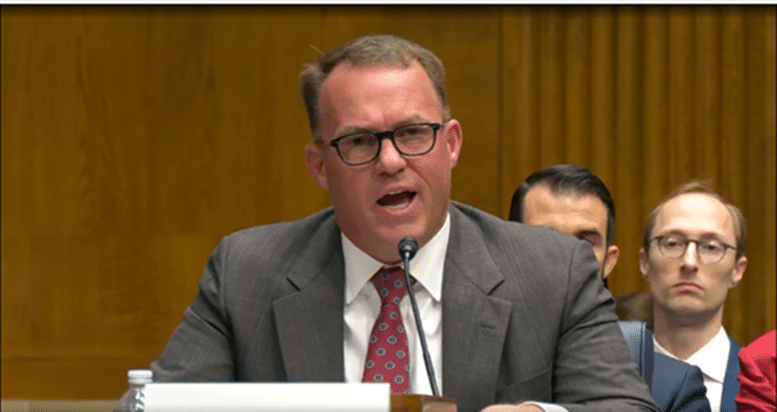
The Senate Subcommittee on Education and the American Family held a hearing Tuesday on advancing workforce development that featured work being done to close skills gaps and get people into living-wage jobs.
But there also was talk about the need for more investments in career and technical education (CTE), and concern was voiced about the Trump administration’s recent transfer of oversight of CTE programs from the U.S. Education Department (ED) to the Department of Labor (DOL).
Agility in Alabama
Chris Cox, deputy chancellor for instruction, research and development at the Alabama Community College System (ACCS), plugged workforce development efforts happening in his state. He said ACCS gets the word to everyone in the state that they’re “college material,” whether that means completing a two-week training course or completing a two-year degree program.
Dual enrollment also is growing in the state, particularly in rural areas, where over half of high school students are graduating with an associate degree.
ACCS is reaching into rural areas in other ways, too. For example, new nursing training programs at rural hospital sites effectively are “taking the training to the people of Alabama,” Cox said.
ACCS is also helping small businesses grow their workforce through the Skills for Success program and providing specialized training for industry through the Alabama Technology Network. And apprenticeships are helping to close workforce gaps, too. Each of ACCS’s 24 colleges is a registered apprenticeship sponsor.
Another witness from Alabama – Joel Stadtlander, director of human resources for steel processor ArcelorMittal Calvert – noted that his company works with Coastal Alabama and Bishop State community colleges on apprenticeships that graduate ready-to-work technicians.
Cox also noted the importance of investing in instructors, whose pay is behind what they could earn in the workforce.
“We got to have the instructor so we can give the folks all over Alabama the access they need” to education, he said.
Investing in workforce development
Chelle Travis, executive director of SkillsUSA, similarly called for a strengthening in the pipeline of skilled CTE instructors “because without our CTE instructors, there is no skilled workforce.”
Travis also observed the need for more federal investment in CTE programs, particularly Perkins V grant funding.
Her other recommendations included expanding infrastructure for youth work-based learning and reauthorizing the National Apprenticeship Act.
Workforce Pell also was mentioned during the hearing. Cox noted that community colleges are the best place for Workforce Pell to start as they are “agile” and already preparing students for work.
Sen. Jon Husted (R-Ohio) said he was glad funding was put toward Workforce Pell in the recent budget reconciliation. It makes sense, he said, to put Pell grants toward short-term credentials because “employers are hiring skills, not degrees.”
Sen. Tim Kaine (D-Virginia), a proponent of Workforce Pell, said he was concerned about how ED, with its reduced staffing, can effectively implement the new program, which is slated to begin July 1.
Witness Luke Rhine, vice president of the Rodel Foundation in Delaware, echoed those concerns, noting that “clear guardrails, expectations and accountability” will be necessary for successful implementation at the state level, which may be difficult with the changes at ED.
Concerns for CTE
Several senators expressed concern about the move of CTE oversight and Perkins funding from ED to DOL. Sen. Lisa Blunt Rochester (D-Delaware) said that she was “disappointed” with the move and concerned how it is creating inefficiencies at the state level.
Kaine added that he doesn’t mind reform, but “if you’re going to do reform, do it carefully and thoughtfully, not chaotically.” He contended that the transfer of CTE oversight to DOL “was made unilaterally and in secret,” creating chaos.
Rhine said the decision has led to delays in Perkins grant funding and uncertainty about data collection of CTE and Perkins information. This makes it harder for states to plan and inserts “layers of bureaucracy” that can add administrative costs.
“CTE is fundamentally an education program,” Rhine said, recommending that Congress should keep CTE and Perkins oversight with ED to ensure CTE “continues to deliver opportunity for students” and a competitive workforce for the nation.