Brandon Dyer owes his career in higher education to the federal TRIO program, which is designed to help low-income students, first-generation college students and individuals with disabilities progress through the academic pipeline from middle school through college.
In 2010, Dyer was hired to counsel students from disadvantaged backgrounds at a North Carolina community college, with the help of a TRIO grant.
“Working in a TRIO-funded program, I’ve witnessed the impact these grants have on students who are first-generation college students or who have barriers that other students might not have,” he said. “It brings about opportunities for success.”
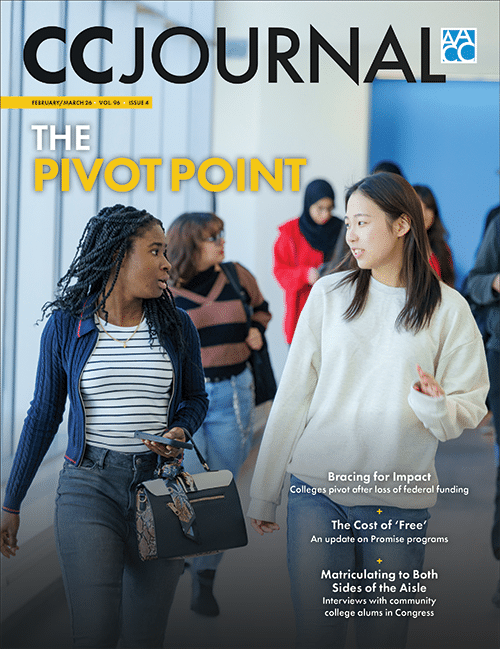
This excerpt comes from an article in the current issue of the Community College Journal, the flagship publication of the American Association of Community Colleges since 1930.
Fifteen years later, Dyer serves as vice president for strategic enrollment and student success at Everett Community College (EvCC) in Washington. This past summer, EvCC learned that its TRIO Classic funding would not be renewed, depriving the college of $1.3 million over the next five years to increase retention and graduation rates for vulnerable student populations.
“The notification we got said the program no longer aligned with the [U.S. Education Department’s] priorities,” Dyer said.
EvCC isn’t alone. Community colleges nationwide have been told by the U.S. Education Department (ED) that grant funding they’ve relied on for years was suddenly discontinued.
In some cases, the grants aren’t being renewed. In others, funding is being cut off mid-program cycle. The common thread is that the initiatives serve low-income and minority students in particular — the very students that make up a large percentage of community college enrollment.
The abrupt loss of millions of dollars in federal funding is forcing campus leaders to pivot rapidly. Community colleges are scrambling to ensure their most at-risk students don’t lose valuable services proven to boost completion rates, such as campus-based childcare, advising and academic support.
‘A vital part of our mission’
TRIO is among the key programs that federal officials have targeted for removal. The program has been around since the 1960s, originally supporting college access for underrepresented students through three programs: Upward Bound, Talent Search and Student Support Services. Today, there are eight TRIO programs serving nearly 900,000 students nationwide, funded at about $1.2 billion annually.
EvCC’s TRIO funding provided personalized academic planning, advising and targeted tutoring services for 140 students each year, as well as educational events and cultural experiences to broaden their horizons.
The Everett Community College Foundation has agreed to step in and cover the costs of ensuring that the current cohort of TRIO students continue to receive personalized advising and tutoring, Dyer said — but no new students will be accepted into the program moving forward.
EvCC also will continue to receive $1.3 million in federal TRIO STEM funding targeted toward students in science, technology, engineering and math-related disciplines in particular over the next five years, and its Upward Bound funding also remains intact — for now.
Montgomery County Community College (MCCC) in Pennsylvania wasn’t as lucky. MCCC had a TRIO Upward Bound program from 2007 until May 2025, when federal officials told the college they were stopping its funding in the middle of a five-year cycle. The decision cost the college about $650,000 in lost resources through the 2026-27 school year.
“There was no prior indication that the grant would be cancelled or that it was being reviewed,” said Mike Bettinger, director of government and external relations. “Consequently, the college was shocked at the abruptness of the cancellation and immediately began to discuss efforts to mitigate the impact to our students.”
During the program’s 18-year history at MCCC, Upward Bound supported nearly 300 first-generation, low-income students from the Norristown and Pottstown high schools in grades nine through 11. The program helped students develop the skills, study habits, discipline and attitude necessary to be successful in high school and college. It included a summer program and enrichment opportunities.
“This work was a vital part of our mission to expand access to all students and support student success,” said Rosann Bar, MCCC’s dean of academic innovation.
By creatively shuffling resources and relying on community partners, the college was able to offer the current cohort of Upward Bound students a one-week summer program from July 21-25, giving them the opportunity to visit and explore its campuses and experience cultural events. It also provided financial support for any students who wanted to take a dual enrollment course over the summer.
MCCC filed a Request for Reconsideration with ED on June 26, explaining why it disagreed with the cancellation. Campus leaders also recruited their U.S. senators and representatives to advocate on MCCC’s behalf.
“To our understanding,” Bettinger said, “none of their offices have received a response” from ED officials.
Tough to backfill
TRIO isn’t the only grant program in ED officials’ sights. Bunker Hill Community College (BHCC) lost nearly $260,000 in federal grants for colleges that serve large populations of Hispanic, Asian American and Native American or Pacific Islander students.
Trump administration officials believe these programs are unfair because they’re intended to help certain ethnic groups in particular, said President Pam Eddinger. But in reality, the five-year grants enable colleges to meet the needs of students who have historically been underrepresented — and the activities they support benefit the entire community.
“These are institution-strengthening and capacity-building grants,” Eddinger said. “The programs we’ve built with this funding don’t just serve Hispanic students and other minority populations.”
For instance, BHCC has used the funding it received as a Hispanic-Serving Institution to create guided pathways that help students navigate their college experience more easily. The college has organized its certificate and degree programs into six “meta-majors” that simplify students’ educational journey, allowing them to choose from among broad areas of interest such as arts and communications, STEM, social sciences, healthcare, business and hospitality, or safety, law and public service and then find their specific pathway within these clusters.
“That transformation we made was for everyone at the college,” Eddinger observed. “It touches all students equally.”
Similarly, the college used the first federal grant it received as an Asian American and Native American Pacific Islander-Serving Institution to align its English as a second language and developmental English courses, helping students acquire the language fluency they’ll need for college success. This change benefits the 70% of BHCC students who need language support, whether they’re Asian, Native American or Pacific Islanders or not.
Nationally, community colleges receive about half of all minority-serving grants that ED issues.
“We’re usually the least-funded institutions, and our students don’t have the social or political clout to attract more money,” Eddinger said. She argued that there aren’t many alternative sources that community colleges can use to make up for the lost funding, noting: “There’s not enough money in our state coffers to backfill what we’re losing.”
The grants that BHCC has lost also fund personalized advising, tutoring and other case management services.
“I need actual bodies,” Eddinger said. “We’re trying to preserve as many positions as we can, because we feel it’s not right to mess with our employees’ lives. Layoffs affect staff morale, culture and institutional history as well as programming.”
Eddinger thinks the college might be able to maintain these staff positions in the short term, but “not for five years.” She added: “I don’t have a long-term solution. If I told you I did, I’d be lying.”