

I grew up not knowing what Juneteenth was.
That’s not something I say with shame. It’s something I say with honesty.

It wasn’t until I became president and CEO of Phi Theta Kappa and moved to Jackson, Mississippi, a place deeply connected to the Civil Rights Movement, that I began to understand what Juneteenth represents. Not simply the end of slavery, but the reality that freedom delayed is freedom diminished. The news of emancipation took more than two years to reach enslaved people in Galveston, Texas. That history reminds us that progress does not always arrive equally or at the same pace for everyone.
That lesson still resonates today.
I’m a math person at heart. I look for patterns. It’s how I make sense of the world. Every year, I have the privilege of meeting thousands of students through Phi Theta Kappa. I attend induction ceremonies, conventions, leadership events and graduations. I hear students’ stories. I celebrate their achievements. And over time, I have noticed a pattern that continues to concern me.
I do not see enough Black women earning STEM degrees.
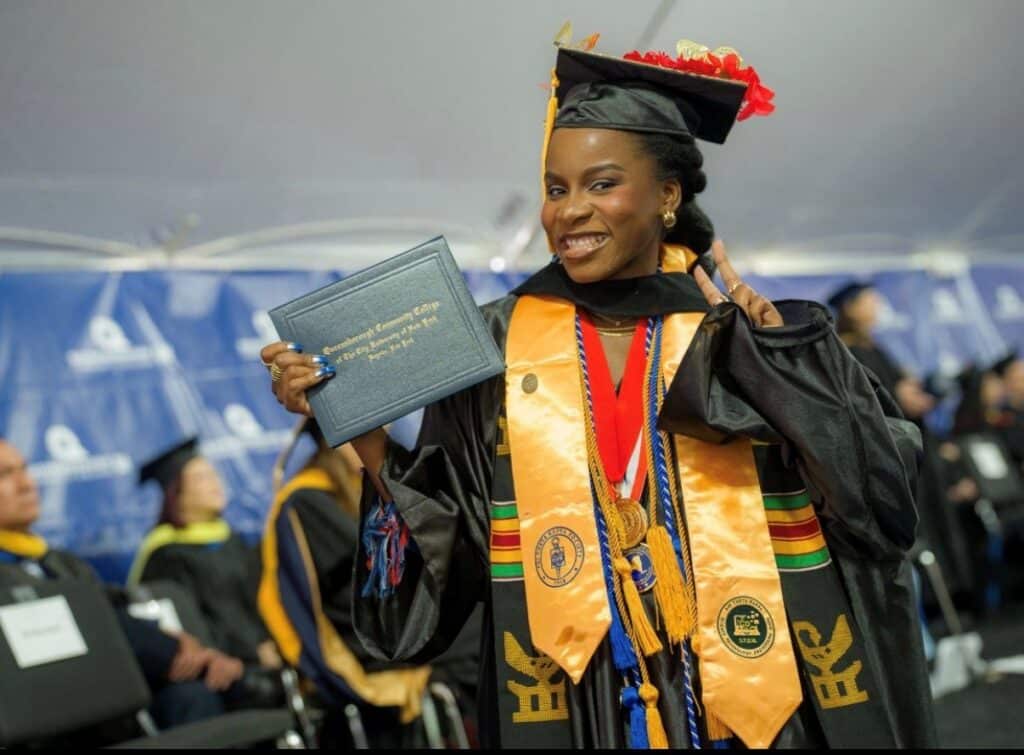
When I look at this photo of Kehinde Adekunle, a graduate of Queensborough Community College (New York), holding her diploma, her face lit with pride and accomplishment, I see much more than a graduation picture. I see excellence. I notice the honors cords and medallions. I see that she is a Coca-Cola Scholar and a member of the All-New York Academic Team. I notice the PTK STEM stole draped across her shoulders, signifying her achievement in one of the most challenging academic pathways available. I also notice the Pan-African stole celebrating her heritage. In a single image, her accomplishments and her identity are both honored.
That photograph fills me with pride, but it also reminds me how uncommon this scene still feels.
What struck me even more was the conversation that followed. When I reached out to ask permission to use her photo, Kehinde shared that she is passionate about creating and supporting opportunities that empower Black women in STEM fields. Here was a student celebrating her own success, yet thinking about how to help others achieve theirs. As someone who spends my life working with student leaders, I wasn’t surprised. But I was inspired. Her graduation photo inspired this article. Her vision for what comes next reminded me why we still have work to do.
The data confirm what many of us have observed. Black students continue to experience lower college completion rates than many of their peers. In STEM fields, Black women remain significantly underrepresented despite their talent, determination and academic achievement.
But I don’t need a data table to notice it.
I see it when I meet our highest-achieving students. I see it among scholarship recipients, academic team members and student leaders. Even among students who have already demonstrated exceptional talent and resilience, there are simply not enough Black women pursuing STEM degrees.
And that matters.
STEM careers open doors to innovation, economic mobility and leadership opportunities. When talented students do not see themselves reflected in those spaces, we all lose potential that could strengthen our communities, industries and future.
Juneteenth is a celebration of freedom. But freedom alone is not enough. Opportunity matters. Access matters. Belonging matters. Students are more likely to persist when they can see a future for themselves and when they know they belong in the rooms they aspire to enter.
My students have taught me that.
They have also taught me that awareness must lead to action. If we want to see more Black women thriving in STEM, we must ask hard questions. Are we identifying talent early enough? Are we creating pathways that encourage persistence? Are students finding mentors who help them navigate challenges and envision possibilities?
We know many of the answers. Mentorship matters. Representation matters. Supportive learning communities matter. Recognition matters. Organizations like Phi Theta Kappa can play an important role by helping students see that their hard work is recognized, their achievements are valued and their future is worth investing in.
This Juneteenth, I celebrate students like Kehinde Adekunle. I celebrate the barriers they overcome, the opportunities they create for themselves and the doors they hold open for others.
The goal is not simply to admire exceptional students when they reach the finish line. The goal is to make sure many more students have the opportunity to begin the journey, persist through the challenges and earn the degrees they dream of earning.
When I see too few Black women earning STEM degrees, I know we have work to do. But when I meet students like Kehinde, I am reminded that change is possible and that the future is already taking shape.
Perhaps that is one of the lessons of Juneteenth. Progress may not always arrive as quickly as it should, but it does arrive because people keep pushing it forward.
And students like Kehinde are doing exactly that.
About Phi Theta Kappa
Phi Theta Kappa (PTK) is the first honor society recognizing the academic achievement of students at associate degree-granting colleges and helping them grow as scholars and leaders. PTK is the largest honor society in higher education, with more than 4.4 million members and nearly 1,250 chapters in 11 countries, including approximately 220,000 active members in the nation’s colleges. Learn more at ptk.org.