San Diego College of Continuing Education (SDCCE) can make utility and water infrastructure improvements thanks to $500,000 in new federal funding secured by Rep. Juan Vargas (D-California). The funding was included in the House fiscal year 2026 appropriations legislation.
The campus infrastructure improvements will strengthen SDCCE’s ability to provide hands-on workforce training to approximately 30,000 adult learners each year, according to the college.
“This funding isn’t just an investment in the school’s infrastructure; it’s also an investment in the next generation of students they serve – welders, auto repair workers, electricians, health care workers and more,” Vargas said.
* * *
San Diego City College (SDCC) has received $1 million in federal funding to create a new training hub that will combine a hands-on learning lab with an incubator that helps students and faculty develop cyber projects and startups.
Inside the CyberLab Incubator, students will tackle simulated ransomware and network-attack scenarios. They’ll configure servers, run exercises and practice incident response – all without the risk of disrupting live systems.
The project builds on SDCC’s cyber defense and analysis bachelor’s degree program, which will graduate its first class in May. The program – the only one of its kind in California – prepares students to protect critical digital infrastructure and strengthen cybersecurity across industries and government agencies.
Iowa
Eastern Iowa Community Colleges and North Iowa Area Community College each received $1 million in grants through the state’s Career Academy Incentive Fund, which creates and supports partnerships among community colleges, schools, local businesses and community stakeholders to provide students with opportunities and pathways to achieve postsecondary success.
Eastern Iowa Community Colleges will use the funds to renovate and update three career academies at the Clinton Regional Center, bolstering facilities for healthcare, criminal justice and networking for systems and security. The regional center serves students from eight school districts.
North Iowa Area Community College will establish a regional center on its main campus that serves students from six school districts. The college plans to construct a dedicated building for its dental hygiene career academy, renovate existing space for use as the electrical technology career academy and update its agriculture and machinist career academies.
Maine
Eastern Maine Community College’s Katahdin Higher Education Center has received a $10,000 Movement Grant from the Quimby Family Foundation to support its Story Trail initiative, which combines literacy, outdoor recreation and community engagement.
As part of the project, interpretive signage installed along a walking path encourages families to read, learn about Penobscot culture and explore nature. The grant will support the continued development and expansion of the trail, increasing access to place-based learning opportunities for residents and visitors in the Katahdin region, the college said.
Michigan
A $650,000 state grant to Central Michigan University (CMU) will benefit several Michigan community colleges and their students.
The grant from the Michigan Department of Lifelong Education, Advancement and Potential supports the expansion of CMU’s community college partnership program, Central Bound. It will fund new partnerships with Muskegon Community College, North Central Michigan College, Kirtland Community College and Bay College.
Students at those colleges planning to transfer CMU will have a clearer and more affordable path to a bachelor’s degree. Through dual admission and co-enrollment, Central Bound students can continue community college coursework while beginning progress toward a CMU degree. Students also receive coordinated advising, shared resources and the full support of both schools.
Mississippi
Copiah-Lincoln Community College (Co-Lin) received nearly $16.3 million FEMA Hazard Mitigation Grant to support the construction of a new safe room facility.
Co-Lin’s 35,000-square-foot multi-use facility will accommodate more than 2,000 occupants. In addition to serving as a safe room for the community, the facility will include a gymnasium to house the college’s basketball and volleyball programs.
An additional $175,000 administrative grant was awarded for the project, bringing the total FEMA investment in the project to just over $18 million, which includes a nearly $1.6 million planning and design grant awarded in 2024.
“This project will provide a secure shelter during severe weather while also creating a first-class facility for our student-athletes and campus community,” said Co-Lin President Dewayne Middleton.
New York
Dutchess Community College (DCC) can expand training programs in advanced manufacturing and clean energy technology thanks to a nearly $2 million state Pay for Performance Operating Grant.
DCC plans to grow its existing microcredential pathways for electrical technology, advanced manufacturing and HVAC careers to 630 participants over three years at its Center of Excellence for Business, Industry and Innovation. Funding also will support instructor training and certification to provide more varied and advanced modules in advanced manufacturing and clean technology.
By expanding these training programs, DCC will help address growing workforce shortages in HVAC, advanced manufacturing and electrical technology as the Hudson Valley’s clean energy and manufacturing sectors continue to expand.
The state grant supports workforce training programs that provide industry-recognized credentials in high-demand fields across New York.
* * *
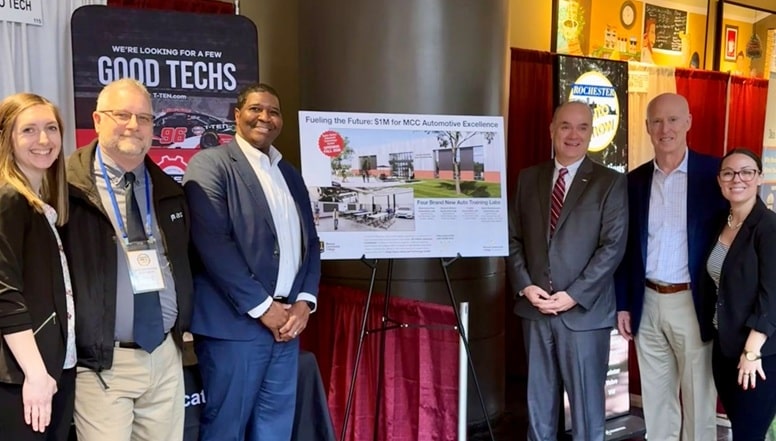
The Rochester Automobile Dealers Association (RADA) led a consortium of regional automotive partners in making a $1 million collective investment to support Monroe Community College’s (MCC) upcoming Sydor Optics Advanced Technology Center (ATC).
The funds will help to strengthen ATC’s hands-on automotive education, advance workforce development and ensure students are trained with industry-relevant technologies. A wing in the center will bear RADA’s name in recognition of RADA’s leadership and convening role.
“This is how strong programs grow — through meaningful community investment and partnership. RADA has supported MCC automotive students through scholarships for years, and we’re honored to see this partnership continue to flourish,” said Gretchen Wood, MCC’s vice president of institutional advancement and executive director of the college’s foundation.
The $69 million, 110,000-square-foot center is scheduled to open in the fall. It’s funded through joint state and county support, including a $34 million state investment and more than $34 million from Monroe County. The new facility will advance MCC’s technology programs with hands-on training in optical systems, precision tooling, HVAC service, automotive technology and renewable energy in a new solar lab.