
Wake Technical Community College in North Carolina will re-name a building at its Southern Wake Campus the Kellie J. Falk Center for Building Technologies in recognition of a $1 million gift from Falk, a local business leader and former college trustee.
Falk’s gift establishes a sustainable source of funding to support faculty through professional development, stipends and externships, the college said. It also will provide equipment and materials that strengthen hands-on learning for students in Wake Tech’s skilled trades programs.
With this addition to her prior endowment, the fund is now the college’s largest endowed fund supporting skilled trades at the college.
“[Falk] continues to be a difference maker, not just for Wake Tech, but for our community by investing in these important occupations,” Wake Tech President Scott Ralls said.
Florida
St. Petersburg College (SPC) has received a $500,000 grant from the Duke Energy Foundation to support the college’s electrical lineworker training program, which prepares students for entry-level utility careers through industry-recognized training and hands-on experience.
Seminole State College of Florida, South Florida State College and Valencia College also received support from the foundation.
Georgia
Augusta Technical College has received a $6.8 million grant from the Economic Development Administration of the U.S. Department of Commerce to support completion of the Jim Hudson Automotive Institute.
The college is renovating a former Cadillac dealership to serve as an automotive workforce training center, designed to prepare students for careers in automotive maintenance technology. It will expand Augusta Tech’s automotive training footprint and serve hundreds of students annually.
The facility is designed to support dealership operations, fleet maintenance and emerging vehicle technologies, while providing hands-on, industry-aligned instruction that responds to both regional and national labor market demand, according to the college.
“By transforming a legacy automotive site into a modern training facility, we are aligning education, industry and economic development in a way that delivers real value to employers and opportunity to our community,” said Augusta Tech President Kendricks D. Hooker.
The project has drawn strong public and private support, including early philanthropic investments from community and industry partners. The new federal grant will accelerate completion of the institute.
Massachusetts
Holyoke Community College (HCC) will use a $455,000 grant from the Massachusetts Clean Energy Center (Mass CEC) to continue and refine its clean energy careers training programs.
The grant will cover two free training programs for up to 30 individuals: Introductory Training in Construction, Electricity and Clean Energy Systems in fall 2026, and Solar Installer/Electrical Pre-Apprenticeship program in spring 2027.
HCC piloted both programs in 2025 through a $1.42 million grant from the Massachusetts Executive Office of Education for climate-related workforce training initiatives. The new grant is part of a $7 million allocation in clean energy and climate tech grants.
“The first grant was really to design, develop and essentially figure out what would work in our market,” said Kermit Dunkelberg, HCC assistant vice president of adult basic education and workforce development. “Now we’ll not just be continuing but refining these programs to achieve even stronger outcomes.”
The Massachusetts Association of Community Colleges, a consortium of all 15 community colleges in the state, received a $120,000 Mass CEC grant to support HVAC programs across the community college system.
New York
Dutchess Community College (DCC) announced a $200,000 investment from Central Hudson Gas & Electric Corp. to expand clean energy and advanced manufacturing workforce training.
The funding will support the development of a new HVAC and building trades laboratory within DCC’s Center of Excellence for Business, Industry and Innovation. The lab will provide training in modern, energy-efficient technologies, including heat pumps, mini-split systems and high-efficiency electric equipment.
The space will include replicated real-world working environments, such as simulated residential settings and advanced diagnostic and commissioning stations.
Many DCC graduates already go on to work at Central Hudson and other regional employers, making this investment a natural extension of a strong and growing workforce pipeline that benefits both students, communities and the regional economy, according to a press release.
Ohio
With a $15,641 donation, the Presidents Club of Dayton has established six scholarships for Sinclair Community College students.
The $2,500 scholarships will go to Sinclair students in good academic standing and who demonstrate qualities of leadership and participate in extracurricular or community activities.
Texas
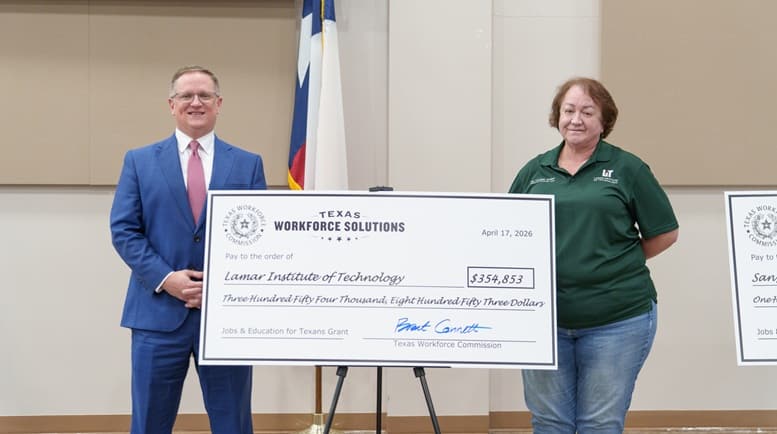
Brazosport and San Jacinto colleges and Lamar Institute of Technology recently were named Jobs and Education for Texans (JET) grant recipients.
They are among six schools in southeast Texas to receive the grants, which will support career and technical education training programs by helping the schools purchase and install equipment to train 410 students for high-demand occupations such as information security analysts, nurses, welders and more.
Brazosport College will use its $356,250 grant to train 75 students as information security analysts. San Jacinto College will use its $189,987 grant to train 110 students as electrical and electronic engineering technologists and technicians. And Lamar Institute of Technology’s (LIT) $354,853 grant will be used to train 50 students as electrical and electronics repairers of commercial and industrial equipment.
“These funds allow us to expand access to high-quality, hands-on training at LIT and across our partner campuses,” said LIT President Sid Valentine. “Together, we are preparing students with the technical skills needed to succeed in today’s workforce and meet the evolving needs of industry.”