
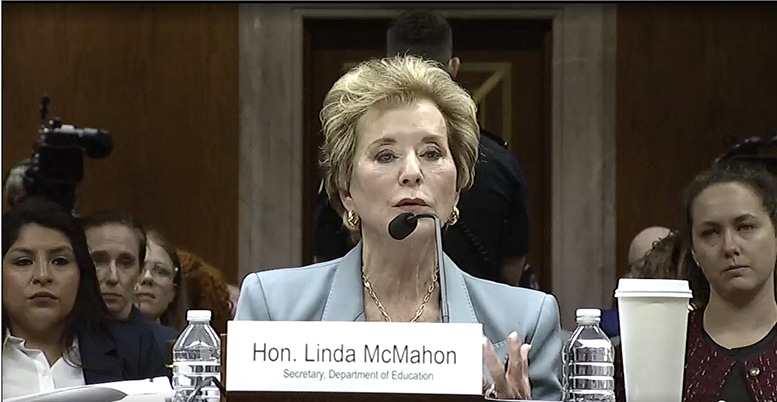
Senate appropriators from both parties on Tuesday pushed back on the Education Department’s (ED) proposal to nix funding for the popular federal TRIO programs and to change their priorities.
During a Senate subcommittee appropriations hearing on ED’s proposed fiscal year (FY) 2027 budget, Education Secretary Linda McMahon spent considerable time defending her agency’s changes to TRIO’s Talent Search and Educational Opportunity Centers grant competitions, prioritizing programs focused on workforce development, including those that promote apprenticeships. She said TRIO has “not achieved its own goals,” so ED looked at how it could revamp the programs.
“It was worth taking an opportunity of reform to show that there might be alternatives to higher education other than college, given that we do have a lack of a skilled workforce in the country,” McMahon said, noting the department has invested $2.1 million into researching how to improve TRIO.
Like its FY 26 budget pitch, ED’s FY 27 budget would eliminate many programs that community colleges prioritize and reduce others. It would nix funding for TRIO, GEAR-UP, Adult Basic Education, Minority Serving Institutions, Strengthening Institutions, Supplemental Educational Opportunity Grants and Childcare Access Means Parents in School programs.
Pushing back
Sen. Susan Collins (R-Maine), chair of the full Senate Appropriations Committee, said she opposes eliminating TRIO, noting that three of her staff members are alums of the programs. She added that changes to the Talent Search grant competition would be a “dramatic shift” to its mission.
“I’m a very strong supporter of apprenticeship programs and other workforce training programs, but that’s not what TRIO is designed for,” she said. “It’s designed to promote college awareness, preparation and completion for low-income and first-generation students.”
Other lawmakers challenged McMahon on her statement that TRIO wasn’t meeting its own goals. Sen. Jeanne Shaheen (D-New Hampshire) said she’s only seen data indicating higher retention and completion rates among TRIO students. She asked McMahon to provide ED’s metrics on the programs.
Sen. Jeffrey Merkley (D-Oregon) also questioned her assertion. He said ED data show that Talent Search students were 33% more likely to enroll in college, Upward Bound students were twice as likely to earn a bachelor’s degree, and Veterans Upward Bound students were 42% more likely to earn a bachelor’s degree.
“The stats on these programs are pretty damn impressive,” he said, noting a bipartisan letter sent by a dozen senators this month to ED in support of TRIO.
Interagency agreements and Workforce Pell
Democrats also went after the Trump administration’s efforts to dismantle ED, reduce funding, cancel or hold grants, and stymie various programs. Sen. Tammy Baldwin (D-Wisconsin) charged that the moving of various staff and program management from ED to the Department of Labor has been costly and confusing for states, schools and students, which McMahon argued was incorrect. And while ED’s budget proposal calls for an additional $10.5 billion — for a total of $33 billion — to help fill a projected shortfall for the Pell Grant program, Baldwin said it also would cut or eliminate funding for most other higher education programs.
McMahon highlighted various ED efforts to reduce costs while redirecting funding to strengthen programs, in addition to implementing the new Workforce Pell program, developing a new earnings indicator, and instituting a new process to weed out fraudulent student aid applications.
Sen. Jon Husted (R-Ohio) asked whether the predicted shortfall in the Pell program would affect the Workforce Pell program that will begin on July 1. McMahon said there would be enough in Pell to fund it, while ensuring the traditional Pell grant maximum award remains at $7,395.
“Our local community colleges are very excited about this, and our local workforce boards are excited about this,” Husted said of Workforce Pell. He also encouraged ED to implement safeguards to ensure that students earn credentials that lead to good-paying jobs. (The department is currently working on final regulations for Workforce Pell.)
“When you set up a new stream of funding, there’s going to be someone out there who’s going to figure out how to scam it,” he said.