For parenting students, accessible childcare can be a lifeline and a necessity in order to stay in college. While many community colleges provide childcare on campus, some work with community partners to connect students to off-campus childcare.
Other colleges have made the difficult decision to shut down their childcare centers.
Doing what’s right for the community
In June, Washington’s Everett Community College (EvCC) closed down its on-campus Early Learning Center (ELC). It was a contentious decision in the community, but for EVCC President Chemene Crawford, it was the only right decision.
At the time it closed, the ELC had about 70 children enrolled; 23 EvCC students had children enrolled there, and some members of the community also had children in the center. There were long waiting lists. However, the 14,400-square-foot building had the ability to accommodate more than 200 children.
The business model wasn’t working, Crawford said. What’s more, over the last 10 years, the center only broke even or made a profit in one or two years. It typically ran at a large deficit.
“We weren’t in it to make money; the point was to provide childcare in a childcare desert,” Crawford said.
But to consistently run a deficit of $300,000 to $400,000 didn’t make good business sense, and to underuse a space that could accommodate so many more children didn’t benefit the community.
EvCC considered shutting down the ELC in 2021, but county funding and federal funding from the American Rescue Plan Act kept it open. Relying on that funding wasn’t an option anymore. In addition, the state has cut funding for the Early Childhood Education and Assessment Program (ECEAP), which helped subsidize early learning programs that served low-income families.
So, after analysis and a lot of discussion, Crawford and EvCC’s board of directors made the decision to close the ELC and “we braced for impact,” Crawford said. When the news hit the community in May, things got “very contentious,” she said. “It put my staff through the ringer.”
A parent even filed an injunction to try to stop EvCC from closing the center.
EVCC staff worked to help students whose children were in the ELC find alternative childcare – and offered to help pay for it. They also tried to help those non-students using the center.
“We weren’t going to leave people hanging,” Crawford said.
And there’s a plan in place to help even more families. EVCC will lease the ELC facility to another early learning organization – one that can maximize the full space to serve even more students and community members.
Crawford hopes to have the center reopen as soon as possible – maybe even by the end of 2025.
“I can’t wait until that center gets bustling with children,” she said. “I can’t wait to see those playgrounds out there full of kids.”
EvCC is not alone. Earlier this year, Mesa Community College (Arizona) and Bluegrass Community & Technical College (Kentucky) announced the closures of their childcare programs.
Crawford added: “Community colleges cannot bear the full brunt of childcare needs of our communities. We cannot do it without partnerships.”
Giving students autonomy
In Boston, Bunker Hill Community College (BHCC) understands the importance of partnerships, too.
Sixty percent of BHCC students are either parents or caregivers – and they all have different needs, including when it comes to childcare. The college doesn’t operate a childcare center, but it does provide assistance in affording and finding childcare thanks to a federal Child Care Access Means Parents in School (CCAMPIS) grant and a partnership with an area nonprofit.
BHCC, through its Single Stop office, offers childcare vouchers to qualified parenting students and connects them with partner Child Care Choices of Boston (CCCB) to find childcare options that fit their needs. CCCB is a program under ABCD (Action for Boston Community Development) that offers support, resources and training for families and childcare providers in Boston and surrounding areas.
“When students come to Single Stop, many are desperate,” said Single Stop Director Kathleen O’Neill. “If you can’t get childcare, you can’t take classes.”
For parenting students, flexibility is key, explained Zanny Alter, an academic coordinator with the Single Stop program. And choosing childcare is “such a personal decision,” she said. Hours, location, size and language spoken are just some of the factors that parents take into consideration. Providing vouchers and options gives students autonomy, Alter added.
As a bonus, Child Care Choices of Boston works with childcare providers to ensure they understand how to take the vouchers, which lessens administrative issues for students and the college.
O’Neill said helping students to get this financial help for childcare is “truly a gift … a gift that opens their world as they complete their education, which will impact generations.”
But BHCC’s CCAMPIS grant is set to expire in August 2026. There are some state vouchers available, but the application and approval process are arduous.
“It’s hard to think about this grant going away,” Alter said. “It’s been a lifeline.”
Advancing with AVANCE partnership
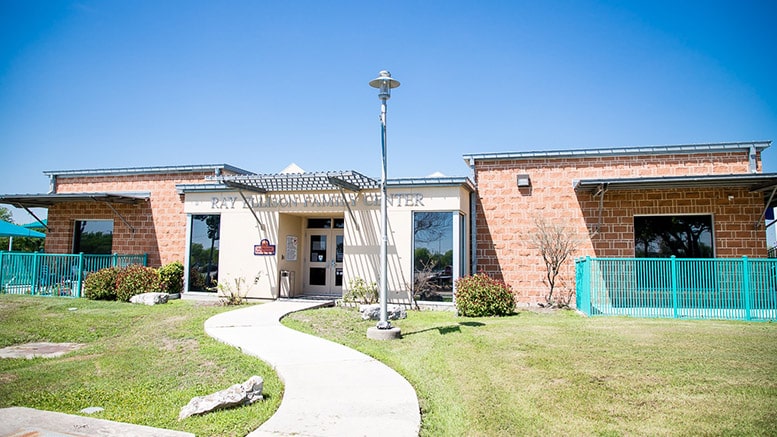
Palo Alto College’s CCAMPIS grant expired in May. With the federal funding, the Texas college was able to offer parenting students drop-in childcare at its Ray Ellison Family Center.
The end of the CCAMPIS grant is “a hard pill to swallow,” said the center’s director, Isabel Cavazos.
Without the funding, the college had to quickly shift gears to help parenting students.
Thanks to a new partnership with AVANCE – San Antonio, the Ray Ellison Family Center is now hosting the first Kids on Campus Head Start program in Texas. That means parenting students have access to on-campus, no-cost, high-quality early learning and childcare.
The program, which is currently capped at 31 children, already has a waitlist. The college is looking for ways to help those students who can’t get their children into the new program, according to Cavazos.
“It’s a hurdle we’re trying to overcome,” she said.
For the students who are benefiting from the new Head Start program, it’s a lifeline.
“Through this partnership, we are reimagining what is possible for student-parents by creating pathways for both parents and children to learn, grow, and succeed together,” Yesenia Alvarez-Gonzalez, executive director of AVANCE-San Antonio, said in a press release.