
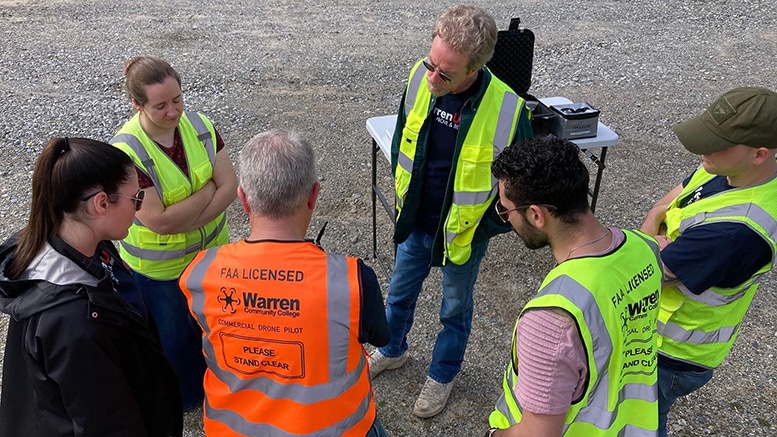
A New Jersey community college known for its drone training is adding drone security to its program.
Warren County Community College is enhancing its drone development and piloting curriculum with one of the nation’s first higher education programs to train professionals in protection against illicit or threatening use of the unmanned systems. The program is being developed by two leading experts in drone security.
Warren President Will Austin, who played a key role in the founding and growth of the Warren drone program (WarrenUAS), said the credit curriculum and workshops for working professionals will start this fall at the college’s Washington campus.
“Drones are an expanding, incredibly valuable tool for nearly every sector of our economy, but it is clear that in the wrong hands they can present a threat to public safety or the security of our infrastructure,” Austin said. “Our mission at WarrenUAS is to meet the need for professionals who can develop, maintain and pilot drones safely and effectively, but we also want to address the rare but serious threats they can pose.”
Experts in the field
Austin and WarrenUAS began discussing the need for greater drone security expertise two years ago. This year, the college brought on board two leading experts in drone deployment and countering unmanned aircraft systems (C-UAS) and asked them to develop a program to address the issue and oversee it as it takes shape this fall.
Brandon Youngblood, vice president for government programs for Spatial Persistent Software Air Domain Awareness, has consulted with Austin about the general structure of the program and is building the curriculum along with L. Scott Parker, founder of Aerisq Solutions, which helps critical infrastructure owners and public safety organizations understand and manage the risks posed by drones.
Youngblood is a former Federal Aviation Administration manager responsible for the oversight of UAS security, interagency C-UAS operations coordination and security airspace management. Parker was a senior leader at the Cybersecurity and Infrastructure Security Agency, serving as chief of UAS security, where he established the agency’s first dedicated UAS security program and helped shape the federal approach to managing drone-related cyber and physical risks.
Austin noted that the curriculum the two experts are developing will train students in the threats posed by drones, how to distinguish those threats from safe and legal flight, and report and respond to them. Interested students must first complete the general WarrenUAS drone operation training.
Why it’s important
Youngblood and Parker noted that there is a critical need for both a broader understanding of drone threats and security and for training of professionals who can assist public and private entities with a better understanding of the distinction between safe and threatening use of the technology and how to protect assets.
“A thousand-dollar drone could potentially take out a $200-million F-22 fighter jet or poison a water supply or cripple an airport, costing millions,” Youngblood said. “Finding ways to provide protection is now getting a lot of attention, and WarrenUAS will be ahead of the curve in broadening our understanding of how to handle those threats and in training professionals to provide that expertise.”
Parker noted that it is also critical for governments and public safety agencies at every level to have a clearer understanding of the safe usage of drones, how they are regulated and how threats can be regulated without stifling the productive use of the technology.
“A lot of people see threats in areas of conflict around the world and make that the perspective they take away. That certainly is a real problem, but there are distinct differences between that and the variety of domestic threats out there,” Parker said. “This program will give students an understanding of both and improve industry knowledge in that realm.”
Beyond the formal course offering, Youngblood and Parker are developing a professional development segment on an ongoing basis for first responders and law enforcement or public utility security officials and others in infrastructure security. They also plan to tap their connections in the industry for guest speakers and develop experiential learning for students on specific current topics. That includes helping WCCC cultivate federal security partnerships with the goal of intern and job placement for C-UAS-focused students.
Expanding its program
The new program is part of several growing offerings from Warren in the fields where unmanned system use is booming – areas like agriculture and utilities, transportation, environmental research and in the entertainment, hospitality or real estate industry and other commercial enterprises.
Austin noted that the college will continue to build the program to meet the needs of students with an increasing interest in unmanned systems – and the public and private sectors, whose demand for professionals is growing as fast as any employment segment. The C-UAS training is part of that mission.
WarrenUAS has grown rapidly in the past seven years and expects to enroll more than 100 students next fall, who will have the opportunity to work with $5-million worth of drone and robotic equipment, including the latest technologies, such as advanced multispectral sensing, aerial robotic spraying and treatment, and data processing through artificial intelligence.
Austin noted that Warren graduates are often getting jobs well before graduation, in a wide range of fields, often with starting compensation of over $100,000
Related article: Tapping into drone technology
WarrenUAS is also collaborating with other colleges, along with building connections to other organizations in the field and in the community. It is partnering in a number of ways with the leading aeronautical university in the country, Embry-Riddle, based in Daytona Beach, Florida.
The college also has invested in its $500,000 Smith Flight Training Center, procured a fleet of more than 75 UAS comprising over 30 unique systems for student usage, as well as ground and maritime robotic vehicles. The Joseph Warren robotics center opened in 2022 with over 5,000 square feet dedicated to CTE and STEM educational opportunities.
Custom training for working professionals is an important part of what Warren County Community College offers as an educational institution, said Peter Miller, chief pilot.
“As a community college, it is a vital part of their mission to strengthen their county community. Warren will be adding counter UAS to its current offerings to law enforcement and other essential personnel in and out of Warren County, New Jersey,” he said.
WarrenUAS has also developed a relationship with the Federal Aviation Administration (FAA), with the FAA hosting its regional conference at the college. WCCC has also gained several FAA waivers so it can safely train students in the latest methods for drone use.
