
At Dallas College, flexibility and adaptability were familiar leadership imperatives, however, the pace of change within the current landscape recently led to new, creative responses to complex institutional and enrollment challenges. One key example is the collaboration between Health Services and Promotion, and Enrollment Management related to meningitis vaccinations, a consistent barrier (and the only vaccination compliance requirement) for our students.

As Dallas College pursued a mission-driven enrollment goal of 180,000 students by 2030, this persistent structural barrier threatened a key outcome. Seeing a new collaboration and outreach possibility, senior leadership put into place new vaccination efforts during 2025-2026 recruitment PUSH drives in high schools at Dallas-area independent school districts (ISDs).
This new strategy required bringing together key staff across multiple teams, defining a tentative plan, launching that plan and creating mechanisms for feedback to finalize the strategy. It demanded a clear emphasis on cultivating leaders at all levels, and empowering staff within the organization to act within their purview, often with considerable autonomy.
This effort involved senior leadership (associate vice chancellors and deans) but relied on staff managing frontline operations. As part of the design framework, responsibility flowed through the Student Outreach and Recruitment (SOAR) team, associate deans, senior nurses and health promotion lead, who managed staffing and clinical workflows.
“This work required creating the context for collaborative change, and for empowering staff closer to direct implementation of PUSH drives to design and implement processes for success,” shared Dean of Student Outreach and Recruitment Chad Decker. “Senior leadership work looked different. It involved setting priorities, allocating skilled nursing capacity, and ensuring alignment between health operations and enrollment goals.”
A structural barrier, not a student problem
The college’s recruitment and enrollment staff regularly encountered students who were otherwise ready to register but were impacted by meningitis admission holds — often because of cost (on average about $150+), confusion about documentation or difficulty accessing vaccinations quickly.
“These were not isolated incidents or communication failures,” Decker said. “They were structural pain points that repeated every enrollment cycle.”
The numbers are staggering and the student impact profound. During the March–May 2026 reporting period, Dallas College SOAR and Health Services and Promotion staff engaged 1,795 students, processed approximately 800 immunization records and removed roughly 1,100 meningitis-related registration holds — 61% of which resulted in same-day enrollment. These data reinforce what frontline teams knew: the barrier was systemic, recurring and directly tied to enrollment momentum.
Gonzalez shared a critical vantage point that four-year institutions, whose students often have insurance, don’t experience: “Asking students to navigate the private healthcare marketplace on tight timelines effectively outsourced a state and institutional requirement to students and families who often lacked the time, transportation or funds to do so. We believed we could lead better and with more intentionality, more caring and better support for our students.”
Decker added, “For the enrollment team and senior institutional leaders, the question occurred annually. If this barrier is known, recurring and systemwide, is it reasonable to treat it solely as an individual responsibility?”
Ultimately, with the support of the chancellor, the board of trustees and senior leadership, Dallas College’s answer was “no.”
When a student health solution aligns with enrollment strategy
Globally, many colleges and universities treat student health requirements — like immunizations and health insurance — as downstream compliance obligations — necessary but disconnected from enrollment strategy. Meningitis vaccination requirements are often addressed late in the admissions and registration process, when students are already navigating multiple hurdles.
“At Dallas College, we came to see this mandate and requirement not just as a health matter or an admissions checklist item,” said Vice Chancellor of Student Success Beatriz Joseph. “We knew it was a predictable enrollment barrier — one that disproportionately affected students enrolling from surrounding ISDs and that, if left unaddressed, contributed to enrollment impacts and ultimately economic and social mobility for our students. We decided that was not acceptable, based on our institutional ethos as barrier busters.”
“What changed,” she added, “was not the requirement itself, but how we chose to lead around it.”
A deliberate enrollment decision
Rather than asking enrollment staff to work around the problem — or students to simply “figure it out” — Dallas College made a deliberate choice. In close partnership between Enrollment Management and the Health Services and Promotion teams, the college committed to providing meningitis vaccines at no-cost. The institution committed to providing necessary funding support. Eliminating this cost at Dallas College simplified the enrollment pathway, reduced holds, and allowed the recruitment team to focus on providing support and momentum.
Designing for care and access
Dallas College relied on the SOAR team and staff at nurse-led health centers to operationalize the details through their unique vantage point. Starting in fall 2020 (on each of the seven campuses at Dallas College) and expanding to PUSH Drives at ISDs in fall 2025, nursing staff provided meningitis vaccines, often supported by the health promotion coordinators, and in collaboration with the dean of student outreach and recruitment, his team and ISD staff.
“Immunization record checks through the State database, ImmTrac2, allowed documentation issues to be addressed (upstream), before there were enrollment delays,” said Gonzalez. “The goal was not to add another service per se, but to redesign where and how the service occurred — earlier and closer to students.”
Trust, professional autonomy and effective communication
Because this work relied on licensed nursing professionals operating across multiple settings, autonomy and professional trust were foundational. Nurses were not simply executing tasks; they were representing the institution in community spaces, exercising judgment and responding to real-time student needs. The nurse leads and associate dean served as critical (distributed) leaders in these spaces.
“Staff motivation came from clear communication and connectedness rather than scrutiny. Senior leaders and associate deans communicated directly about the purpose and staff came to understand better how their work directly affected student access and enrollment,” shared Carlos Cruz, associate vice chancellor for student wellbeing and social support. “That alignment reinforced motivation while preserving staff autonomy.”
This model also depended on intentional communication across teams.
“Enrollment, recruitment, and health services engaged in extensive meetings over many months,” Decker explained. “Frontline staff were not expected to manage agreements and contracts; and senior leadership ensured that expectations and engagement paths were clear.”
The result was improved access for students and clear guidance for staff — an often-overlooked component in effective distributed operational models.
Lessons learned
Looking back, several leadership principles were at work.
“Decision-making authority was placed close to the point of service,” Cruz said. “Enrollment, compliance and health were treated as an interdependent ecosystem rather than separate functions. Access was addressed operationally — by removing cost and timing barriers before they derailed students. And institutional structures were adapted to students’ needs, not the other way around.”
For forward-thinking community colleges, none of these ideas are new. What is less common is applying them concretely to enrollment and compliance concerns. This work also reflects a broader leadership imperative: the responsibility not only to respond to barriers, but to intentionally design systems that prevent them.
By reframing the issue and aligning institutional resources accordingly, leadership at community colleges can construct systems in which access, health and well-being, and enrollment are mutually reinforcing. This approach underscores that effective leadership in matrixed institutions is not simply about oversight, but about creating the conditions under which student success is engineered into everyday practice.
Looking forward
Instinctively, this work was never just about vaccines — it was about seeing the barrier before students felt impacted by it, owning it as an institution and redesigning the path so no student had to navigate it alone. It comes as many community colleges consider the complex choice for students between attending community college or entering the labor market.
For Joseph, the imperative has never been more poignant.
“In higher education, leadership can sometimes feel like it is measured by how rigorously we enforce requirements and processes,” she said. “But in inspired moments, true leadership can be something far more powerful: the ability to anticipate barriers and remove them before they interrupt a student’s momentum.”
“It’s all about heart work and putting students first,” Cruz added.
* * *
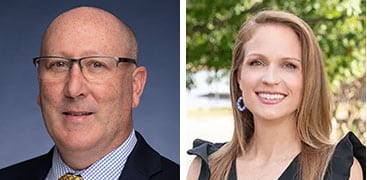
Thad Mantaro, PhD, is dean of student health and wellness at Dallas College (Texas).
Katherine Doss is associate vice chancellor of Enrollment Management at the college.