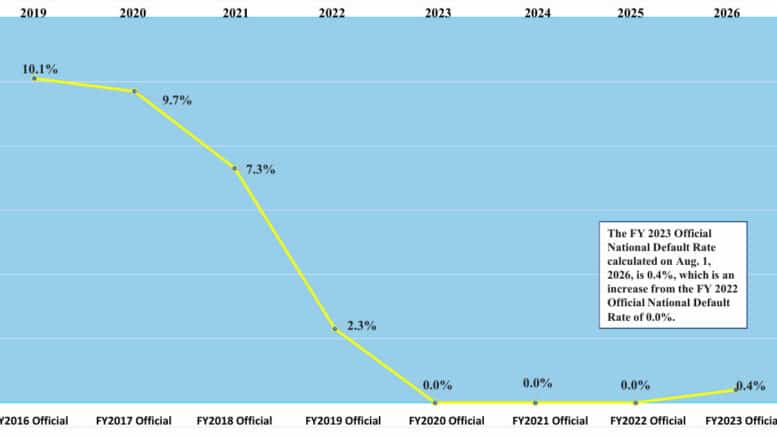
The U.S. Education Department on Wednesday released cohort rates for student loan defaults that reflect failure to repay the loans since ED resumed student loan repayments following a pause during the Covid pandemic.
For community colleges, the cohort default rate (CDR) for fiscal year 2023 (FY 23) is 0.6%, representing 1,957 students in default at 651 colleges. The national CDR for 2023 is 0.4%. For public four-year institutions, it is 0.2%. For all proprietary schools, the rate is 0.8%, with a CDR of 0.9% for two-to-three-year propriety schools.
CDRs reflect the share of federal student loan borrowers who enter repayment and default within three years. They are the primary accountability mechanism for institutions participating in the federal student loan program. If an institution’s CDR is greater than 40% in a single year, the institution may lose eligibility to participate in the Direct Loan Program. If an institution’s CDR is 30% or higher for three consecutive years, it may lose eligibility to participate in both the Direct Loan and Pell Grant programs.
Institutions with CDRs of 30% or higher must establish a default prevention task force, and institutions with CDRs of 30% or higher for a second consecutive year must submit a revised default prevention plan and may be placed on provisional certification.
What it means
The FY 23 CDRs are the first CDRs that could have binding consequences since FY 17, when the national average CDR for all higher education sectors was 9.7% and 15.1% for community colleges. At the time, the rate overall and for community colleges was trending down as a result of servicers, campus administrators, the federal government and especially borrowers making a concerted efforts to lower student loan defaults.
Since then, one, two or all three years of a CDR have been affected by the Covid student loan repayment pause, with CDRs for FY 20, FY 21 and FY 22 at 0%.
While the national CDR for FY 23 is only 0.4%, this three-year cohort includes two years during the repayment pause. ED says that the FY 23 CDRs should be interpreted with caution because they may provide an overly favorable picture of borrower repayment outcomes. The first CDR without any repayment pause years will be FY 25.
Community colleges have historically had higher CDRs compared with other nonprofit sectors of higher education, with the majority of two-year public institutions having a FY 17 CDR between 9% and 20%. The repayment landscape, especially for community college borrowers, has grown even more complicated and confusing for borrowers to navigate since then. Borrowers have faced significant challenges in successfully navigating repayment, including limited experience with repayment, difficulty maintaining contact with or locating their loan servicer, and frequent changes in federal student loan policies. These challenges can make it more difficult for borrowers to successfully manage their loans and avoid default.
Colleges should review their newly released FY 23 CDRs, which, while not telling the full story, will give an indication of repayment trends for their student borrowers. Colleges are also encouraged to compare FY 23 CDRs with past and future nonpayment rate data to assess whether default management interventions are moving the needle and where additional support may be needed.
New support tool for borrowers in default
ED and the Treasury Department also this week launched a new online portal, the Defaulted Loans Support Center, to help borrowers with defaulted federal student loans understand their options, rehabilitate or consolidate their loans, and return to repayment.
The new portal is intended to streamline the process by replacing outdated websites and paper- and fax-based processes with a centralized online system, ED says. Borrowers can upload documents, review estimated payments, electronically sign their agreements, track application progress, make payments, and review repayment and discharge options through StudentAid.gov.
Beta testing of the new portal garnered positive feedback from borrowers, with 89% reporting that the application was easy to complete and 86% reporting that they understood what to do next, according to the departments.