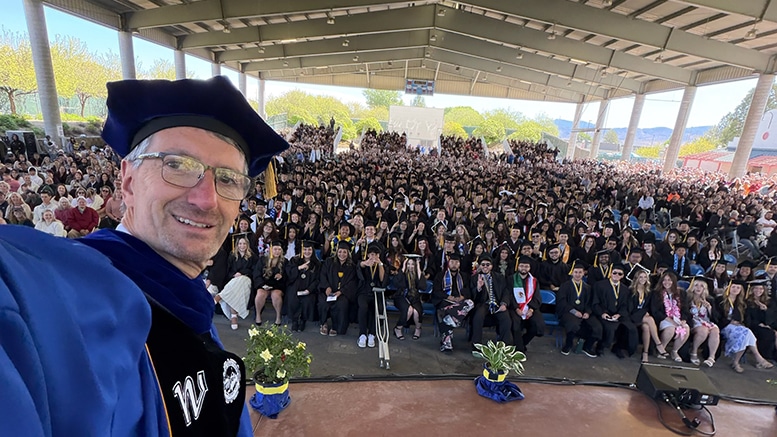
Nearly 700 students earned degrees and certificates this spring at Western Nevada College (WNC), marking the largest graduating class in the history of the college.

For a small rural community college serving more than 12,000 square miles of Nevada, the milestone represents far more than enrollment growth. It reflects years of intentional work to understand today’s students, how they access higher education and what community colleges must do to serve them successfully.
The record class includes students who completed associate degrees before receiving their high school diplomas, adults returning to finish credentials decades after entering the workforce, career changers preparing for emerging industries and aspiring nurses training to serve communities across rural Nevada.
At Western Nevada College, nearly 70% of students now fall outside what many would consider a traditional college profile. Approximately 30% are age 25 or older, while nearly 40% are 18 and under, participating in dual-enrollment opportunities before graduating from high school.
Those numbers tell a larger story unfolding across higher education. The traditional college pathway is no longer the dominant one. Students are pursuing education at different stages of life, balancing work and family responsibilities, seeking shorter pathways to meaningful careers and expecting institutions to adapt alongside them.
For community colleges, that shift presents both a challenge and an opportunity.
Building a culture around enrollment
Several years ago, we made a deliberate decision at Western Nevada College: enrollment would belong to everyone. Growing opportunities for students could not rest within a single office or department. It had to become part of our institutional culture.
Faculty, staff and administrators came together through an empowered and representative strategic enrollment management committee focused on one central question: How do we remove barriers and help more students succeed? The results were significant. WNC experienced a 17% increase in enrollment in a single year in fall 2024, growth we have maintained while strengthening retention, completion and student outcomes. For WNC, it’s not just about getting students in the door; it’s about walking them through it and across the stage. That philosophy guides our work.
Every employee has a role to play in student success. Whether someone works in instruction, facilities, student services, workforce development or administration, every interaction shapes a student’s experience and influences their ability to persist and graduate.
Community colleges have always been engines of opportunity. Today, they must also be catalysts for adaptability. Students are telling us they need flexibility, responsiveness and support systems that acknowledge the realities of modern life. Institutions that listen, like we have, will be best positioned to serve their communities in the years ahead.
Serving the new majority of students
Two recent Western Nevada College graduates illustrate this changing landscape. Arturo Martell calls his educational journey “backwards” — and he means that in a good way. After graduating from Carson High School in 2004, Martell entered the workforce and began building a successful career in aerospace manufacturing before returning to college years later.
“I’m happy I did things backwards because it gave me a different perspective,” he said. “I came into the workforce first and gained years of real-world experience. In class, I could connect the dots. I could apply what I was learning, and I could speak to it.”
He embraced being one of the oldest students in the classroom. “There’s a misconception that college is only for young people,” Martell said. “I met students of all ages who were discovering themselves just like I was.”
Along the way, the WNC classes Arturo pursued to advance his career and broaden his knowledge ultimately culminated in an associate of general studies degree, formalizing years of learning that had already shaped his professional life. His experience reflects a growing population of adult learners seeking advancement, fulfillment and new opportunities.
“Manufacturing has done so much for me,” he said. “It gave me a solid foundation, opened the door to multiple career paths and ultimately allowed me to directly serve the aerospace industry I once dreamed of joining. That’s why I still have so much passion for the work I do today.”
At the opposite end of the age spectrum stands fellow WNC graduate Eleanor Joiner Davis. Before receiving her high school diploma from Reno High School, Davis earned an associate degree from Western Nevada College, all while performing in musicals, competing internationally in gymnastics, studying ballet and piano, and preparing to attend Harvard University this fall.
Davis pursued her college coursework independently, driving herself to campus several days each week to take specialized performing arts classes unavailable through traditional high school pathways.
“I took musical theater classes from Stephanie Arrigotti, voice classes from Judy Monson, dance with Gina Davis and piano with John Shipley,” she said. “They gave me a world-class performing arts education.” Those experiences led to opportunities to perform in New York through Broadway Artists Alliance programs and Musical Theatre International workshops.
“I’m very excited to attend Harvard in the fall,” Davis added. “I’m interested in theater, music and applied math, and I’m excited to continue performing and exploring different academic paths.”
Arturo and Eleanor could not have followed more different journeys. Yet both represent the new majority of students community colleges increasingly serve — learners who enter higher education on their own timelines and according to their own ambitions.
Responding to rural workforce needs
For rural institutions like WNC, adaptability extends beyond demographics. It also means responding quickly to changing workforce demands and community priorities.
One of the greatest advantages community colleges possess is agility. We can work directly with employers, revise programs efficiently and create educational pathways aligned with emerging industries far more rapidly than larger, more bureaucratic systems. The National Skills Coalition reports that more than 50% of jobs in Nevada require more than a high school diploma but less than a bachelor’s degree. That is what we do every day at WNC.
The college has also expanded support for adult and workforce learners through its ROADS program — Realizing Opportunities for the American Dream to Succeed — which combines career coaching, financial assistance and wraparound services with training opportunities in high-demand fields. Programs like ROADS recognize an important truth: access alone is not enough. Students also need support systems that help them persist and complete their educational goals.
Healthcare provides another example. Recognizing persistent workforce shortages throughout rural Nevada, WNC has expanded nursing education opportunities deeper into the communities we serve, including Fallon in Churchill County and Minden-Gardnerville in Douglas County. By bringing programs closer to students and healthcare providers, we are preparing more nurses to remain and serve in their hometowns.
These efforts are not separate initiatives. They are connected expressions of the same mission: creating pathways to opportunity that reflect the needs of our communities.
Looking ahead
Arturo Martell completed his degree while building a career. Eleanor Joiner Davis completed hers before finishing high school. One arrived at college after years in the workforce. The other before beginning her professional life.
Their stories look nothing alike, yet both demonstrate a simple reality: higher education is no longer a linear experience.
Western Nevada College’s largest graduating class in history was not built around a traditional student model. It was built by embracing students who arrive earlier, return later and move in and out of education throughout their lives.
More importantly, it has reinforced a principle that will continue guiding our work in the years ahead: there is no single path to success. Our responsibility is to create opportunities, remove barriers and walk alongside students from their first day on campus to the moment they cross the stage.