
Editor’s note: This article is based on a paper, “The Road Less Travel: Women’s Internship Experiences in College Automotive Technology Programs,” written by Townsend, Creamer and Mayhew, that has received the Distinguished Paper Award from the Mid-Western Educational Research Association and will be featured at the 2026 American Educational Research Association Annual Meeting on April 10 in Los Angeles.
Community colleges are rightly being recognized as central to the nation’s skilled trades pipeline. They are nimble, workforce-focused and deeply connected to regional employers. In automotive technology, especially, that role matters. The U.S. Bureau of Labor Statistics (BLS) projects about 70,000 openings for automotive service technicians and mechanics each year over the next decade, and the occupation employed about 805,600 workers in 2024.

But if we are serious about strengthening that pipeline, we need to be honest about a problem hiding in plain sight: women remain dramatically underrepresented in the field, and “access” alone is not the same thing as equity. According to recent BLS data, women make up just 4.2% of automotive service technicians and mechanics, placing the occupation among those with the smallest share of women workers.
That is not just a representation issue. It is a talent issue, a workforce issue and a design issue.
Feedback on internships
Our recent mix-method study, EDiCTS (Enhancing Diversity in Career & Technical STEM) explored the experiences of community college students enrolled in four Ford ASSET (Automotive Student Service Educational Training) programs. For one paper, we focused on the internship experiences of five women enrolled in a manufacturer-specific automotive technician training program across four community colleges. In the larger study, women represented only about 4% of students. What the women described should push educators and employers beyond a simple “recruit more women” message. Their stories showed that internships did provide valuable exposure to the realities of the field, but they also exposed women to gender discrimination, exclusion from learning opportunities and a need for extraordinary self-advocacy just to access the same kinds of experiences their male peers received more automatically.
That finding matters because internships are supposed to be where classroom learning becomes professional preparation.
In the best cases, they are exactly that. Students test their skills, learn workplace norms, build confidence and imagine themselves in long-term careers. Elevating the importance of public-private partnerships, work-based learning can be one of the strongest ways to align employer need with student opportunity.
But internships do not automatically become high-quality learning environments simply because they happen at a worksite.
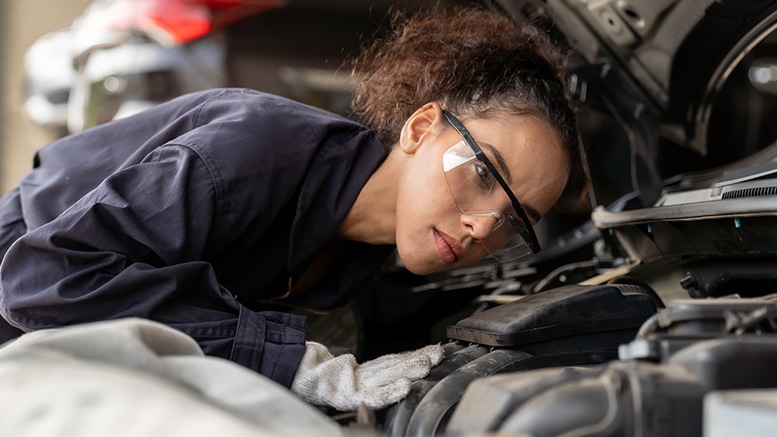
The women in our study described internships that revealed the “true nature” of the industry. That included physical demands, yes, but also workplace cultures that questioned their competence, mentors who stepped in too quickly instead of teaching, and supervisors who withheld better assignments or mentorship altogether. One participant was told directly that an employer did not want a woman in the shop. Another spent months in the oil-change lane while a male trainee advanced into more technical diagnostic work. Others found that if they wanted better experiences, they had to chase them down themselves by asking, hovering, proving and re-proving that they belonged.
That is the hidden curriculum women in auto tech are too often forced to master: not just how to fix vehicles, but how to negotiate bias while learning.
And that should concern everyone involved in workforce preparation.
How community colleges can help
Community colleges cannot solve labor shortages by sending students into internships that are educationally uneven and culturally exclusionary. Employers cannot claim to want a stronger pipeline while relying on informal, inconsistent training environments that make some students work harder for less learning, less pay or less confidence. If women leave these programs or the profession, it is too easy to misread that departure as lack of fit, rather than what it often is: a predictable response to a system that has not been designed with their success in mind.
This is where community colleges can lead.
First, internship quality needs to be monitored, not assumed. Programs should set clear expectations for what students must experience on site: substantive tasks, guided learning, equitable supervision and regular check-ins. No student should spend months sidelined from core technical work in a required training experience without intervention. Our study points directly to the need for standardized internship quality controls and more active monitoring of field placements.
Second, mentors need preparation. In many skilled trades environments, technical expertise is treated as enough. It is not. A strong technician is not automatically a strong mentor. Women in our study benefited most when mentors were patient, trusted them with real work and knew how to coach without patronizing. Programs and industry partners should build mentor training that addresses pedagogy and gender bias together. That recommendation also aligns with prior research on women-centered training environments and mentoring supports in the trades.
Third, women need networks, not isolation. In small automotive programs, there may be only one or two women in a cohort, if any. That makes every setback feel personal when it is often structural. Cross-campus peer communities, alumni networks and women-centered industry mentoring could help students share strategies, build social capital and see a future for themselves in the field. Our findings strongly support those kinds of networking structures.
Finally, colleges and employers should stop treating women’s persistence as an individual test of grit.
The point is not whether women can survive auto tech. Of course they can. The women in our study were resilient, capable and deeply committed to the profession. The real question is whether our institutions are willing to redesign the pathway so women do not have to survive barriers that should not be there in the first place.
This conversation is timely. More employers see women as an important pool for addressing skilled trades shortages, and about 60% of survey respondents said more women would join the trades if a clearer path were built for them. That is exactly the point. The issue is not interest alone. It is pathway design.
* * *

Dr. Emily T. Creamer is the research director of The Ohio State University’s College Impact Laboratory, where she co-manages multiple mixed-methods research projects, EDiCTS. She is the co-principal investigator of a multi-year project exploring community college success, titled “Drive to Thrive: Student Success in Career & Technical STEM Education.”
Susannah Townsend is a Ph.D. candidate in the Higher Education and Student Affairs program at The Ohio State University with more than 10 years of experience working in institutional research.
Dr. Matthew J. Mayhew is the William Ray and Marie Adamson Flesher Professor of Educational Administration with a focus on higher education and student affairs at The Ohio State University. He is the lead author of more than 100 articles and the book How College Affects Students: 21st Century Evidence that Higher Education Works.