
When was the last time you took a moment to reflect on why you became an educator?

For some of you, it has always been your lifelong dream to serve society in this manner. For others, perhaps it was a calling shaped by family, mentors or a pivotal moment in life that redirected your journey. And for many, the path into education was unexpected. Life led you away from the private sector and toward greater fulfillment in helping others achieve their dreams.
Whatever your story may be, each of us has a “why” — the compass that guides us to serve. Every decision we make, whether in the classroom, the boardroom or the president’s office, should advance the greater good that first called us into this work.
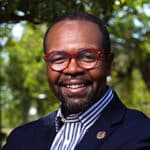
This article is part of a monthly column in CC Daily by Mordecai Ian Brownlee, president of the Community College of Aurora in Colorado.
Few leaders intentionally make decisions that undermine their institution’s mission or harm the people they serve. Yet such decisions happen every day because of the various biases and perceptions that shape how we see ourselves in the world.
The German philosopher of the continental tradition, Hans-Georg Gadamer, perhaps said it best: “It is the tyranny of hidden prejudices that makes us deaf to what speaks to us in tradition.” This cautionary quote should challenge readers to listen before judging and to examine what drives our innate assumptions. When we fail to do so, the consequences can ripple across students, faculty, staff and communities — sometimes without us even realizing it.
What’s ‘moral?’
By definition, the word “moral” relates to principles of right and wrong in behavior. These principles are based on a system of values that live deep in each of us, known as our ethics. Potter Stewart, former associate justice of the U.S. Supreme Court, once said, “Ethics is knowing the difference between what you have a right to do and what is right to do.”
Far too often, leaders fail to understand that just because you can do something doesn’t mean you should. In higher education leadership, that distinction matters more than ever. Just because a strategy is available and convenient does not mean it is right.
It is critically important for each of us to develop fail-safe systems that prevent personal ego from prompting us to make decisions that fail to advance our institutions strategically and instead feed hidden agendas, whatever they may be. Confucius said, “To know what is right and not do it is the worst cowardice.” Dr. Martin Luther King, Jr. said, “The time is always right to do what is right.” Each of us has a responsibility, no matter the times, to stand for what is right and just, and to let the moral nature of being an educator guide our actions – especially in these times.
Where we are
The post-pandemic environment in which we serve is riddled with implications and complications that are forcing institutions to re-evaluate both the relevance of their missions and the methods used to operationalize their strategies. Factors such as demographic shifting have exacerbated enrollment declines, which directly impact financial sustainability. Combined with political and cultural pressures and value scrutiny of the overall value of higher education, we have entered an era of constraint.
The challenge for us all is to see opportunity, amid the constraints, and to allow the moral responsibility we have to the greater good of society to drive our strategies and, ultimately, the actions we take at our respective institutions. In this moment, strategy is not a technical exercise or the implementation of the latest trend; It is a moral act.
Beautifully stated by Winston Churchill, the former prime minister of the United Kingdom, “A pessimist sees the difficulty in every opportunity; an optimist sees the opportunity in every difficulty.” Because in an era of constraint, strategy is no longer just about what we can afford to do; it is about what we are morally called to do.
May we all embrace the inner optimism within us.