

Last spring, Lumina Foundation announced a new national goal to steer more Americans toward good-paying jobs: By 2040, 75% of adults in the U.S. workforce should have a college degree or credential of value leading to economic prosperity.
On Thursday, the foundation announced the country’s current standing on that measure: 43.6%.
The figure is part of Lumina’s latest findings on college attainment and “credentials of value” goals. As part of its annual “A Stronger Nation” report, the foundation updated its online dashboard that tracks progress toward the 75% goal, and includes a breakdown based on states, education types and demographics (gender, age and race/ethnicity).
For example, among the 141.5 million adults in the U.S. labor force with a credential of value, 5.1% hold an associate degree, with short-term credentials accounting for 7%. Bachelor’s degrees make up the bulk of valued credentials at 18%. Lumina bases its figures for a credential of value on the share of the labor force ages 25-64 with a post-high school degree, certification or certificate who are making at least 15% more than the national median annual salary of a high school graduate.
Higher levels of education are often linked to greater economic prosperity, according to the Lumina findings. Among the 13.3 million Americans with an associate degree, 55% are earning at or above the benchmark. For the 8.3 million with a certification, 55% are meeting the benchmark. Among the 36.5 million individuals with a bachelor’s degree, it’s 70%.
Digging deeper
Lumina’s dashboard provides a further breakdown of the data, showing that older Americans tend to have higher percentages toward the 75% goal. For example, 44% of associate-degree earners meet the credential of value threshold, compared to 56% of those ages 35 to 44, and 60% of those 45 to 54.
The same holds true for baccalaureate earners, though they tend to have higher rates and less variance: earners ages 35-34 are at 66%, with those ages 45 to 54 at 74%.
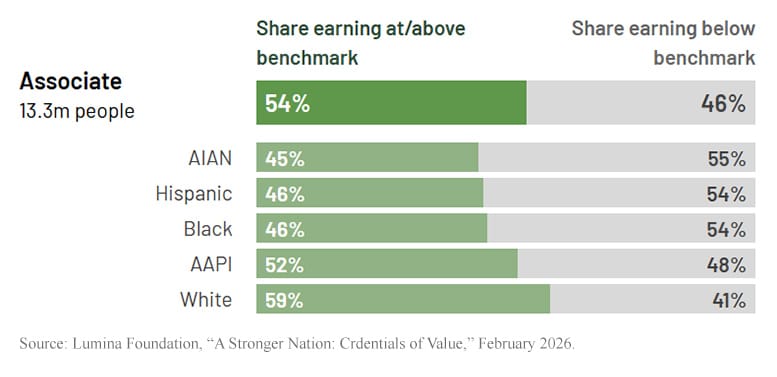
Figures also show (see below) that White students with associate degrees have the highest rate toward the benchmark at 59%, followed by students who are Asian American and Pacific Islander (52%), Black (46%), Hispanic (46%) and American Indians and Alaska Natives (45%).
In terms of states, Massachusetts (52.5%) Colorado (51.7%), Washington (49.8%), Virginia (49.4%) and Maryland (49.2%) are the farthest along on the credential of value mark. Nevada (33.6%), West Virginia (34.6%), Mississippi (36.4%), Tennessee (37.3%) and New Mexico (37.6%) were on the far end.
Updates on attainment, too
Lumina continues to track postsecondary attainment — the share of the U.S. working-age population with a post-high school degree, certificate or certification — which it started to follow in 2009. It set a goal for 60% by 2020. In 2024, the national figure was 54.8%. That’s 16.7 percentage points higher than when the foundation started tracking the number. Nearly 48% have an associate degree or higher, reflecting a 9.7 percentage point increase since 2009.
In terms of states, attainment largely mirrors the figures for credentials of value rates. Four states have exceeded the 60% attainment goal: Colorado (64.3%), Massachusetts (62.6%), Utah (62.6%) and Minnesota (61.0%). West Virginia (43.3%), Nevada (44.7%), Tennessee (48.1%), Louisiana (48.4%) and Arkansas (48.6%) were at the bottom end.
Opportunities for improvement
Courtney Brown, vice president of impact and planning at Lumina, said the foundation pivoted as the national discussion shifted from just attaining credentials to earning credentials that led to good-paying jobs.
“It’s no longer just about whether someone has a degree or credential; it’s whether they are economically better off with it,” she said in a media briefing on Wednesday.
Brown noted that the findings show bachelor’s degrees remain a consistent pathway to higher earnings, while outcomes for associate degrees and short-term credentials vary more widely.
“I think it points to real opportunities to strengthen quality and alignment with labor-market demand,” she said.
Brown said she doesn’t see the 43.6% baseline as a “story about education failing,” but rather a story about progress, transparency and evolving expectations. The new findings are designed to help policymakers, educators, employers and other stakeholders set their goals for efforts to reach the national mark, she said.