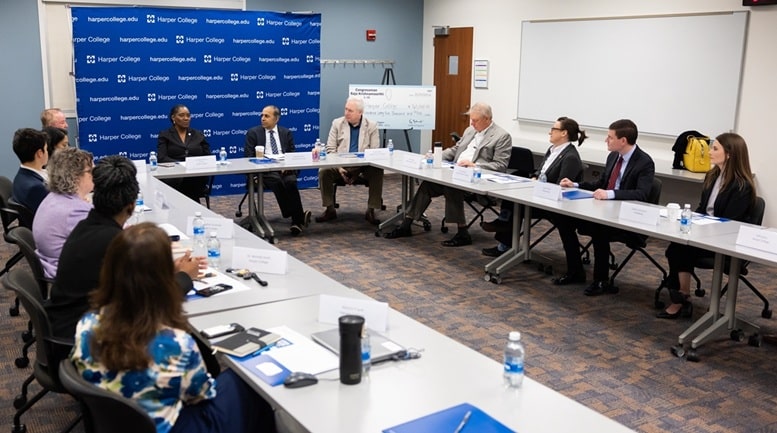
U.S. Rep. Raja Krishnamoorthi (D-Illinois) visited Harper College this month to present $765,000 in federal funding he secured to support science education and expand access to careers in quantum science and technology.
The investment will help Harper modernize its science lab infrastructure and launch hands-on learning opportunities that introduce students to quantum concepts and career pathways.
“Quantum technology is already transforming our economy by revolutionizing industries like cybersecurity, healthcare, clean energy and advanced manufacturing,” Krishnamoorthi said. “By building a stronger pipeline from the classroom to careers, we’re strengthening our workforce and keeping Illinois competitive. The future of this technology should be built here at home.”
* * *
Elsewhere in Illinois, Western Governors University (WGU) presented College of DuPage (COD) with a $10,000 scholarship grant to benefit business students as they take the next step in their academic journey.
The grant will support graduating COD students who plan to continue their education at WGU’s School of Business, helping to reduce financial barriers and create a seamless path forward for aspiring business professionals.
California
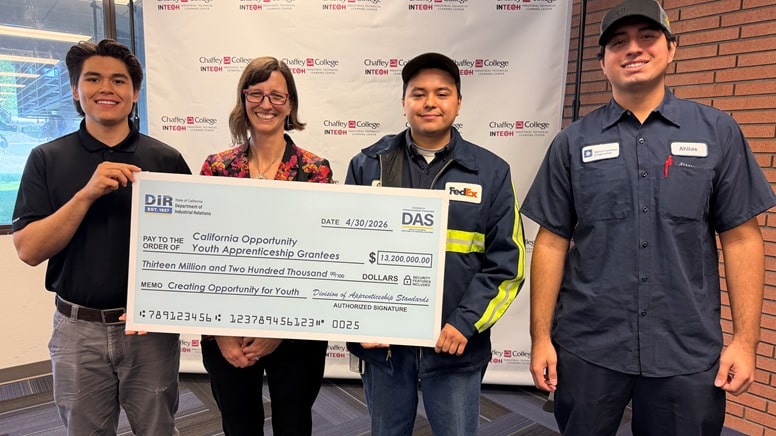
Chaffey College has received nearly $1 million in California Opportunity Youth Apprenticeship (COYA) grant funds. COYA is a state-funded program connecting disadvantaged youth to high-paying careers.
In total, COYA awarded $13.2 million to 25 schools and organizations to expand apprenticeship opportunities for young people. The funding allows organizations to partner with employers to provide paid training to students.
Through its InTech Center, Chaffey College offers a no-cost pre-apprenticeship program that prepares students for careers in industrial maintenance, mechanics and electro-mechanics.
Ahlias Calderon is one of the students who has already benefited from the training. The 19-year-old now makes more than $30 per hour as a production technician for Anheuser-Busch, with a goal of going into management.
“I had hundreds of hours of hands-on training, classroom training, and it just really prepared me for the interviews and my career,” Calderon said. “This program helped me to understand everything when I walked into that plant.”
Kansas
Hutchinson Community College students for generations to come will benefit from a $1.8 million gift from the estate of Ray and Dolores “Dee” Waldo.
The gift, made to the Hutchinson Community College Endowment Association, follows the Waldos’ previous $1 million donation 10 years ago. It will expand scholarship and educational opportunities.
Ray Waldo attended Hutchinson Community College in 1956–57 before launching a career as an engineering technician.
“This extraordinary gift is a testament to Ray and Dee’s belief in the life-changing power of education,” said Cindy Keast, director of the college’s endowment association. “Their generosity will expand opportunities for our students, helping remove financial barriers and opening doors. We are deeply grateful for their vision and the legacy they have created.”
North Carolina
Four North Carolina community colleges are partnering with the University of North Carolina (UNC) at Charlotte on a new $5 million National Science Foundation grant project.
With UNC Charlotte, Gaston College and Cleveland, Rowan-Cabarrus and South Piedmont community colleges will expand the STEM Persistence and Retention via Curricula, Centralization, Cohorts (SPARC) initiative, which is designed to support academically talented students with financial need who are pursuing degrees in STEM.
The five-year project focuses on improving retention, transfer and graduation rates in disciplines including biology, computer science and data science. The grant will provide scholarships and comprehensive academic support for students across the partner institutions. Students also will get undergraduate research opportunities and cohort coursework designed to support persistence.
At Gaston College, the new grant builds on the strong outcomes of previous SPARC programs. Among earlier SPARC cohorts at Gaston, 83% of students completed their associate degrees and 87% successfully transferred to a university.
Gaston College graduate Jesus Vina Moreno is now in his second year at UNC Chapel Hill Medical School. Moreno credits the SPARC program for helping shape his path.
“SPARC was more than just a program; it was a launchpad,” he said. “By providing the mentorship and tools I needed to thrive, it allowed me to dedicate myself fully to my studies without distraction.”
* * *
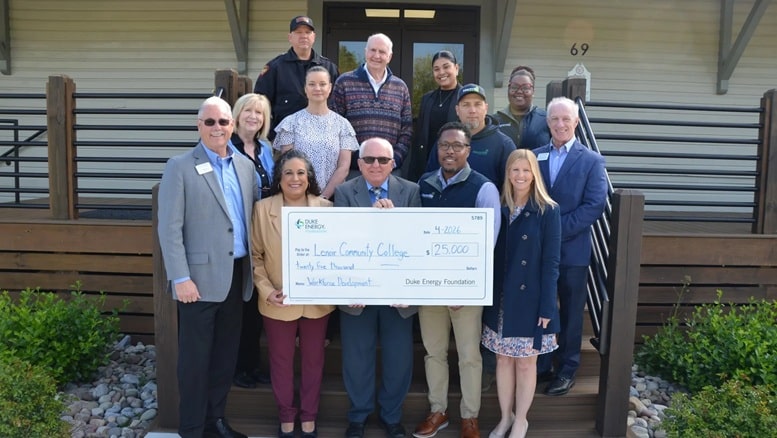
Lenoir Community College (LCC) celebrated recently a $25,000 grant from the Duke Energy Foundation that will support the launch of an accredited electrician training program at the new Maysville Workforce Development Center.
LCC will design and implement a hands-on training program that prepares students for careers as residential and commercial electricians. The program will emphasize hands-on learning in a realistic training environment, led by highly qualified instructors.
“This investment represents the kind of forward-thinking partnership that strengthens both our college and the communities we serve,” said LCC President Rusty Hunt.
A significant portion of the funding will support implementation of the National Center for Construction Education and Research (NCCER) curriculum, a nationally recognized credentialing system aligned with industry standards. Grant funds also will cover instructional materials, including textbooks, lab equipment and safety supplies.
Texas
A $15.3 million grant from Arnold Ventures will expand San Jacinto College’s student success work. The grant supports the Accelerated Study in Associate Programs (ASAP) model, a project to improve community college completion rates.
Modeled on the City University of New York’s rigorously evaluated ASAP, the program combines high-touch advising, structured pathways and a comprehensive financial and academic support system. It is expected to double graduation rates for participating students.
The ASAP program at San Jacinto will be embedded within the college’s Promise program, aiming to start with 900 Promise Scholars studying natural sciences or who are enrolled in one of the college’s four bachelor’s degree programs.
“We know that completion outcomes for many of our natural sciences students is low, which is one reason the discipline was selected for this program,” said Chancellor Brenda Hellyer. “By introducing this ASAP program and other supports that address both academic and non-academic barriers related to completion, we believe we can lead a transformation in completion, not just with our students, but across the state as well.”