
Career-connected learning in high school is taking off. High school students and their families have become increasingly enthusiastic about it. Community colleges should share students’ and families’ enthusiasm — and use dual enrollment more strategically to build on it.

High schools are strengthening career and technical education (CTE), expanding industry-recognized credentials and work-based learning. Career academies connect academic and technical coursework to students’ interests while preparing them for college and careers. Some districts have adopted “wall-to-wall” academies that reach nearly every student. These innovations have attracted strong interest from students, families, employers, and policymakers.
In many parts of the country, college enrollment rates among high school graduates have declined, with young men a particular concern. At the same time, substantive postsecondary education and training are increasingly important for securing family-supporting employment with opportunities for advancement. Career education in high school is a great start, but young adults who complete a degree, apprenticeship or other substantive postsecondary training by age 26 are more likely to secure high-quality jobs by age 30.
Community colleges are well positioned to help bridge this gap. Nearly 2.2 million high school students now enroll at community colleges through dual enrollment. This growing connection to high schools creates an opportunity to encourage and prepare more students to continue their education after graduation — especially the many who question the value of higher education.
But offering more college courses to high school students is not enough. In many states and colleges, dual enrollment consists largely of discrete courses, often in general education subjects. Students can accumulate credits without understanding how those credits connect to a college program or career. The Community College Research Center’s analysis of a nationally representative sample of 2019 high school graduates found that one third earned at least three high school CTE credits but never took a dual enrollment course.
These students represent a major opportunity. Colleges can build on their career interests and high schools’ investments to create stronger on-ramps to postsecondary education and training through dual enrollment.
Our new report, “Scaling Career-Connected Dual Enrollment: How College and K-12 Partners Can Strengthen Pathways and Expand Opportunity,” draws on interviews with practitioners at 12 sites across the country to identify three strategies for building dual enrollment into existing high school and college programs.
Three strategies for career-connected dual enrollment
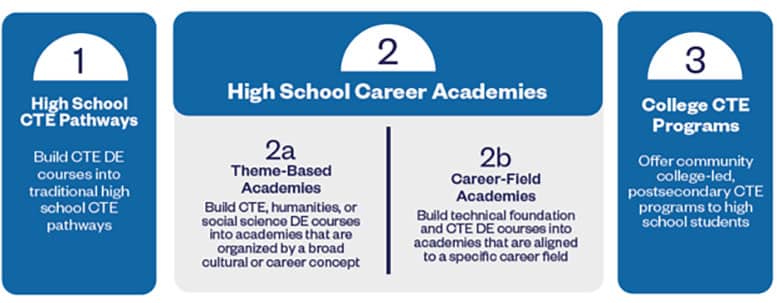
Build dual enrollment into traditional high school CTE pathways. Texarkana College in Texas, for example, works with partner districts to embed college coursework into existing high school CTE programs. Pathway plans customized for each school show students how courses connect to college credentials, well-paying, high-demand careers, and further education. College academic coaches embedded in high schools help students plan and make the transition after graduation.
Build dual enrollment into high school career academies. In California, Oakland Unified School District builds dual enrollment into its Linked Learning academies, deepening students’ exploration of academy themes and introducing related postsecondary programs and careers. In Centinela Valley Union High School District, El Camino College coursework, work-based learning and advising help academy students build interests and motivation to continue in career-path college programs.
Enroll high school students in college CTE programs. Eastern Iowa Community Colleges (EICC), for example, offers college technical programs through college-run career academies and other locations across its multi-county service area. High school students can begin associate of applied sciences programs in high-demand fields designed with local employers and taught by EICC career technical faculty. By bringing together students from multiple districts, the colleges provide access to specialized facilities, equipment and instruction that individual high schools could not sustain.
Across these strategies, the work extends beyond deciding which courses to offer. College and school partners help students explore their interests, develop educational plans, and understand the next steps toward credentials and careers. They engage employers, support instructors, and invest in staff and systems to sustain the partnerships. Career exploration remains central: Students need opportunities to explore interests while keeping their options open.
For community colleges, career-connected dual enrollment offers a strategy to expand the pipeline of young people prepared for high-demand, well-paying jobs in their communities while building a supply of students who might not otherwise continue their education after high school.
The opportunity is already here: Dual enrollment is widespread, and high schools are increasingly focused on high-quality career programming. Community colleges need to connect the two. It’s time to turn random acts of dual enrollment into purposeful on-ramps to college and careers.