As a participant of the American Association of Community Colleges’ Pathways Project more than a decade ago, Tulsa Community College (TCC) mapped out the pathway its incoming students took, from admission to enrollment, and found it to be rather circuitous.
The process took roughly 15 separate steps, some of which students often discovered they still needed to complete when they unsuccessfully tried to register for classes, which sometimes happened two or more times. School leaders decided this required far too much traipsing around campus when they should have been gearing up for academics and settling in.
In response, the college redesigned the pathway to get those steps done in a more organized fashion before or during its New Student Orientation program. TCC also has enlivened the orientation significantly after realizing that incoming students found it somewhat soporific. The college’s work has received several awards recognizing its ingenuity.
This excerpt comes from the current issue of the Community College Journal, the bimonthly magazine of the American Association of Community Colleges (AACC).
In addition, TCC has taken other steps to boost student retention, such as tripling the number of advisors and streamlining its reporting process for faculty to raise red flags about students who are struggling. All of which has combined to help steadily increase fall-to-fall retention rates from 55.9% in 2021-22, before the roll-out, to 63.1% in 2024-25, while headcount jumped from 20,053 in 2023-24 to 21,157 in 2024-25.
The college has drawn from its mission, vision and values in rolling out the orientation program and other retention-oriented initiatives, based on five principles, according to Leigh Goodson, college president and immediate past AACC board.
“You belong here, everyone can learn, community unites us, a quality education is affordable and excellence is our culture,” she said, adding: “It’s a filter and a set of paradigms we can use to make all of our institutional decisions. They’re easy to remember and easy to embrace.”
Condensing the pathway
The college has condensed the 15-step onboarding process significantly by determining which of those steps could be handled either before orientation or in one-stop-shop fashion that day, Goodson says.
“With every step a student has to take, to get from first contact to learning in the classroom, there is a chance of that student stopping and no longer pursuing their interest in college,” she says.
Previously, before students could enroll, they were frequently “passed around for small issues,” like confirming their residency information or providing their high school transcripts or assessment scores, says Eileen Kenney, associate vice president of enrollment and retention. Now, TCC reviews student records proactively to ensure they do not have “holds” that would prevent registration. This helps determine, for example, who has a FAFSA on file, and who may need co-requisite support as part of registration to be ready for college-level work, Kenney says.
Those who have gaps in their information can fill those in during orientation sessions, which now have representatives from various offices on-site to assist students with student IDs, financial aid documents, testing referral, registration with the bursar’s office and more, she adds.
“The goal is to walk away with your schedule and be ready for the semester,” Goodson says.
Orientation leaders on all four TCC campuses also make sure new students know how to find their classes on day one, offering optional tours before school starts, says Goodson, who has a background as an admissions counselor, academic adviser and enrollment manager.
“The enrollment steps were critical so students could concentrate on everything going on within the classroom, as opposed to worrying about everything outside the classroom,” she says.
Keeping students’ attention
Enlivening the proceedings also was a key aim of the redesign, says Nash McQuarters, who worked as an admission counselor and academic advisor at TCC prior to becoming new student orientation coordinator in 2019. Previously, orientations was held in one room for several hours with multiple speakers talking through Powerpoints, with very little student-to-student or student-to-faculty interaction, he says.
“Students never want to do orientation. I wanted to change that feeling, once they left,” says McQuarters, who was also a student orientation leader in high school and college. “When [TCC] first started to make orientation mandatory, in 2016, I could read people’s faces. It was so obvious it wasn’t really exciting for them. You could tell they weren’t latching on to the information too well.”
McQuarters proposed a complete revamp that would create a “more engaging, higher energy, more in-depth program that could accommodate larger numbers of students,” says Kenney. “We wanted to create a program that would validate students’ decisions to attend TCC. We wanted them to look around the room and think, ‘This is great.’”
Previously, the college offered 80 different orientation sessions at various times throughout the week, which meant many of them were not particularly well-attended. That has been streamlined to 20, mostly held on Fridays between April and August, which means they are significantly larger, about 175 students each.
“That, in turn, makes it more exciting,” McQuarters says.
A new plan
To orientate the 3,000 new students across four campuses, TCC created a “Freshman Fridays” model with support from academic leadership, in which offices around campus are reduced to a skeleton staff on Fridays so that most employees can attend and help with orientation sessions, providing 30-minute one-on-one advising sessions to discuss what classes students need to take for their particular degree program.
Kenney says she worked with Angela Sivadon, senior vice president and chief academic officer, to get the buy-in from academic affairs to ensure college-wide support for the Freshman Fridays model, given the skeleton staff aspect.
“We knew that if we could do that, we could create a program engaging enough and that provided the right level of information that we could start to increase retention rates, which we did,” she says.
The changes to orientation were formed during the 2019-20 school year but were scrapped due to Covid, which moved orientation virtual for two years, so 2022 ended up being the year of the big roll-out. The reinvented orientation stays within the four-hour timeframe previously used but rotates students to different parts of campus to get their blood flowing between sessions and also build in an informal campus tour from their assigned orientation leader, who answers questions as they stroll from place to place.
To deepen engagement, students can follow the Powerpoint slide decks on their phones, download them afterward and take online quizzes that both provide leaders a sense of how well they understood the information, as well as create a gaming-like atmosphere, complete with a leaderboard showing who scored highest, McQuarters says.
“Instead of making everything a presentation, one breakout is a workshop and one is a panel with three of our departments at TCC,” McQuarters says. Those nervous about asking questions in front of people can submit them anonymously. “We try to incorporate different types of learning styles and methods. There is a lot of information we’re giving them in such a short amount of time,” he says.
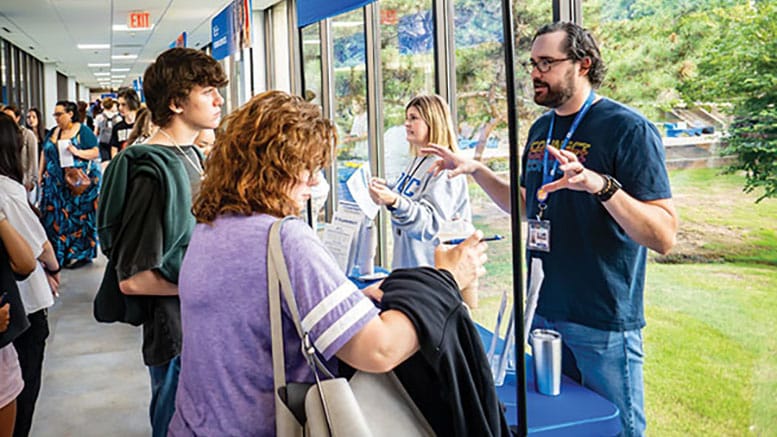
Another new aspect of the orientation is a resource fair where more than 32 schools, departments and offices set up tables in the fitness center or other open common spaces. Students can mill around and ask questions about everything from their major, to accessibility resources, to transfer options, McQuarters says. This creates faculty interaction, which the previous version of orientation had lacked.