

A new report highlights how community colleges can quickly increase enrollment in “high-value programs” that lead to good jobs and decrease enrollment in “low-opportunity” programs that don’t.
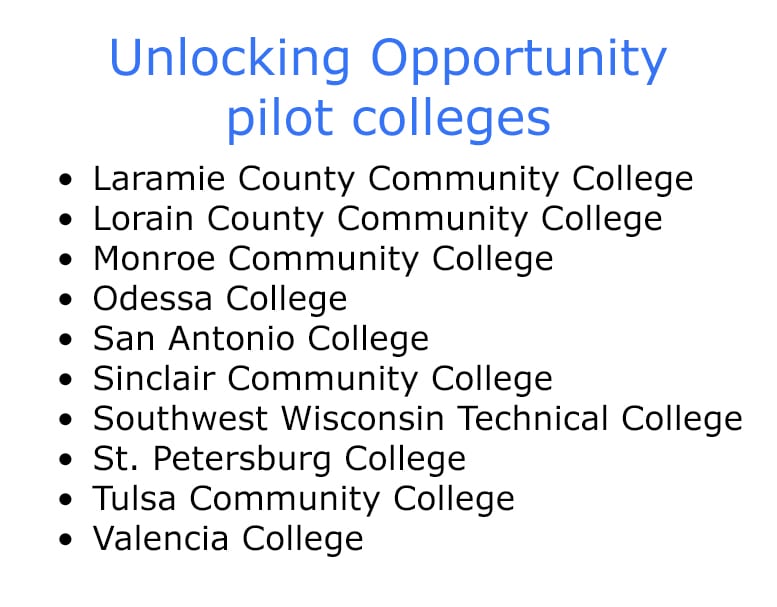
The report from the Community College Research Center (CCRC) and the Aspen Institute College Excellence Program examines lessons from 10 community colleges participating in their Unlocking Opportunity network, which launched in 2023. Between 2022 and 2025, the colleges increased the number of students enrolled in high-value pathways by 20,104 (a 27% increase), including more than 17,000 students (a 40% increase) from low-income backgrounds and students of color, according to the findings. They simultaneously decreased the number of students in low-opportunity programs by 7,648 (a 25% decrease).
How did they do it? The colleges implemented institution-wide reforms to strengthen both workforce programs and bachelor’s degree pathways. Participating colleges adopted evidence-based strategies that included:
- Developing and expanding high-value programs aligned with employer demand.
- Strengthening low-opportunity workforce programs so they lead to better jobs.
- Accelerating bachelor’s degree attainment through strengthened transfer pathways, while reducing the number of students in general studies programs that lack clear transfer or career outcomes.
- Redesigning advising and onboarding processes to connect students with high-value pathways from the start.
- Aligning dual-enrollment programs with college and career pathways.
Some examples of the plans in action:
- Southwestern Wisconsin Technical College started a radiological technology program to address regional workforce shortages.
- San Antonio College in Texas teamed with employers to expand clinical placements in nursing, increasing enrollment in its selective nursing programs by 71% in three years.
- Odessa College, also in Texas, nixed general studies associate degrees because of their poor track record in post-graduation opportunities, while beefing up career and academic planning to guide students into better career pathways.
“While completing a credential is important, community colleges can no longer measure their success simply by how many students graduate; they also need to ask where those credentials lead,” Davis Jenkins, CCRC senior research scholar, said in a release.
Researchers also noted substantial growth of dual-enrollment students with educational plans among the pilot colleges. Over three years, the number of dually enrolled students on educational plans increased from 10,099 to 16,818.
The report also observed the importance of community college presidents and other institutional leaders in driving change.
“Many of the reforms required substantial shifts in institutional policies, procedures, data systems and external partnerships. College leaders played a critical role in ensuring that these changes were implemented at scale and remained focused on improving students’ post-graduation outcomes,” the report says.
The researchers noted that there’s still a lot to do in this area.
“These community colleges will need to ensure that students not only enroll in but also complete high-value pathways,” the report says.
The Unlocking Opportunity network expanded by an additional 54 colleges in September 2025. CCRC and the Aspen Institute plan to report on their progress over the coming years, as well as continuing research on the 10 original network colleges.