
Recruitment at Bay College starts early — very early.
The community college, which serves 2,000 students across 15 counties in Michigan’s Upper Peninsula, begins outreach in fifth grade. Students from local school districts are invited to the Escanaba campus, where they learn about potential careers as well as the basics of college life.
Children get a window into continuing education, whether examining insects through a microscope or learning how various metals burn at different temperatures. Visitors also get a personal welcome from President Nerita Hughes, who is happy to meet young minds at their “sweet spot,” she says.
This article is an excerpt from the new issue of the Community College Journal, published by the American Association of Community Colleges.
“These are kids who are going into middle school, where they’re percolating ideas of who they want to be, and starting to identify a career path,” Hughes says. “Back in the day, when I was in school, you went to a parent or a mentor. You can still do that, but that’s not as prominent. So how do we reach kids early to start talking about this?”
The program, called Fifth Grade Friday, was a cornerstone of the college’s outreach strategy when Hughes joined the Bay College team in 2023. This work is especially critical today, due to an approaching enrollment cliff sparked by declining birth rates, shifting student priorities and evolving perceptions of post-high school life. The National Center for Education Statistics predicts a 5% decline in college enrollment nationwide by 2030, with states such as California (16% decline) and New York (14%) taking particularly hard hits.
Mitigating the damage requires a more strategic recruitment approach, a laundry list encompassing targeted marketing, AI use and large-scale campus investment.
Welcoming high schoolers
Bay College is not content with just introducing elementary students to college and career opportunities. Hughes and her team are welcoming 11th graders (College 101) and soon-to-be-graduating high schoolers as well.
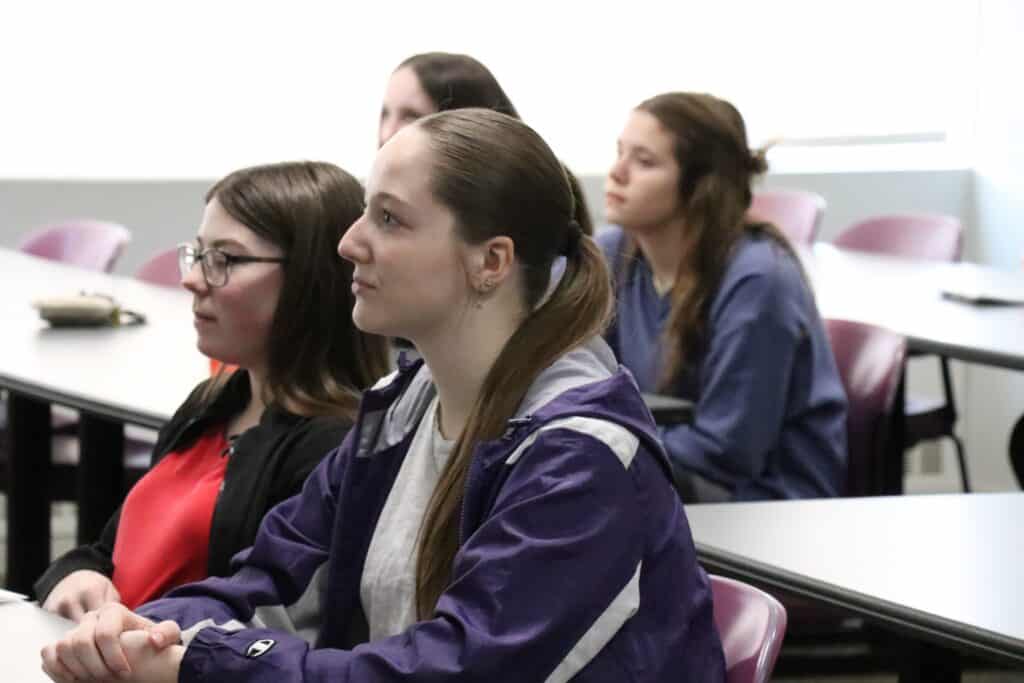
Bay is the Way Day brings students in for campus tours, presentations from graduates and meetings with staff and faculty. In addition to financial guidance, the visits expose students to specialized roles in areas like healthcare they may not have otherwise considered. Taken together, such immersive on-site programming lets students envision a life beyond their backyard, Hughes notes.
“I believe that if you can see it, you can be it,” Hughes says. “Kids are seeing people who look like them in these various roles, and they’re excited to learn about different programs and careers. We are starting these students young enough to have more ideation, because even by middle school, you’re deciding what you want to do in life.”
Not ‘lesser than’
Bay College is only a few miles from the Delta-Schoolcraft Independent School District (ISD), which serves 275 students at two schools. About 12.5% to 15% of the district’s learners live below the poverty rate, with many taking career technical education courses at specialized centers in Delta and Schoolcraft counties.
Bay College’s proactive outreach is a lifeline for first-generation students who lack an understanding of the school-to-workforce pipeline, says Delta-Schoolcraft ISD Superintendent Kristina Hansen.
“They might not know what opportunities are out there, so we show them how they can partner with the college,” Hansen says. “(Bay College) has tremendous outreach with the middle schools and younger kids. They added athletics as well, so we’ve got students attending those events. Their presence around the community is helpful in beginning that partnership at a young age.”
While a field trip offers immediate enjoyment for Delta Schoolcraft fifth graders, these visits are also meant to be aspirational, Hansen adds. Older students get hands-on learning with Mind Trekkers, a travelling STEM road show that offers interactive experiments and science-based demonstrations. The goal is to ignite interest in STEM, while showcasing a fresh spectrum of career possibilities.
For high school seniors, the opportunity to stroll campus and sit in on lectures can deconstruct myths about community college being “lesser than” a university path, Hansen says. Beyond standard enrollment, Bay College’s dual-credit programs serve an additional 900 students each year, offering an accelerated pathway into collegiate careers.
“Community college is a way to be on a smaller campus that still has phenomenal opportunities,” Hansen says. “Many students are surprised by the programs available, whether they’re on a degree or certification track or finding ways to gain different skills. Opening eyes to these programs is vastly important, especially for students that come from smaller schools.”
Forging a deeper connection
A Bay College alum herself, Hansen knows first-hand the attraction of the less-traveled path. Community college acted as a steadying force, allowing her to build confidence before attending Northern Michigan University as a full-time student. Individuals should know their options, which include dual enrollment.
An early connection to a college campus also gives her students a shot of confidence, Hansen says.
“At first, students were afraid to ask professors questions,” Hansen says. “The way to improvement has been through regular communication and collaboration. Every ISD and community college could create a partnership like this, but the willingness to communicate is the biggest piece. Bay being responsive to our community’s needs is a huge asset.”
Where many two-year schools pour dollars into expensive advertising campaigns, San Bernardino Valley College (SBVC) is putting its efforts into the campus experience itself. The California college, which celebrates its 100th anniversary this year, has leaned into its identity as a “place-based college.”
In practice, this means investment into campus beautification, expanded student services and new academic facilities — a tale told by an in-house marketing team across video and social media. Ultimately, SBVC aims to prioritize grassroots community building over a paid media approach, says President Gilbert Contreras.
“We’ve got people choosing a college, and determining if higher education is worth it,” he says. “There’s personal choice, plus a stigma that the university path is the path to go through. Let’s showcase the benefits of a community college education, while educating our area partners on our promise.”
“Valley Up!” acts as both mantra and branding strategy for a campus thriving in the heart of San Bernardino, Contreras says. High school students soak up the vibes during tours and sporting events, while famous alumni like late actor Gene Hackman get love from the marketing team.
A Hispanic-Serving Institution with three-quarters of learners of Hispanic descent, SBVC’s Dreamers Resource Center has specialized academic counseling and other resources. Smaller student populations benefit from tailored programming like the Taytayan Learning Community — living up to the Tagalog name for “bridge,” the initiative delivers coursework through a dedicated Asian and Pacific Islander lens.
SBVC also is recognized by the state as a Black-Serving Institution, and the college works to bolster the academic journey of its Black student body. Recognition of the college’s larger work comes mostly from word-of-mouth, as SBVC has not purchased a single paid ad for the last two years, according to Contreras.
“Word spreads when students have an experience beyond just being a number,” Contreras says. “We’re connecting with their families and neighborhoods, and giving people an opportunity for upward social mobility through education. This is an intentional creation that’s all packaged together. We want to fulfill our role as a community institution, and have that word-of-mouth spread.”