
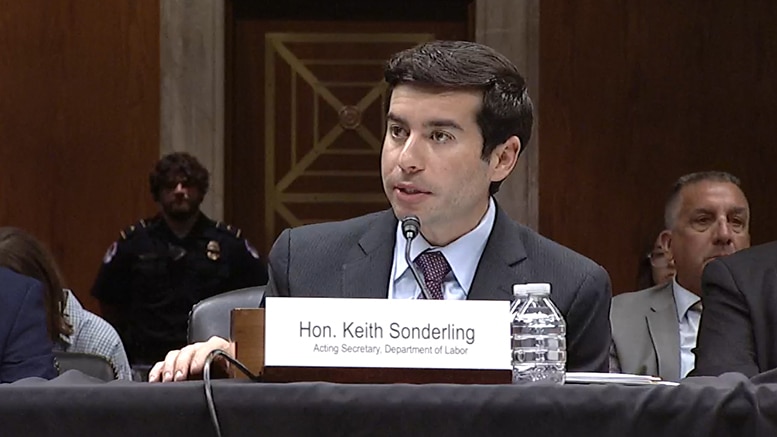
Except for a different secretary, Tuesday’s hearing on the Department of Labor’s (DOL) proposed budget was almost identical to last year’s, with Acting Secretary Keith Sonderling pitching to significantly cut his agency’s funding while seeking to expand registered apprenticeships and consolidate funding for many workforce development programs into block grants to states.
And, as they did at last year’s Senate appropriations subcommittee hearing, lawmakers on both sides of the aisle questioned how that could be done with less federal funding, as DOL proposes to slash its total discretionary budget by $2.6 billion to $10.7 billion.
In her opening statement, subcommittee Chair Shelley Capito (R-West Virginia) said she was encouraged with DOL’s efforts to strengthen the nation’s workforce training and cut regulatory red tape to help U.S. businesses compete, noting persistent workforce shortages.
“This is why it’s so important for our workers to have access to robust workforce training programs, especially to those that provide on-the-job training and those focused on in-demand jobs,” she said.
Capito noted DOL last year registered more than 2,300 new apprenticeship programs that produced nearly 300,000 new apprentices nationwide.
“This is an important step in meeting our country’s workforce needs, but more must be done,” she said. “I hope to see DOL continue to build on this success and expand apprenticeship opportunities to new programs and fields, as many valuable apprenticeship opportunities don’t fit the current registered apprenticeship model.”
Questions about registered apprenticeships
Sen. Jon Husted (R-Ohio) asked about some of the proposed changes to apprenticeships in the DOL budget, specifically requiring that 10% of the proposed Workforce Innovation and Opportunity Act (WIOA) block grants go toward apprenticeships. The acting secretary said the changes also would help to expand registered apprenticeships by making it easier for employers to join and invest in them.
Sonderling, who last month became acting secretary after Lori Chavez-DeRemer resigned, sidestepped a question from Husted about whether the administration could meet the president’s goal of 1 million new apprentices annually, saying he’s committed to making it happen.
Sen. Tammy Baldwin (D-Wisconsin) questioned whether the administration’s policies have cooled the growth of apprenticeships. She noted registered apprenticeships steadily expanded from about 400,000 in 2016, to 666,000 in 2024, reaching 700,000 this past year. But she asked if terminating federal funding for various infrastructure and energy projects and workforce development have dimmed their growth.
“If we are truly going to reach 1 million active apprentices someday, we aren’t going to get there by cutting infrastructure investments that employ these workers, or slashing funding for the workforce training programs that support them,” she said.
Going after interagency agreements again
Democrats on the subcommittee also criticized the administration’s “political crusade” to eliminate the Education Department by shifting to co-manage programs with other agencies. They argued that DOL is now focused on learning the ins and outs of those programs, and that “scattering these programs” across agencies has resulted in DOL facing challenges in administering its own programs, citing federal audits.
Sonderling countered that the interagency agreements have been successful.
“We believe this is the most efficient way for federal dollars in the WIOA programs to get out to states,” he said, noting stakeholders already work with both agencies so it’s a matter of efficiency. He cited that DOL has already processed 4,182 payments for career and technical education grants.
“From our perspective, it’s working and it’s ultimately going to help the students in workforce development,” Sonderling said.
Protecting Job Corps
Like last year, Sen. Susan Collins (R-Maine), chair of the full Appropriations Committee, pushed back on the administration’s efforts to nix funding for Job Corps again, with other committee members also expressing support for the program that serves at-risk young adults.
Collins noted one Job Corps student in her district who went on to attend Northern Maine Community College, where he was recently named its Student of the Year in recognition of his academic excellence, leadership and service to the campus. Upon graduation, he will return to the Job Corps center to serve as its IT administrator.
“Stories like Joshua, who came from a very difficult background, show the effectiveness of Job Corps in helping students turn around their lives and pursue successful careers,” Collins said.
The committee chair criticized DOL for again proposing to eliminate funding for the program after Congress “rejected soundly” the plan last year. She said that the administration’s actions — from paused operations to halted enrollments — have chilled enrollment, which has dropped to about 55%. She also chided the department for using “distorted” performance data that are the results of its own actions.
“How can you use the metrics of decreased enrollments to fairly and accurately evaluate this program?” she said.
Sonderling thanked Collins for the story, noting it is the type DOL wants to hear. But he argued that the statistics don’t reflect that story for many students. The administration would rather focus on programs that show better results to help participants land jobs, he said.
Sen. Chris Murphy (D-Connecticut) also charged that the administration was delivering a “false narrative” around Job Corps. In addition, he argued that the administration is touting its desire for more apprenticeships for efforts such as domestic shipbuilding, yet it wants to cut funding for the programs that would train the workforce to build them.
Sonderling responded that it can be done. He noted the administration, through its proposed “Make America Skilled Again” block grants, would provide states and localities with the flexibility to invest in training to serve their specific workforce needs.
Other topics briefly discussed at the hour-long hearing included WIOA accountability measures, seasonal and nonseasonal H-2 visas, unemployment insurance fraud and worker safety.