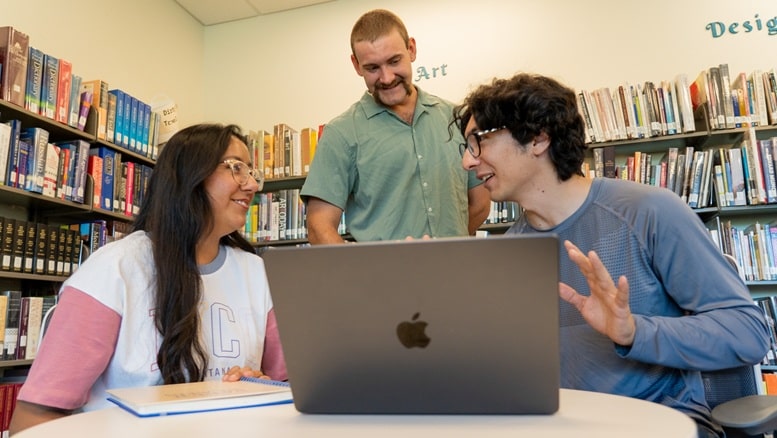
Many community college students juggle classes with work, family and long commutes — a balancing act that requires them to fit in their studies whenever they can. Campus libraries are key to this dynamic, offering a convenient and quiet environment, not to mention technology sometimes unavailable at home.
As college libraries expand, so does public demand for the resources they provide, a tricky notion with funding at a premium. Yet, these facilities continue to act as a “third space” outside the home and classroom, serving a vital role for students pulled in numerous directions at once.
This article is from the new issue of AACC’s Community College Journal.
Flathead Valley Community College (FVCC) in Montana is refining its services.
Visitors with video or podcasting aspirations can use the library’s redesigned recording set-up, which requires no previous production experience — all students need is an empty flash drive to save their project. A new on-site makerspace offers laser engravers, 3D printers, sewing machines and other innovations meant to spark creativity in learners of all ages, says FVCC Director of Library Services Morgan Ray.
Thanks to its recent renovations, FVCC’s Broussard Family Library won a national 2026 excellence award for community colleges from the Association of College and Research Libraries (ACRL). The award recognizes academic libraries that serve the public while furthering the mission of their parent institutions.
“The library at Flathead Valley Community College has outstanding collaborations with internal campus units and external community partners, all in support of Flathead Valley Community College,” said Beth McNeil, chair of the ACRL Excellence in Academic Libraries Committee, in a press release. “The library is a true community hub, with a small but mighty staff.”
Ray took over as director in 2021. As a rural resource center serving about 1,250 full-time equivalent degree seekers, the library stays nimble when putting student suggestions into action.
“We’ll talk to our student success teams to look at gaps in college preparedness and research skills, then turn around in two weeks with a workshop to meet those gaps,” Ray says. “Or we’ll have a ‘Taking Stock’ survey that asks students where they’ve struggled during the semester. If they’re worried about time management, we’ll make sure our workshops reflect that.”
A calming redesign
Though known primarily as a student gathering space, FVCC’s library also provides lifelong learning services to the wider public. Operating in a close-knit community means knowing every patron by name, whether a student or local resident.
Put simply, anyone with a thirst for learning or connection can find their people and purpose within the facility’s walls.
“Our school has a strong reputation in the community, so we’re able to show how we use this space, why it matters and how people make connections within it,” says Ray. “I serve on the campus student success committee and attend comprehensive student services and academic and student affairs leadership meetings. Our team has regularly walked students over to the appropriate office to ensure the connection is made. Getting students to the right resources is part of the support that’s consistent across campus.”
Expanding access
Nor should library accessibility be limited only to neurotypical students, notes Ashtin Trimble, director of library services at Black Hawk College (BHC). In May, the Illinois college secured a $10,000 grant from the American Library Association to make its spaces more friendly for people with disabilities.
Once enacted, the award will improve study spaces for neurodiverse students visiting the Gust E. Lundberg Library on BHC’s East Campus. Two-year colleges are stepping up efforts to support these students, including those with autism, ADHD and OCD.
Along with individualized counseling and peer mentoring, colleges are stocking their rooms with stress balls and other tools designed to relax overstimulated minds. Other campuses are installing soundproof, self-contained pods with adjustable lighting and ambient white noise, while ensuring computers and loaner laptops have screen readers and text-to-speech tools.
Many of these upgrades are currently being considered for BHC’s library renovation, slated to begin this fall. Although the East Campus currently has a “zen zone” stocked with fidget toys, coloring books and noise cancelling earphones, the space at-large lacks private study rooms or ergonomically correct furniture.
A 2024 furniture master plan resulted in the purchase of a new reference desk compliant with American Disabilities Act standards. The American Library Association grant, meanwhile, grew out of direct conversations with students, library staff and college faculty. Though precise plans remain unknown, college officials are exploring a variety of features for a more user-friendly experience.
“We’ve been looking at private booths, or booths with private screens,” Trimble says. “Students have also said they want noise-cancelling headphones, white noise machines, and fidget baskets they can grab from if needed.”
In harnessing principles of universal design, BHC plans to eschew wide-open study spaces that can distract neurodivergent learners. The idea is to give all students more options, whether breaking a space into distinct zones, or offering a mix of high- and low-stimulation areas.
A one-stop shop
Oakton College (Illinois) transformed its Des Plaines campus library into a learning commons this January. The $5.9 million renovation features inviting study spaces, group rooms and a “one-stop shop” for academic support. In its new role, the commons combines tutoring, technology support, student services and access to Oakton’s historical archives.
The facility’s old layout was so rigid that some staffers jokingly dubbed it the “fortress of solitude,” says Dean of Library Jacob Jeremiah.
“There were signs prohibiting everything, even ways our students were working with us,” Jeremiah says. “This was not sustainable. Gen Z values the idea of a third space where they can be free to be themselves, without expectations of having to act a certain way.”
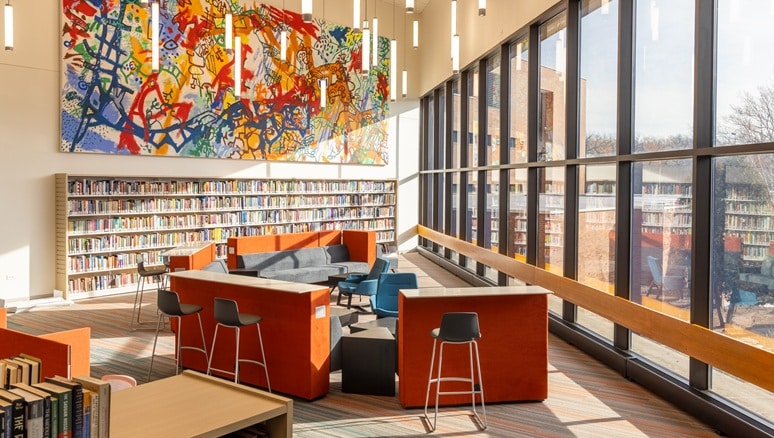
The learning commons arrives after a decade of planning, for a space that had not been updated in 30 years. Bringing services under one roof proved a matter of practicality — students entering the building today will immediately see a circulation desk and signs pointing them toward IT assistance.
Another desk connects directly to a learning center, where visitors can sign up for tutoring or TRIO services. The new library also has dedicated study areas along with an open reading room facing a forest preserve. Jeremiah says his team is excited to serve both students and those visiting from the surrounding community.
“What I love is that we’ve done open houses, but students are finding these spaces on their own,” Jeremiah says. “My dream was making this a place that everyone thought of for whatever they needed. As a community college, we are an open-access institution, but we also want to ensure that we remove any unnecessary barriers to success. The sort of runaround students would encounter before we had a unified service point could be considered such a barrier.”