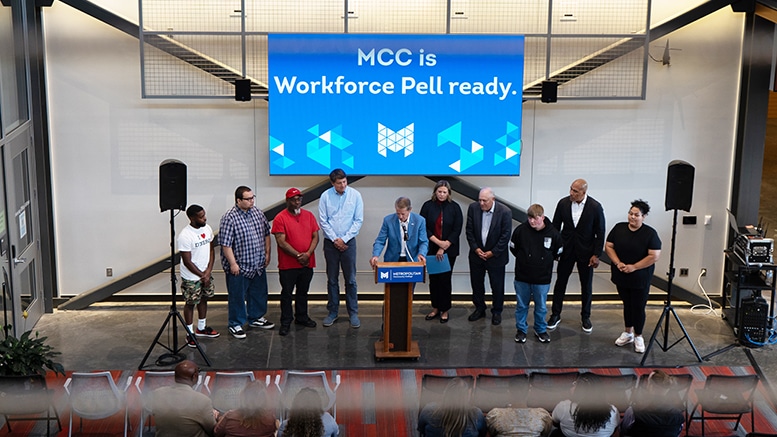
Nebraska Gov. Jim Pillen visited Metropolitan Community College (MCC) last month to announce four programs the state has approved to participate in the Workforce Pell Grant program, a new federal initiative designed to help students pay for short-term career training in high-demand fields.
But the roots of MCC’s Workforce Pell efforts go back several years, and begin with federal funding during the Covid pandemic.
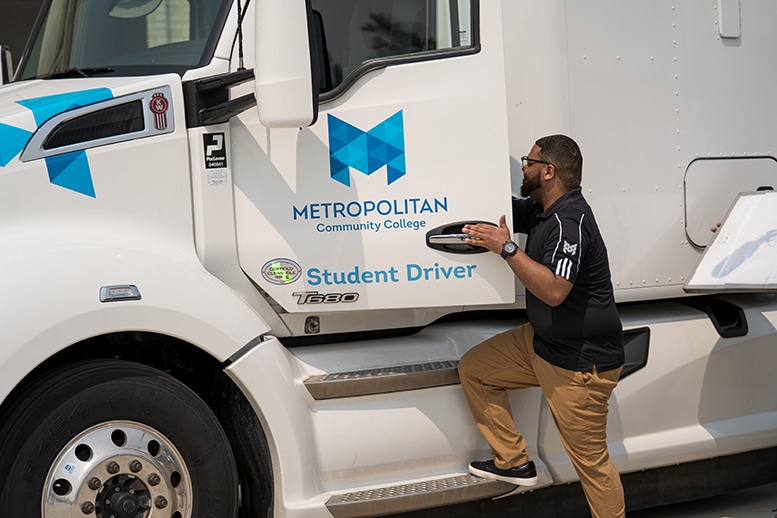
In his announcement of the programs — Class A commercial driver’s license, phlebotomy technician, pharmacy technician and CompTIA Tech+ with Google IT Support — MCC has become one of the first postsecondary institutions in the country to reach this milestone, which now requires a final approval from the U.S. Education Department (ED).
But MCC’s journey to this point didn’t start in July 2025, when Congress finally passed legislation to create Workforce Pell, a goal sought by community college and workforce development advocates for about a decade. Its seeding started in 2021, when states began to receive funding through the federal American Rescue Plan Act (ARPA), which provided funding to help schools cover pandemic-related costs and activities. ED required that colleges disburse at least half of the funds as emergency student financial aid grants and allowed institutions to use the remainder to cover other expenses resulting from the pandemic, such as safely operating campuses and avoiding layoffs.
MCC tapped $9 million through ARPA to create Career Forward, a large-scale workforce training initiative designed to accelerate access to short-term, high-demand credentials. The initiative also created pathways into credit-bearing programs and degrees. Another key element of the program was providing student supports, such as payments to cover emergencies (like repairing a flat tire), paying students $16 an hour for instruction seat-time and providing dedicated career coaches to follow learners through the process to completion and job attainment.
Over the course of the federal funding, which has expired, MCC has served more than 1,800 learners, with completion and job placement rates above 70%. Plus the college saw the average self-reported wage of participants increase from $17.39 an hour to $23.36 after completion.
With that information in hand, MCC officials knew they had something special with Career Forward.
“We knew that this was a prototype for the eventuality of Workforce Pell five years ago,” said Gary Girard, vice president for community and workforce education at MCC.
Building path, razing barriers
So how did Metropolitan connect the dots? It started with an overall plan to create a non-credit-to-credit path. Like other community colleges, MCC had for years mulled how to start such a continuum, said Nathan Barry, MCC’s vice president for strategic operations and initiatives. The prospect of Workforce Pell prompted the college to take a closer look.
“This really did catapult us to say ‘How can we figure this out?'” Barry said, noting MCC brought together its structural designers and placed them into one system as a team.
Career Forward is run as a system, not a program, Girard noted. It includes short-term and degree programs in areas such as automotive, healthcare, advanced manufacturing, IT and more. For students who complete a short-term program, there is a path to a job, to continue into other courses and even into a degree path, he said.
MCC also focused on tackling some of the main barriers for students. For example, many of the students MCC targeted could not afford to step away from work to take classes. So the college created a Workforce Support Grant that provided $16 an hour for students’ classroom time to help offset lost income when they weren’t working.
“That was the single most important thing to make sure that students were equalized so they could stay in the program,” Girard said.
‘That one trusted individual’
Another key cog in MCC’s model is the career coach, who follows learners through completion and is the conduit to a job. The college has eight to 10 career coaches who support the students, from advising on credential stacking, to helping them persist, to job placement and transition.
“All these students need that one trusted individual, and the career coach is that one person in the entire program that is there. So when they have a flat tire, the career coach is the one who says ‘Let me see what I can do to help,'” Barry said.
Girard added that the coaches are part of the process, which starts with a strong onboarding program and then flows into the skills-building model.
Connecting with businesses, learners
Another important part of the plan is partnerships with businesses. Participating companies not only provide earn-and-learn opportunities — internship wages commonly exceeded $26 an hour for IT and advanced manufacturing — but they also guaranteed learners jobs when they complete their credential.
“That is really big to gain momentum, to get those handful of industry partners that are walking hand-in-hand with you,” Barry said.
MCC also had a plan to find the learners who would benefit from the system. That included connecting with employers and local organizations — such as a housing authority — that could refer individuals. The college also linked with local school districts, said Barry, who noted that 35% of Nebraska’s high school seniors have no plans after graduation. MCC created a “Credential College,” which is the Career Forward model for high school graduates. It took its career coaches and navigators into those high schools and talked to teachers and counselors to ID students with no post-graduation plans to let them see the opportunities through a short-term training program that leads to a job.
Barry thinks the Credential College model is one community colleges can focus on, knowing high schools know which students don’t have a post-high school plan or the resources to attend college.
“The community college is that conduit to industry, to help that student even before they graduate, to kind of have a vision of where they want to go. If it’s not the community college, then who?” he said.
MCC is now broadening the model to serve individuals in the juvenile justice system and students with disabilities.
Braided funding
Another key element to Career Forward is its braided funding. The college didn’t just rely on ARPA funding for its initiative — and it won’t just rely on Workforce Pell. It weaves together funding from Workforce Innovation and Opportunity Act programs, the Supplemental Nutrition Assistance Program, Nebraska’s Community College Gap Assistance Program (which serves students in credit or non-credit programs who are not eligible for Pell grants), employer-paid tuition and internships, and more.
“Workforce Pell is not going to be enough in itself,” said Girard, noting the college’s efforts to find new funding streams will continue.