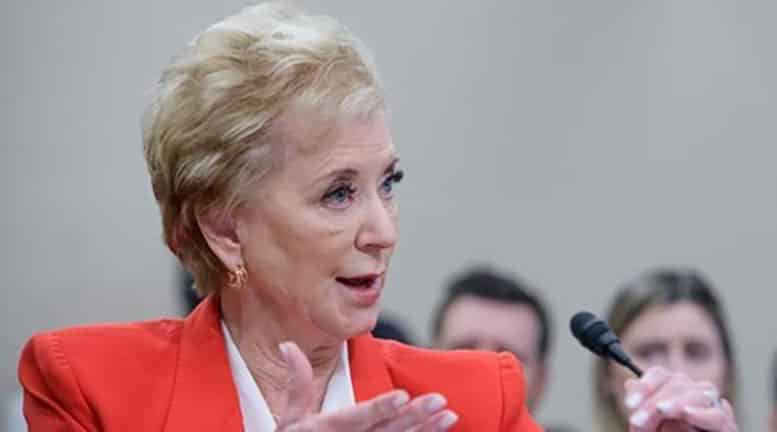
Education Secretary Linda McMahon on Monday sent a “National Call to Action” to all college and university presidents to respond to what she termed was a “drift from the principles that built up so much public esteem” in higher education.
McMahon cited criticisms and requested reforms that echoed those in President Donald Trump’s proposed “Compact” unveiled last year. The compact was sent to only a handful of elite institutions.
In Monday’s communication, McMahon called on all postsecondary institutions by year’s end to publicly describe their commitment to “rigorous teaching, pathbreaking research, and national service — commitments that make our universities a bedrock institution of the American republic.”
She added that “these statements of principle” should be posted prominently on institutional websites.
In response, DeRionne Pollard, president and CEO of the American Association of Community Colleges (AACC), said that community colleges already demonstrate the affordability, transparency and accountability called for by the secretary. She added that many of the criticisms of universities in the communication don’t apply to community colleges.
“We are open access, have affordable tuition and fees, sustain tight connections to business needs and are deeply trusted in our communities. Economic mobility for our graduates is a top priority,” Pollard said.
Confusing message
The intended universe of the Call to Action is confusing. While McMahon’s correspondence was sent to all higher education institutions, much of it is explicitly focused on the activities engaged in by and issues facing elite research institutions, not community colleges or many other types of institutions.
Some items that McMahon is asking colleges to respond to simply are not relevant to community colleges or clearly are not widespread problem areas. These include selective admissions, free speech, ideological diversity and research activity. Other topics, including affordability and post-graduate outcomes, are ongoing priorities for the sector.
Even though community colleges across the country may choose to engage with the administration by highlighting how they are helping to meet the secretary’s goals — and are part of the solution, not part of the problem — community colleges are not required to take any action in response to the administration’s overture. AACC will formally comment on the statement on behalf of the sector, highlighting its fundamental priorities and differentiating itself from the universities and elite institutions that have drawn the administration’s criticism.
Stay focused
Campus leaders should keep in mind that more consequential Trump administration actions are pending, including proposed regulations on Uniform Guidance, as well as a forthcoming accreditation Notice of Proposed Rulemaking.