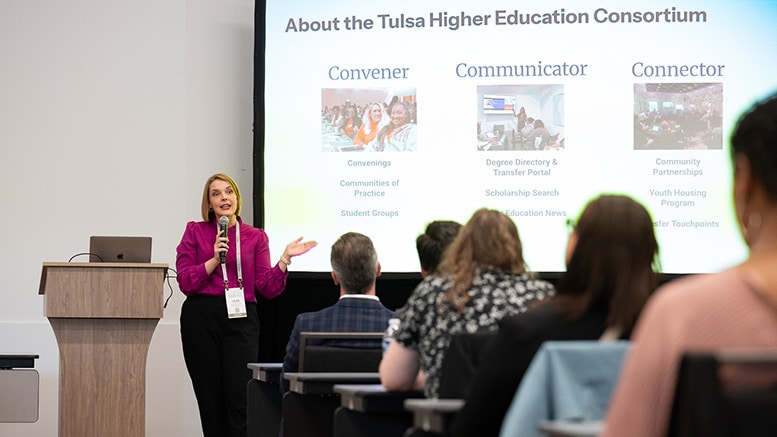
SEATTLE — Nine higher education institutions in Tulsa, Oklahoma, including Tulsa Community College and the College of the Muscogee Nation, have partnered to improve the educational journey for students through the Tulsa Higher Education (THE) Consortium.
Launched in 2021, the consortium has helped to “break silos and open communication” for the institutions, said its executive director, Laura Latta, during a session at the American Association of Community Colleges’ annual convention this month.
The member institutions are joined in the consortium by business partners, city and state officials, foundations and more to improve higher education outcomes.
The big benefits
One big benefit of collaboration is that the institutions can scale initiatives by applying for grant funding together. For example, the consortium secured a federal Housing and Urban Development grant to provide rental assistance, housing navigation and other supports to students at the nine institutions.
Another big benefit: The consortium brings together educators through communities of practice. These communities are not committees or working groups, but groups of people coming together around an area of passion to have conversations and “build capacity, connection and innovative ideas,” Latta said.
Communities include academic advising, student wellbeing, career services, institutional research and transfer. Participants – who meet monthly, bi-monthly or quarterly – are both cross-institutional and cross-departmental.
“Different vantage points add to the conversation,” Latta said.
Focus on transfer
For an example of the work coming out of the communities, look at the transfer-focused community of practice. It’s helping to move the needle on transfer success in Tulsa.
The community includes transfer professionals from the member institutions, working together to develop and improve cross-institutional transfer initiatives as well as transfer student supports.
The transfer community originally started as an admissions and recruitment community. When that didn’t gain the hoped-for traction, the focus shifted to improving transfer – something all the institutions could get behind, according to Brandon Miller, director of university transfer and academic partnerships at Tulsa Community College (TCC).
Transfer pathways have grown a lot in the last decade; there are about 175 articulation agreements among the nine Tulsa institutions. But there is still a need for professional development and new innovations to improve those pathways.
The transfer community has already held a conference and hosts a virtual book club.
Bus trips
But one of the major benefits of having these voices come together is that they help inform Transfer Touchpoints, a collaborative program led by Tulsa Community College and the THE Consortium to help students explore transfer options, connect with universities and prepare for a successful transition.
Transfer Touchpoints was launched with support from a 2024 Tulsa Area United Way grant. Among other things, the program buses TCC students to university campuses to help them become familiar with transfer institutions.
To gauge effectiveness, participating students are given both a pre-trip and post-trip assessment. The post-trip assessments have shown that, just through guided campus visits and networking with admissions and faculty, students have seen their confidence in their transfer plan increase, gained familiarity with the transfer process and their likelihood to transfer increased.
“Talking with folks made transfer process less scary,” Miller said.
The program has so far reached about 130 students, and there are plans to scale it up.
Miller also leads transfer events where students can apply to member institutions and have their application fee waived.
When the consortium launched in 2021, the transfer success rate was 16% in Tulsa. Now it’s close to 19%.
“There’s a true change that’s occurring,” Latta said.