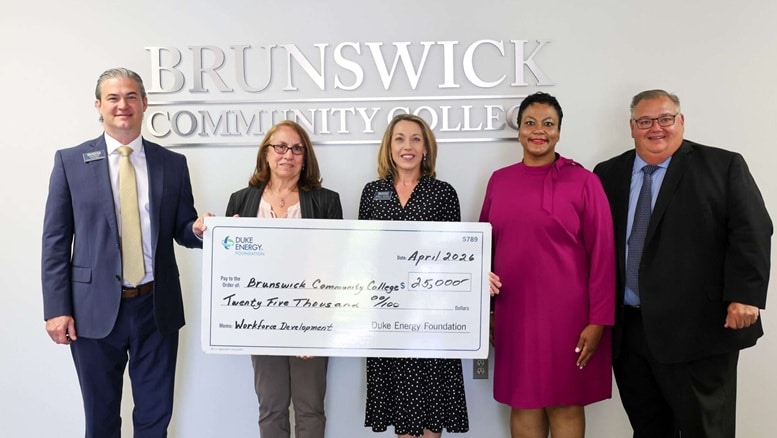
The Duke Energy Foundation is investing $600,000 to strengthen North Carolina’s energy workforce, including $500,000 for 20 North Carolina community colleges and $100,000 for two regional partners expanding access to high-demand training programs aligned with the energy sector.
The colleges will receive $25,000 each to support hands-on training, equipment, scholarships and curriculum enhancements for programs connected to the energy ecosystem – from electrical systems and linework to welding, HVAC, advanced manufacturing and emerging technologies.
One of the grant recipients is Southwestern Community College. The college will buy a mobile electric vehicle lab that instructors can take to area high schools, where students will gain the essential skills of EV maintenance before transitioning to electric vehicle troubleshooting.
Brunswick Community College will use its grant to provide scholarships for students in its electrical technician program, and enhance training with an industrial wiring capstone system, which equips students for careers in the installation, maintenance and repair of electrical systems.
In addition, $50,000 will support The Forward Fund and its zero‑interest loan program for students in skilled trades to cover essential life expenses. It specifically will help students in pipefitting programs at Alamance and Piedmont community colleges.
“This grant will allow us to launch a short-term pipefitting program that will quickly prepare students for high-demand careers while directly supporting the workforce needs of our region,” said Piedmont President Kevin Lee. “It’s a powerful example of how partnerships can create immediate opportunity and long-term economic impact.”
* * *
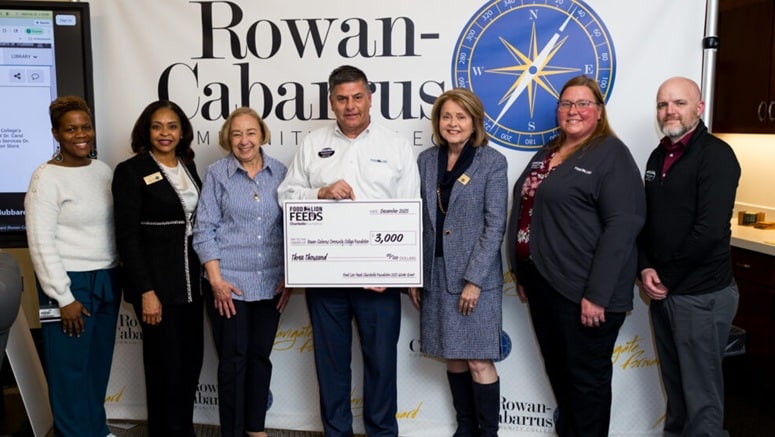
Rowan-Cabarrus Community College has received a $3,000 grant from the Food Lion Feeds Charitable Foundation to provide support for students through the college’s campus markets. The Nourishing Our Neighbors grant supports community-feeding partners by helping increase access to nutritious food and providing nutrition education.
This grant was made possible through the partnership of Rowan-Cabarrus Community College with Second Harvest Food Bank of Metrolina, a hunger-relief organization.
Rowan-Cabarrus operates three Campus Market food and resource pantries through its Student Wellness Center. In fall 2025, the market recorded 349 student visits and distributed 4,136 pounds of food to support students facing food insecurity.
Arizona
Yavapai College has received a $65,000 Recycling Grant Award from the Arizona Department of Environmental Quality (ADEQ). It will use the funds to expand composting infrastructure to divert food waste from landfills, produce compost for the agriculture programs, increase recycling on campus and build community awareness about recycling and composting practices.
The project will improve soil health and reduce the college’s environmental impact in Yavapai County, according to Aimee Novak, Yavapai College’s executive director of culinary experience.
“We are building a replicable model for community colleges across Arizona interested in developing sustainable dining services and circular economy practices,” Novak said. “This project demonstrates what’s possible when education, innovation and environmental stewardship come together, and we are proud to help lead the way toward a more resilient future for our state.”
California
Rep. Maxine Waters (D-California) has secured $2.05 million in federal Community Project Funding for the Compton Community College District (CCCD) that will support facilities improvements at the college, specifically the math and science building and the vocational technology building.
Together, these improvements will address aging infrastructure while enhancing accessibility, sustainability, safety and instructional capacity.
“Modern, safe and accessible facilities are essential to student success, and we are grateful to Congresswoman Waters for her continued advocacy on behalf of the students and communities served by our district,” said Juanita Doplemore, president of the Compton Community College District board of trustees.
Lumina grants
Lumina Foundation announced its 2026 cohort of the Great Admissions Redesign initiative. The foundation is investing more than $3.5 million to simplify the college admissions process and expand student access across the country.
Among the 10 grant recipients are several community colleges and college systems.
The Technical College System of Georgia (TCSG) will receive a planning grant to pilot an AI-driven credit-for-prior-learning platform at three colleges. The platform encourages students to upload their work history, earned credentials, military transcripts and more, allowing adult learners to earn college credit for existing skills, knowledge and competencies.
The effort is designed to make it easier for students to navigate the path to college by creating a more seamless, student-centered experience, according to a TCSG press release.
College of Southern Idaho (CSI) and partners Idaho State University and the College of Eastern Idaho (CEI) also are grant recipients. The three institutions will implement a direct admissions and dual-enrollment system that allows students to apply once at a community college (CSI or CEI) and automatically gain admission to ISU, while also redesigning advising and data-sharing systems to better support student success.
In Florida, Indian River State College, Miami Dade College and St. Petersburg College will work together to design a scalable multi-term enrollment model.
New Hampshire
The Community College System of New Hampshire (CCSNH) and Lakes Region Community College (LRCC) were approved for a $1.2 million Training for Residential Energy Contractors (TREC) grant from the New Hampshire Executive Council.
LRCC will work with company Everblue to coordinate the TREC training. This comes as the state, through a contract with Everblue, is implementing the Home Electrification and Appliance Rebates (HEAR) program.
LRCC will develop specific career training pathways for key positions, such as heat pump and electrification specialists. In addition to college courses, LRCC will work with manufacturers and distributors to provide advanced training pathways for heat pump installers and similar technical positions.
A core TREC offering will be home energy rebates advisor trainings that will enable contractors to integrate HEAR rebates with their energy, HVAC or electrical work.
“The TREC program will also support participants and their employers with business and soft skills trainings,” explained Andy Duncan, LRCC energy training coordinator.
Tennessee
Chattanooga State and Roane State community colleges have received state grants to expand nuclear education and workforce training programs across the state. The funding comes from the Tennessee Higher Education Commission (THEC).
Chattanooga State has received $150,000 and Roane State has received nearly $250,000 to purchase training equipment.
“These investments will help ensure Tennessee continues to lead in building a highly skilled workforce ready to meet the demands of the nuclear energy sector,” said THEC Executive Director Steven Gentile.
South Dakota
Gov. Larry Rhoden announced this month the addition of a new gunsmithing curriculum at Western Dakota Technical College. Rhoden is awarding $4 million from the state’s Future Fund to the college to support the purchase of equipment and related assets and ultimately acquire an accredited gunsmithing school in Colorado.
“This new gunsmithing program will support our growing firearms industry and attract even more guns and ammunition manufacturers to South Dakota,” Rhoden said during a press conference at the college.
The program will expand hands-on training and help meet workforce needs across South Dakota’s defense and firearms industries. Graduates of Western Dakota’s current program find careers with law enforcement, military agencies and firearm manufacturers.
The college is expected to accept its first class into the program in fall 2027.