

Reporting for a new Education Department data survey will be limited to institutions that “primarily” award bachelor’s degrees or higher, exempting all community colleges, including those that are mainly associate-degree institutions but offer limited baccalaureate programs.
The U.S. Education (ED) last month announced that the White House Office of Management and Budget approved the final 2026-27 Integrated Postsecondary Education Data System (IPEDS) elements, including the Admissions and Consumer Transparency Supplement (ACTS). The new ACTS survey will require covered institutions to report a massive tranche of new student-level data on admissions and financial aid awarding. The ACTS survey will be added to the 2025-26 IPEDS as part of the winter data collection.
In October, based on feedback from the American Association of Community Colleges (AACC) and member colleges, ED had exempted most two-year colleges from the ACTS survey requirements in the most recent version open to comments. However, community colleges remained concerned that the approximately 190 community colleges that award some bachelor’s degrees could be required to complete the survey based on the definitions used in the proposed 2026-27 IPEDS Glossary.
In comments filed in December, AACC and supporting member colleges urged ED to change the sector classification system used for conferring ACTS eligibility from “highest degree awarded” to “predominant degree awarded,” thereby excluding all community colleges from the massive survey.
ED incorporated this feedback in the final ACTS survey, thereby exempting all AACC-member institutions.
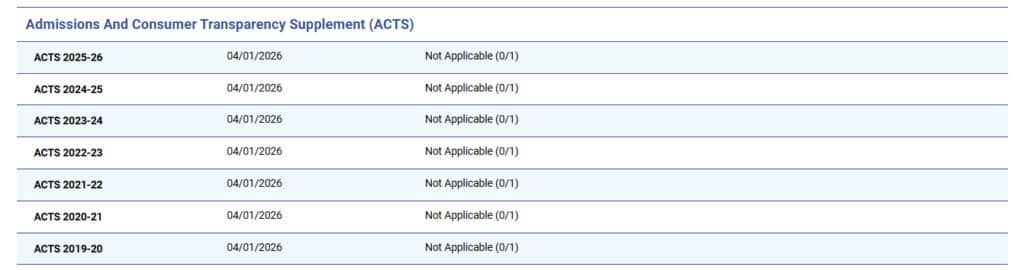
This reporting eligibility determination is made by ED, rather than self-certification by the college. IPEDS keyholders should see “Not Applicable” under each year of the Admissions and Consumer Transparency Supplement section (see screenshot below) and will not be able to access the reporting form for ACTS.
This is a tremendous relief for all the community colleges across the country that won’t face these extremely costly and burdensome requirements. AACC thanks all member colleges that submitted comments for their advocacy on this issue.