
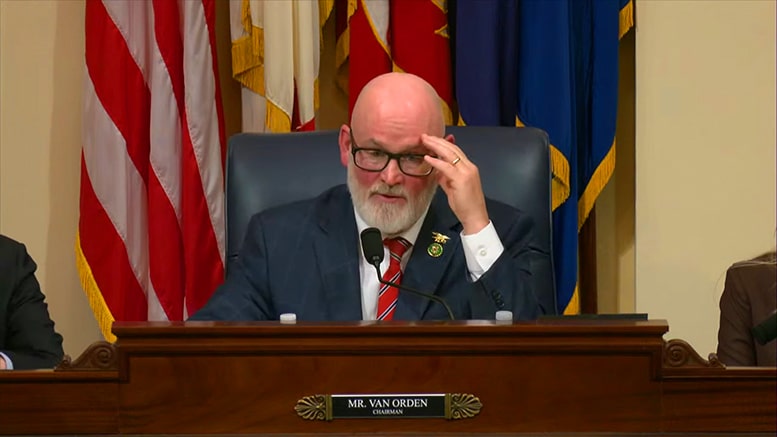
Lawmakers on a House Veterans’ Affairs panel want more service members transitioning out of the military to use their GI benefits toward training for trade careers rather than pursuing four-year degrees.
During an Economic Opportunity Subcommittee hearing Tuesday exploring ways to improve transition services for veterans, members from both sides of the aisle discussed ways to encourage more veterans to consider trade careers, with many industries continuing to face a shortage of skilled workers.
Subcommittee Chair Derrick Van Orden (R-Wisconsin) championed workforce development programs over four-year degrees, particularly registered apprenticeships. He cited Department of Veterans Affairs information that shows the number of veterans using their Post 9/11 GI Bill benefits to pursue on-the-job (OTJ) training or apprenticeships continues to drop. In 2023, there were only 1,008 apprenticeships and 776 OTJ participants, which represents less than 1% of the Post 9/11 GI Bill population.
“The goal is employment, not a piece of paper on a wall,” Van Orden said.
Rep. Morgan McGarvey (D-Kentucky) also supported spotlighting the benefits of trade careers for veterans moving into new careers after the military, noting that fewer than 20% of individuals tapping GI Bill benefits use them for non-degree options.
“Veterans need jobs,” he said. “And we have to make sure that they have what they need to get jobs.”
Officials from the Department of Veterans Affairs (VA) agreed that the agency can do more to inform transitioning veterans about education and training options that better align with their skills, helping them find jobs more quickly. During fiscal year (FY) 2025, nearly 15,300 Post 9/11 GI Bill beneficiaries began training at vocational/technical schools, and 2,219 beneficiaries began an OJT or apprenticeship program, according to Kenneth Smith, executive director of education services at VA. Over the same period, nearly 78,400 individuals began taking undergraduate or graduate degree programs using GI Bill benefits.
Smith also noted that the GI Bill can cover the costs of licenses and certifications required for certain jobs. In FY 2025, more than 3,500 veterans received test reimbursement through the GI Bill, he said.

The subcommittee also heard about promising government/company practices in various industries that are short on skilled workers. The Department of Defense’s SkillBridge program in particular caught the attention of several lawmakers. The program helps active-duty service members gain valuable civilian work experience during their last months of service. Participants work with private and public sector companies, government agencies and non-profits to build resumes, develop job skills and explore career interests, all while continuing to receive military pay and benefits.
David Bostic, a service development manager for Deere & Company — who early in his career attended the John Deere technician training program at Lake Land College (Illinois) — outlined the company’s military hiring program. Since the program started in 2019, John Deere dealers have hired about 800 veterans, including hosting more than 200 SkillBridge interns, which is a cornerstone of the program, he said.
The company’s three key principles for its military hiring program include:
- Be simple to navigate for service members and dealerships.
- Add value for the service member and their potential employer.
- Stay focused on positive outcomes.
Bostic recommended that VA create formal employer advisory councils to help shape transition programs like SkillBridge to ensure alignment with industry needs and emerging career fields. He also encouraged expanding incentives for small and mid-sized employers to participate in programs like SkillBridge.
In addition, Bostic floated the idea of a centralized VA-employer portal to streamline benefits, track outcomes and share best practices across industries. He noted that the current number of programs can overwhelm interested businesses.
“Well-intentioned businesses struggle to navigate a plethora of systems and connect with the right information and resources,” he said.