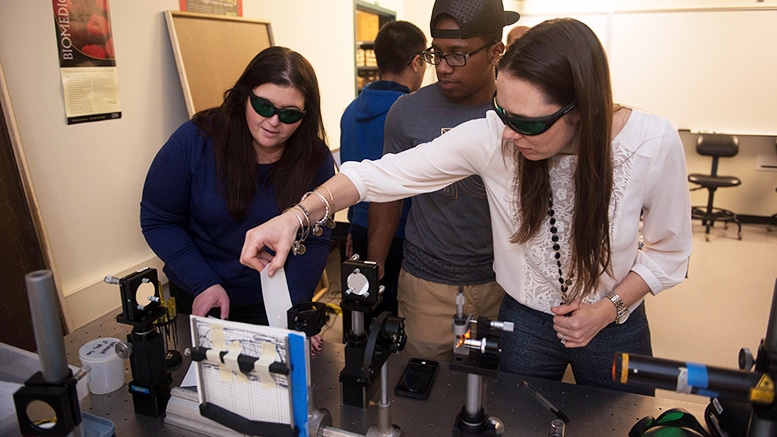
The optical systems technology program at Monroe Community College in Rochester, New York, was founded in the 1960s as the feeder program to train technicians for Kodak, Xerox, Bausch & Lomb and more than 150 other optics firms in the region. But 11 years ago, the program had dwindled to five students, did not have a director, and college leaders were seriously considering shuttering it, given the low enrollment, tranche of expensive equipment to maintain and the significant space the program’s facilities required.
Around that time, Alexis Vogt, who received her Ph.D. from the Institute of Optics at the University of Rochester and had been working in industry, noticed that her company and others were struggling due to a shortage of technicians.
“We didn’t ship product on days when our lead technician was not there, and we couldn’t innovate to the extent that we wanted to be able to because we didn’t have the technical workforce that we needed,” she says. “I connected with other colleagues in the community and asked if they had the same problem. They said, ‘Absolutely. You can’t find technicians anywhere.’”
Vogt learned about the program at Monroe, about a half mile from where she worked, and decided to leave industry to become the college’s new director and solve this recruiting dilemma. In the time since, Monroe’s program has grown to 153 students, 25% female and 37% of color, all of whom find jobs when they graduate — if not before. Vogt also has helped establish cross-sector partnerships as well as optical systems technology programs at other community colleges.
“I’ve also put a strong emphasis on diversifying the student body, to then, ultimately, diversify the industry,” she says. “All of our students get jobs. As I tell everyone, if they show up to class, if they turn in their homework, if they’re a good person, we can guarantee them a job. Because the industry can support more than 550 graduates of our program every single year.”
Monroe President DeAnna Burt-Nanna says the leadership, program faculty, and support of both the institution and industry has helped address the shortage of optics technicians while boosting the Finger Lakes region’s status as the nation’s optics hub.
“The MCC optical systems technology program demonstrates what’s possible when education and industry align around a shared mission — advancing innovation, opportunity and community prosperity,” says Burt-Nanna, who also serves on the board of directors of the American Association of Community Colleges.
Revitalized investments
The program’s successes have begat recent investment. Monroe broke ground on a $69 million Advanced Technology Center in April. The new 110,000-square-foot facility, set to open next fall, will provide facilities for optical systems technology and several other programs, thanks to $34 million each from Monroe County and the state. A related $3 million investment in the optics program from Sydor Optics, a family-owned company with two generations of Monroe alumni and a long history of contributions to the college, led to the facility being named the Sydor Optics Advanced Technology Center.
In addition, Monroe has received an endowed gift of $1 million for the Barbara and John H. Bruning Optical Systems Technology Endowed Directorship, to support the post currently held by Vogt; and another $150,000 from SPIE, the international optics and photonics society, to name a new SPIE Optical Systems Lab within the under-construction facility.
“This philanthropy has not only improved MCC’s facilities but also encouraged a sense of shared ownership between the industry and the college,” Burt-Nanna says. “This is workforce development at its very best: inclusive, industry-driven and globally impactful.”
Adds Vogt, “This highlights that the industry has been supporting me and behind me along this entire journey because they desperately need to have our students.”
Fostering partnerships
Partnerships have been key to the effort all along, from a variety of stakeholders that go beyond industry, Vogt says. Among those partners are the 23 area high schools that have offered the program’s “Introduction to Optics” course as a dual-enrollment class, which has created “a pipeline to build up relationships and connections,” she says.
Monroe also has forged a partnership with Corning Community College, 90 miles to the south, for its students to take classroom portions there, and then travel to Monroe for hands-on classes using the equipment, Vogt says.
In conjunction with Optimax Systems, a Rochester-based company with about 500 employees, Monroe has created the first-ever optics apprenticeship, available to those from other states and beyond, who participate in the college’s classes over Zoom, then travel to campus at the end of the semester to do the hands-on component.
“They’re not required to drive to campus twice a week over the 15-week schedule, which doesn’t work if you live in Arkansas, for example,” she says. “It’s enabled us to reach students all over the world. I’ve had a student who was in my Introduction to Optics class from the U.S. Naval Base in Bahrain.”
Challenges and solutions
Funding has and continues to be a challenge for the program, which costs more than $1 million per year to operate, Vogt says. A three-year, $5.3 million grant from the U.S. Office of Naval Research is the most significant line item, while other government funds have come from the National Science Foundation. In addition to Sydor Optics, private supporters have included the Corning Foundation and Optimax, which “has been a huge supplier of adjuncts for us, to help us keep the program going,” she says.
The Naval Research grant ends in September 2026, though, “and so the question, of course, is, well, what happens on October 1?” Vogt adds. “And that’s why I lose sleep these days, is trying to figure that out.”
Another challenge has been educating people about what optics entails beyond making eyeglasses, Vogt says.
“That’s a portion of optics,” she says. “But we’re talking about the high-end technology that’s making lenses that are going to go into Mars, and all over through space, and in the backup camera in your car, and semiconductor chips … in our smartphones and our smart watches.”
A final challenge is supporting the workforce needs of all companies in this growing field, which extends far beyond the optics companies in Rochester.
“The world’s largest imaging companies are all coming to recruit from my program, too,” she says. “Amazon, Meta, Microsoft — they’ve all traveled to tour our labs here in Rochester because they need our students to graduate, as well. So a challenge has certainly been, how do you share that information out into the community, to recruit students?”
Student pathways
Vogt doesn’t necessarily recruit the types of students one might expect.
“I’m recruiting students who are artists, musicians, gamers, chefs, mechanics and athletes,” she says. “These are the people who have tremendous hand-eye coordination and dexterity, and so they come into our program, and then we just teach them the optics part. … People who like to fix, and tinker with their cars and build Legos and make excellent, excellent optics technicians.”
Vogt makes a pitch to high school students that they can use their gaming skill-set, train for a short period of time, and they’re guaranteed not only a first job, but a career “with incredible longevity,” she says. “And we’re fortunate to have some truly tremendous employers within this industry, and specifically in Rochester.”
Another key to recruiting students has been offering a variety of credential options, ranging from 40-hour training workshops for those already in industry to learn a specific skill like diamond-turning, to three-course micro-credentials, to one-year certificate programs, to the standard two-year associate degree, Vogt says. For the latter, Monroe has 2+2 articulation agreements with the University of Rochester, Rochester Institute of Technology and University of Arizona.
Sometimes, students get job offers shortly after they walk in the door, including three this semester who had employment offers within the first two weeks of classes, after arriving straight from high school, Vogt says. Some complete the program anyway, sometimes part-time, but some just leave.
“But very frankly, among friends, that’s a win for me because I’m helping fill a void within industry,” she says. “Even if they have not completed the program, they set forth to complete.”
The dilemma for students is not whether they will find a job, but what type of job they want, and where — in Rochester, elsewhere in the U.S., or beyond, Vogt says. During a recent optical manufacturing industry conference in Rochester, 172 companies attended from 22 different countries, and she organized a student day during which more than 350 high school and college students walked the floor and met vendors.
“They have the same shortage we do, of technicians,” she says. “They asked me, ‘Would your students leave the United States to go work?’ And for the record, the answer is, yes, they would love to move to France, or move to Germany. So the opportunities for students who come into our program are absolutely tremendous.”
The same week as that conference, MIT Lincoln Laboratory came to campus to recruit for its paid summer internship program; several Monroe students have done that in the past, and one alum works full-time for the organization, Vogt says.
“The idea of going from Monroe Community College to a full-time job at MIT Lincoln Labs — that’s a pretty remarkable jump,” she says.
Advice to other colleges
Vogt’s top piece of advice for other colleges interested in starting an optical technology program — or any type of workforce development track — is to stay closely connected with industry.
“Industry provides advice on courses that need to be taught, on equipment that needs to be purchased,” she says. “Industry can provide all of the adjuncts to help teach.”
Industry also provides members of her advisory board who have the intellect and know-how to ensure the program continues to remain relevant, Vogt says.
“I can’t teach a student every single thing they’re going to need to know when they get into industry,” she says. “But if I can teach them those basics, I can then make it an easier lift on the side of the company, so that they’re requiring less internal training once they get there.”
Another key for hands-on programs is to keep class sizes small, Vogt says.
“It’s imperative, so that the students can still use the state-of-the-art equipment,” she says. “We have over $10 million worth of advanced manufacturing equipment.”
For a handful of colleges, Vogt has gone beyond simply offering advice. Wearing her other hat as the executive director of workforce and higher education at the American Center for Optics Manufacturing (AmeriCOM), she has been exporting the idea to other community colleges. To date, programs have begun in Valencia College (Florida), Sussex County Community College (New Jersey), Keene State College (New Hampshire) and Front Range Community College (Colorado).
“Because simply, there’s such a demand that we can’t, alone, here at Monroe Community College, support what the industry needs,” she says. “So now we’re working and looking to explore more creative methods to do that.”
During the recent tour of Optimax, Vogt talked with the former student who is now a department head there.
“He tried college a couple of times, and nothing really seemed to work out as well, and he came into my program,” she says. “Fast-forward, he’s married, with an adorable three-year-old daughter, and he owns a house. … So this is evidence that you find the right career, it can really be what changes your life and improves it so much.”