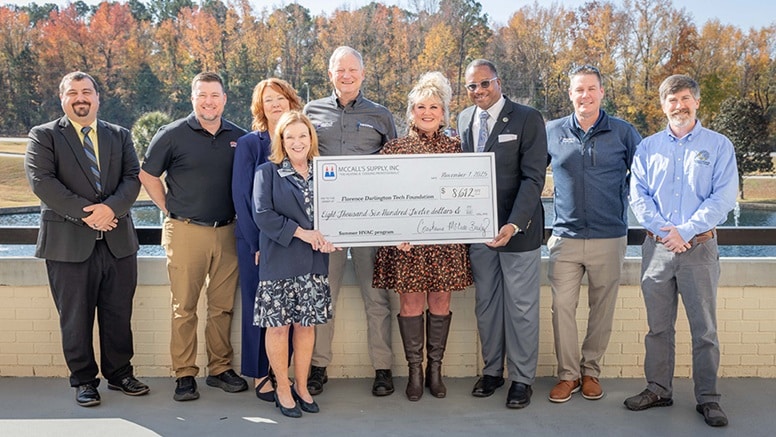
Florence-Darlington Technical College (FDTC) has received an $8,762 donation from McCall’s Supply, Inc., a local HVAC distributor, that will go toward scholarships for students enrolled in the South Carolina college’s HVAC program during the summer semester.
McCall’s Supply identified a growing technician shortage as a pressing issue for its dealer network and the HVAC industry as a whole.
“We consider our dealers family, too. When they struggle, we struggle,” said Raymond Rollins, marketing director for McCall’s Supply. “The biggest hurdle they face right now is finding qualified technicians.”
The funds for the donation were raised through McCall’s inaugural charity golf tournament.
Georgia
In 2024, the U.S. Department of Labor (DOL) awarded the Technical College System of Georgia (TCSG) an $800,000 grant to help dislocated workers in communities affected by Hurricane Debby. Now, DOL is awarding TCSG an additional $700,000 in grant funding to continue its work.
This Disaster Recovery National Dislocated Worker Grant allows TCSG to provide residents with temporary jobs focused on cleanup and recovery efforts, as well as offer employment and training services to eligible participants in the affected communities.
Idaho
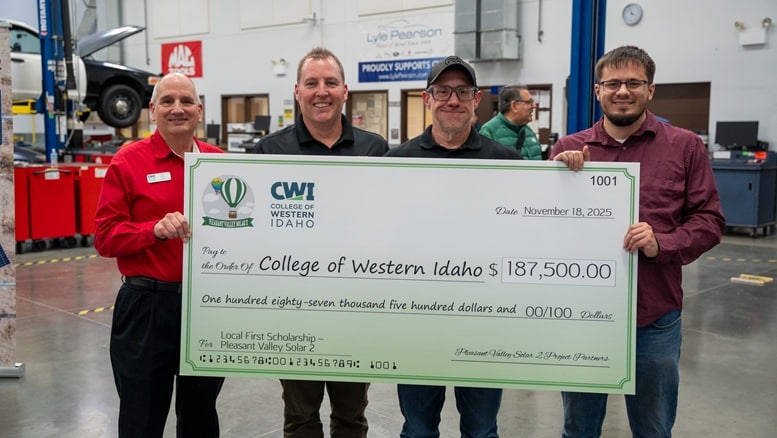
A $187,500 commitment from Pleasant Valley Solar 2 project partners will fund a new workforce development scholarship at College of Western Idaho (CWI).
The Local First – Pleasant Valley Solar 2 Scholarship is open to students pursuing education through a variety of certificates or degrees that lead to employment. The gift continues the momentum of initiatives established during the Pleasant Valley Solar 1 project, which raised $61,500 in 2024 for CWI scholarships.
Johnson Controls grants
The Johnson Controls Community College Partnership Program aims to donate up to $15 million to community colleges by the end of 2026 with a goal of expanding access to high-demand technical fields.
Several community colleges recently announced receiving funding through the program. Among them is Georgia Piedmont Technical College (GPTC), which has received a $100,000. The college has previously received a total of $390,000 over the last several years through the program.
“This investment underscores the importance of innovation and sustainability in technical education, and together we are ensuring our students gain the skills to excel in high-demand careers while strengthening the communities we serve,” GPTC President Tavarez Holston said.
A portion of the renewed funding will provide direct scholarships for students pursuing degrees, diplomas and technical certificates in high-demand fields, such as building automation systems, commercial refrigeration, air conditioning technology, welding and joining technology, and sustainable technologies. Additional funding provides faculty support, retention efforts and software and lab enhancements.
HACC, Central Pennsylvania’s Community College, also received a $100,000 grant for the third year. Half of the funds will support scholarships for tuition and fees, while additional investments will go toward emergency assistance funds for transportation and food insecurity, expand lab equipment in HVAC and welding, and boost recruitment and engagement efforts.
In Texas, Lone Star College’s $100,000 grant adds to the $400,000 already received from Johnson Controls in support of the college’s HVACR and electrical technology programs. Some of the funds benefit mentoring services for students.
Maryland
Howard Community College (HCC) is using a $2.2 million federal grant to develop the Howard Hub for Student Success, a comprehensive, integrated approach to student support services.
The five-year Strengthening Institutions Program grant from the U.S. Education Department (ED) will enable HCC to create a “one front door” model that will streamline access to academic advising, financial aid, career services and other critical student support resources. The hub aims to improve student retention, completion rates and overall success by reducing barriers to services and creating a cohesive student experience.
The grant also supports professional development for faculty and staff to serve diverse student populations better and enhance evaluation systems to measure student outcomes and drive continuous improvement.
ED officials expect the five-year funding to yield scalable service models that can be adapted by other institutions nationwide.
Mine safety grants
The U.S. Department of Labor Mine Safety and Health Administration has awarded more than $10.5 million in grants to reduce mining accidents, injuries and illnesses, including federally mandated training and re-training for miners.
A handful of community colleges are among the recipients, including Alabama’s Bevill State Community College ($244,134), Louisiana’s Northshore Technical Community College ($118,418), South Carolina’s Tri-County Technical College ($111,787) and Wisconsin’s Northcentral Technical College ($361,650).
“This grant helps us provide the critical training and education that keeps Wisconsin’s miners safe, ensuring they return home to their families each day,” said Brad Gast, dean of workforce training at Northcentral Technical College.
Minnesota
Minneapolis College is closer to alleviating food insecurity thanks to a nearly $42,000 Hunger Free Campus Grant from the Minnesota Office of Higher Education.
The grant stipulates that the college will, among other things, maintain an on-campus food pantry or partnership with a local food bank to provide regular, on-campus food distributions. It also will provide information to students on the Supplemental Nutrition Assistance Program (SNAP), the Minnesota Family Investment Program and other programs that reduce food insecurity.
“Many Minneapolis College students experience challenges meeting their basic needs, such as food insecurity, transportation barriers and homelessness. Access to food and essential resources helps them remain in school,” Kyle Sarpong, student activities coordinator for leadership and campus community development, said in a release.
Mississippi
Coahoma Community College (CCC) has received a $40,000 grant from the HBCU Brilliance Initiative to support infrastructure improvements and strategic development projects on campus.
The HBCU Brilliance Initiative was launched earlier this year by the Reinvestment Fund, a community development financial institution. The initiative aims to strengthen the financial health and sustainability of historically black colleges and universities.
North Carolina
A $3.6 million grant from GoldenLEAF will fuel a strategic partnership between Johnston Community College (JCC) and Vulcan Elements, a manufacturer of rare‐earth magnets.
Vulcan Elements recently announced its intent to build a large‐scale manufacturing facility in Benson. JCC will play a pivotal role by training new employees for Vulcan Elements at its new advanced manufacturing training facility prior to the plant’s operational launch.
With the grant, JCC can buy equipment and develop customized hands‐on training programs tailored to Vulcan’s manufacturing requirements. The training infrastructure also will serve regional industry over the long term, enhancing the local workforce pipeline.
“By embedding this training capability at JCC, we’re investing in a sustainable workforce infrastructure that will serve many employers in the years ahead,” JCC President Vern L. Lindquist said in a release.
JCC will begin “train-the‐trainer” instruction next summer, and ongoing production‐employee training will run from August 2026 through at least December 2030.
Texas
Victoria College has received a $15,000 grant from Blue Cross and Blue Shield of Texas through the VC Foundation to fund technology and furniture for the college’s pantry and counseling center as these services move into larger spaces in a new student success center.
The facility will open in January. Planned enhancements include a student check-in kiosk, networking and wiring upgrades, safety devices, relaxation seating areas, product and resource shelving, professional-grade refrigerators for perishable food and staff workstations for meetings with students and community partners.