
The U.S. National Science Foundation (NSF) has been a champion of STEM technician education at community college for 75 years, navigating generations of students to sustainable career opportunities.
That progress is now jeopardized by extensive federal budget cuts proposed by the Trump administration, which call for a 56% reduction in the $9 billion NSF budget.
Community colleges currently are weighing the potential downstream impact of these cutbacks, with the Advanced Technological Education (ATE) program among the initiatives at risk. ATE supports job training in high-tech fields, developing talent for roles that demand more than a high school diploma, but not always a four-year degree.
This article comes from the current issue of the Community College Journal, published by the American Association of Community Colleges since 1930.
The core mission of the ATE program is closely aligned with the goals of two-year colleges working to address the growing skilled labor shortage across U.S. industries. By supporting training in high-demand technical fields, the program plays a key role in expanding middle-class job opportunities in communities nationwide. As workforce needs evolve, many community colleges are positioning upskilling and reskilling at the center of their long-term strategies.
Losing NSF funding will make it difficult to keep that momentum going.
Recent data indicate that the U.S. STEM workforce continues to grow. The National Science Board reports that more than half of the nation’s 37 million STEM workers derive from skilled backgrounds, supporting high-powered industries such as aerospace and advanced manufacturing.
With robust federal investment in tow, community and technical colleges are helping build the nation’s specialized workforce – with NSF’s ATE program being a landmark effort for supplying talent to a host of emerging industries.
Since its 1992 inception, the program has invested more than $1.5 billion for training in automotive tech, cybersecurity innovation, biotechnology, advanced manufacturing and more. Artificial intelligence is another promising sector that would lose talent from NSF cutbacks, particularly as there is no true alternative to this critical resource. Philanthropic endowments and state funds won’t replace the loss of a fund often seen as a “seal of approval” necessary to attract other investors, says Shalin Jyotishi, founder and managing director of New America’s Future of Work and Innovation Economy Initiative.
In the past year alone, NSF tabbed industry giants such as Intel, Micron and GlobalFoundries for co-investments on STEM workforce education. Any major budget shortfalls will hamstring vital relationships with community colleges, if not eliminate them entirely.
“Employers should be hooting and hollering, because they’ll be losing out on talent,” Jyotishi says. “They will have fewer resources to bring on a quality technical workforce, whether they’re a small- to medium-sized manufacturer looking to upskill around AI, or working in (Trump) administration priorities around biotech or quantum technology.”
A major impact
NSF plays a critical role in supporting community colleges as engines of innovation, particularly in regions advancing high-tech fields such as Forsyth Technical Community College’s work in North Carolina’s Piedmont Triad. The region is known for its pioneering efforts in regenerative medicine, a leading field focused on new technologies to heal tissues and organs damaged by injury or disease.
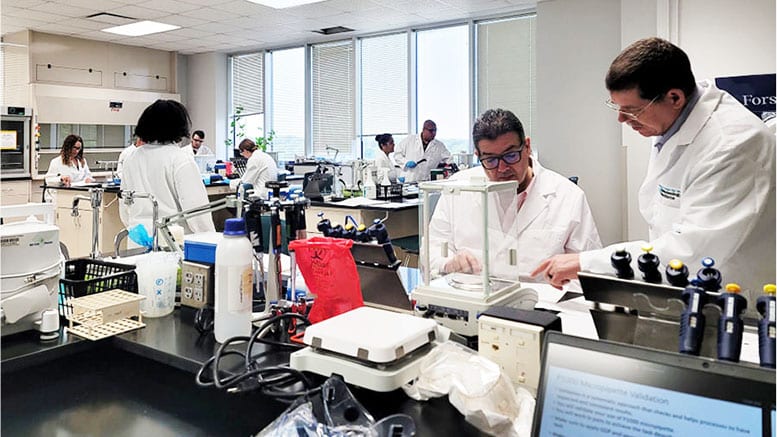
At institutions like Forsyth Tech, NSF funding helps drive workforce development and cutting-edge research, aligning education with emerging industry needs and regional economic growth. The NSF-funded National Center for the Biotechnology Workforce at Forsyth Tech spearheads this work, establishing what Forsyth Tech President Janet Spriggs describes as “a pathway out of poverty” for the region’s underserved communities. The center also provides a pipeline of skilled employees for industry partners like ProKidney, which produces cell therapy products to restore damaged tissue.
Thriving within North Carolina’s economic and workforce development ecosystem comes at a cost. To that end, Forsyth Tech received a $535,297 grant from NSF’s ATE program to help build its new biotech education center. Leveraging the success and strong impact of their ATE grant, the college procured additional funding through NSF’s Regional Innovation Engine award.
Although NSF grants made the center’s existence possible, the agency does more than just support programming and physical spaces, Spriggs notes. With these resources, Forsyth Tech has purchased costly equipment essential for powering North Carolina’s bioeconomy – a high-tech catalog encompassing scanning electron microscopes, bioprinters for organ transplants and a mass spectrometer.
“Students are using this equipment to get hands-on, real-world experience,” Spriggs says. “These are the machines they will be using on the job, so it’s important not to be working on outdated equipment.”
For institutions including Forsyth Tech, NSF support is often a prerequisite for other impactful investment opportunities. The agency’s rigorous oversight gives other potential partners – from hospital systems to local governments – the confidence to collaborate with the college, Spriggs says.
“We use NSF funding strategically – it’s more seed funding to help us launch new ideas and transition into more sustainable business models,” she says. “Without an ability to have that launch, many of these programs would not be possible. We simply don’t have that money in our state appropriation.”
‘Foundational and specific’ funding
The NSF launched the ATE program in 1992, in the wake of the Scientific and Advanced Technology Act passed by Congress that same year. The first ATE grants were awarded in 1994, emphasizing connections among two-year colleges and middle and high schools, industry partners and economic development agencies.
“Many community colleges on the front lines of workforce development rely on grant support through NSF ATE – without these capacity-building investments, STEM innovation at many institutions would be out of reach,” says Ellen Hause, associate vice president of academic and student affairs at the American Association of Community Colleges.
ATE grant funding enables community colleges to expand innovation and respond to changing industry needs. Its distinct focus on the skilled technical workforce, emerging technologies and strong industry partnerships – combined with a supportive community of practice – sets it apart, Hause says.
Nationally competitive NSF grants bring credibility to schools like Forsyth Tech, creating a cascade effect of premium instruction and, ideally, a direct line to employment at a regional business, government institution, or even the college itself, says Forsyth Tech’s Spriggs.
Learners bolstered by NSF-backed programming have gone on to governmental cybersecurity roles or have been hired by Forsyth Tech to safeguard campus from potential hackers.
Losing even a portion of NSF funding would irreparably damage North Carolina’s STEM technology workforce in its preparation for in-demand jobs. Though Forsyth Tech remains resilient and diversified with its funding, the money deriving from NSF is irreplaceable, Spriggs says.
“This funding is foundational and specific,” she says. “Without it we would not be able to have as many industry-related programs. And we wouldn’t have access to the equipment we’ve bought. Our entire state equipment budget is $1.6 million, and one machine could cost $1 million.”