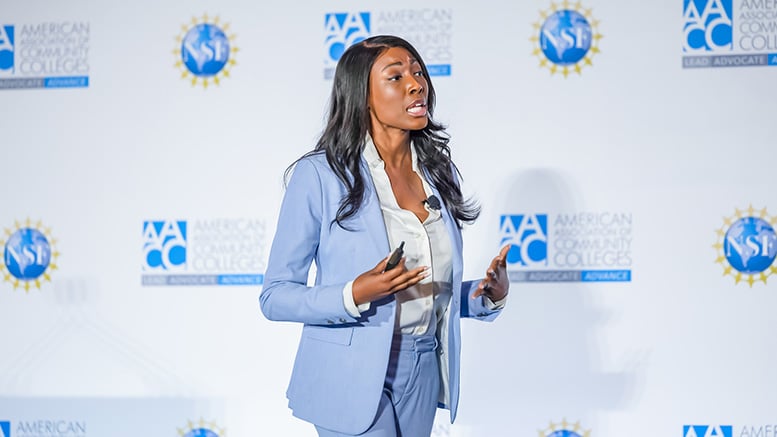
“Impossible is only a suggestion,” Aisha Bowe said after sharing the trajectory of her career from pre-algebra at Washtenaw Community College to becoming an aerospace engineer at NASA, an entrepreneur and then a civilian astronaut-payload operator of botany experiments as part of the all-female crew of Blue Origin’s New Shepard NS-31 mission in 2025.
Of her community college experience, Bowe said, “I will tell you that is where my life began because when I set foot in that community college, I didn’t hear that I can’t. I heard that I can and I will.”
Prior to enrolling at the Ann Arbor, Michigan college, Bowe said, many adults — except her parents — had low expectations for her because of her parents had low-wage jobs. Talking with “students from all walks of life” at Washtenaw prompted her “to let go of other people’s limitations on my dreams.”
The 750 people attending the 2026 Advanced Technological Education (ATE) Principal Investigators’ Conference on Wednesday in Washington, D.C., responded to Bowe’s story of overcoming poverty and discouragement with a standing ovation.
The American Association of Community Colleges convenes the annual conference for the leaders of Advanced Technological Education (ATE) projects and centers with the support of the U.S. National Science Foundation (NSF). During the conference, the teams that have received ATE grants from NSF share what they have learned while developing innovations that strengthen the skilled technical workforce. Two-year college educators have leadership roles in most ATE-funded initiatives, which also work in collaboration with industry, other education sectors, and other workforce stakeholders.
Setting goals
From a young age, Bowe said, “I felt like I was being judged because I was poor, and so I started not to try.” When a high school guidance counselor told Bowe that she was not likely to succeed at a university, Bowe got mad and then she got busy.
She wrote down three goals and then worked at them for years. They were, “Wake up every single morning, look in the mirror and feel proud. I wanted to graduate from a school that I felt not only challenged me, but that I would forever be proud to say the name … and have a very cool job.” In recent years, she added being a civilian astronaut to her goals.
Immediately after high school, her goal was to succeed at Washtenaw.
“In every step of the way, Washtenaw nurtured me, supported me, and quite frankly, they created a monster because I had teachers who were invested, who cared, who called me after class, who were not trying to weed me out. And once I got an ‘A’ in Calc One, I got ‘A’ in Calc Two, I got an ‘A’ in Calc Three.
“And my teacher said to me, ‘I think not only could you really do this, I think you’d be good at it, and I’m going to be here every step of the way.’”
A new aspiration
Bowe transferred to the University of Michigan, where she earned a bachelor’s degree in aerospace engineering and a master’s degree in space systems engineering. She worked at NASA’s Ames Research Center in California for nearly seven years before pursuing another ambitious goal.
“I really wanted to go out and inspire the world because up until that point, most of my career was about proving other people wrong. But proving people wrong is a small ambition. What’s better is showing people what their world could be like if they chose to believe in themselves,” she said.
Bowe founded STEMBoard, a tech company that supports U.S. national security programs, and created LINGO, a hands-on kit that teens can use to learn coding at their pace. She applied to be part of a Blue Origin crew and prepared for three years — including lining up experiments to do in space — without knowing if she would be selected.
The message Bowe shared with students during a live stream from space is one that she continues to share from podiums across the globe: “If I can get this far, what can someone else do? … If I can end up in the same place as some of the richest, most well researched people in the world, then our choices, our decisions, who we are, and where we come from matter, and we are more powerful than we can know.”
At the ATE conference, her slide deck included a giant photo of her associate degree.
“The only thing that was left for me to do after I went to space was to finally graduate from Washtenaw Community College,” she said, explaining the college did not offer the two-year associate in science degree when she transferred.
Encouraging STEM professional
Olga Pierrakos, lead program director of the ATE program at NSF, praised Bowe’s tenacity, courage and resilience and challenged the ATE community to have “a bold vision for purpose and impact.”
Pierrakos told the conference attendees, “I see resilience in your determination to sustain opportunity. Agility in your response to changing needs, ingenuity in how you use resources.”
She encouraged the ATE principal investigators to become leaders, noting this “means recognizing that the knowledge developed through your project may help solve the challenge beyond your issues. It means being willing to bring that knowledge forward, invite others into the work and take responsibility for helping the partnership succeed. So leading is broadening the recent impact. It also means looking beyond the boundaries of your own awards.”
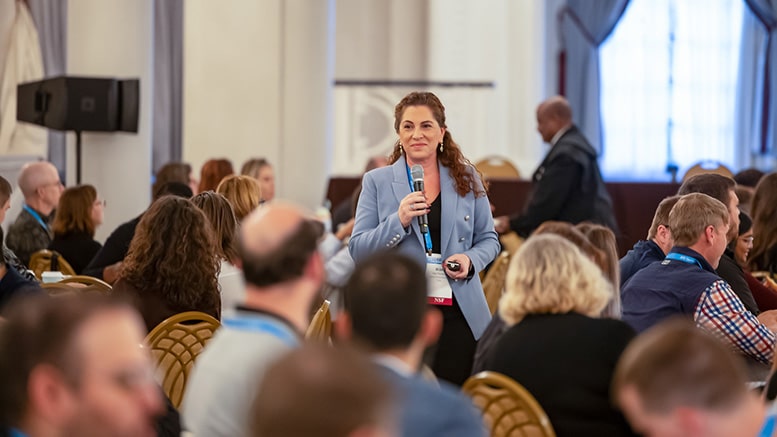
Two other National Science Foundation leaders praised the ATE program during the opening plenary of the three-day conference in Washington, D.C.
Monya Ruffin, acting head of the Directorate for STEM Education at NSF, said, “In an age dominated by emerging technologies, the demand for STEM professionals is at an all-time high and there’s a need to strengthen current pathways and introduce new pathways to the STEM workforce. …
“Since its inception, ATE has been a model of how important and impactful partnerships are for preparing a skilled technical workforce. Those of you in this room know how critical ATE is to the business community and to a thriving and prosperous nation.”
Charisse Carney-Nunes, deputy directorate head of the Directorate for STEM Education, told the ATE community of educators, project and center staff members, and industry partners that she was there to listen and learn from them.
“ATE has developed approaches, evidence, and practical knowledge that can inform the broader national conversation about STEM workforce development,” she said, posing these questions for the ATE principal investigators and their teams: “Where are learners encountering barriers to entering or persisting in technical pathways? How are changing technologies reshaping the skills employers need? What support do faculty and institutions need to keep pace? Where is employer alignment strong and where is it more difficult?”