Campus civic engagement activities encourage students to find their voices and become leaders in their communities, positively impacting both their academic and life experiences — especially if designed with the financial and logistical challenges of many community college students in mind.
The Center for Civic Engagement at Elgin Community College (ECC), founded three years ago, provides a $500 scholarship per semester for students to serve as civic leaders, with a time commitment of three to five hours per week. They undertake academic projects, present findings at conferences and on-campus forums, participate in nonpartisan civic engagement and media training, help develop and lead education and advocacy workshops, conduct voter education and registration and attend state legislative sessions.
This article is an excerpt from the current issue of the Community College Journal, published by the American Association of Community Colleges.
The center evolved out of prior government simulation activities that made Director Antonio Ramirez, a political science and history professor at the Illinois college, realize that students became engaged with experiential learning and discussing real-life issues that matter with their peers, not to mention building friendships and having conversations with people who did not always agree with them.
“Why can’t they do this for real and make contributions to community culture?” he thought — and then he and a colleague pitched that idea to the administration. “Everybody is concerned about the state of our democracy and our levels of participation, and everyone instinctively understands that young people are really critical to making sure our democracy is strong. Our administrators were cautious about delving into more explicitly political issues, particularly in such a polarized time, but they also felt a commitment to doing our part.”
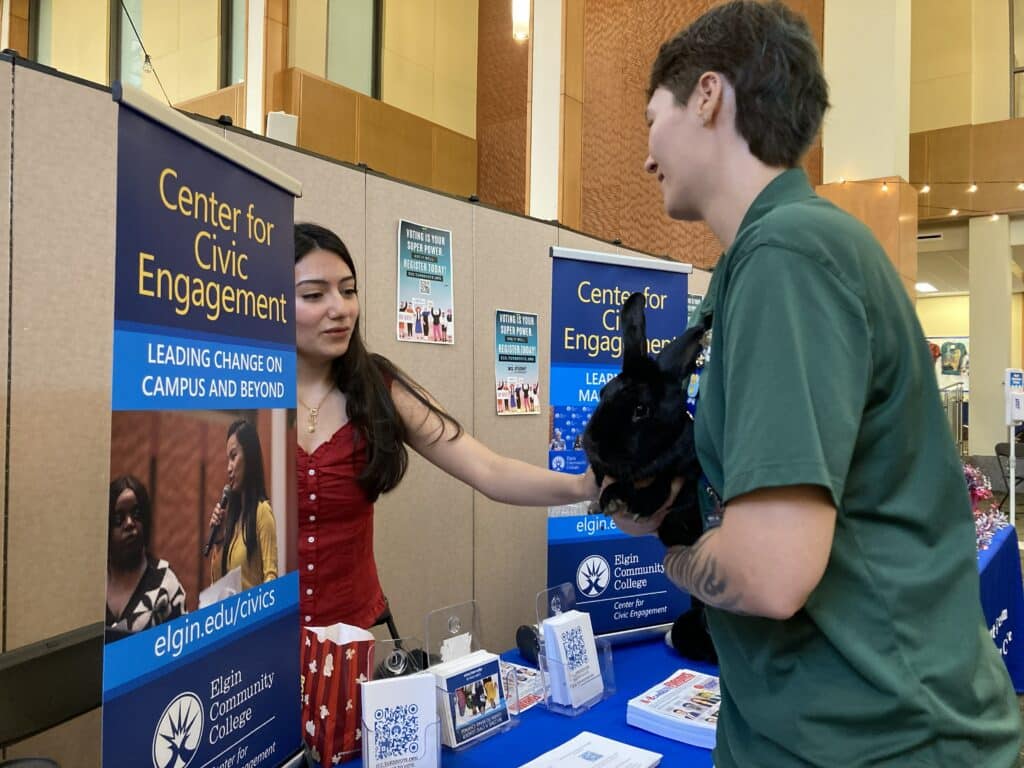
Candidate and issue policy forums have brought in those seeking election to Congress, the county board and township-level offices, as well as the college’s own board of trustees.
“That is something that we have authentically contributed to our campus and regional political culture,” Ramirez says. “Young people don’t often understand how the political system works. They have biases about corrupt politicians, that politicians just want to serve themselves. Elected officials tend to be older, and they also have biases about young people: ‘They don’t care. They’re disengaged.’”
But when put into a room together, those biases melt away, Ramirez says.
“Young people discover elected officials are just people doing the thankless work of public service,” he says. “Elected officials discover something I see every day in the classroom: They see young people as bright, eager, passionate individuals who care about making a change.”
Getting involved
Raymesha Henry, a 2026 graduate of Northern Illinois University in forensic psychology who received her associate degree from ECC, became involved in the center after meeting the cofounders in classes, a couple months after it opened.
“You found your posse — people just as passionate about different things as you are,” she says.
Henry and her classmates traveled to the state capital of Springfield to attend committee hearings, conducted research that they presented at the Midwest Political Science Association conference, and helped lead a panel for county state’s attorney candidates — and she ended up later interning in the state’s attorney’s office.
“These are people who make the rules for the communities we live in, where we go to school, where our children go to school,” she says. “There are lots of opportunities to network and connect.”
Esteban Gonzalez-Chavez, a political science major at University of Illinois who transferred from ECC, became involved due to his academic interests upon seeing an informational flyer.
“You might not take an interest in politics, but politics definitely takes an interest in you,” he says. “People are like, ‘Why should I vote? It doesn’t affect me.’ Well, it does.”
Catalyst for community action
The Center for Civic Learning & Community Engagement at Florida’s St. Petersburg College (SPC) was founded more than a decade ago to empower students both academically and otherwise, based on the concept that community engagement is a part of the school’s DNA, says Founding Director Tara Newsom.
“Using the community as a means to amplify our learning objectives, reach our course goals, connect students to global citizenship, all that good stuff — we should take that natural energy that we have at the college and put it into a more structured, institutional body,” she says.
The center has held annual events to demonstrate that commitment, such as the 9/11 Day of Remembrance and Service, celebrated civic holidays like National Voter Registration Day, and helped people get to the polls on Election Day, Newsom says. SPC also has tried to build opportunities in coursework to connect students to community, no matter their major.
SPC has served as a catalyst for community action, ranging from candidate forums, to civic concerts, to mural projects, Newsom says. On Martin Luther King, Jr., Day, a group went to St. Petersburg Youth Farm, located in a food desert, which uses hydroponics to grow food, and faculty, students and administrators helped tend the garden.
The center is currently in the midst of a yearlong celebration of the nation’s 250th anniversary that has included academic and co-curricular programming across a range of disciplines, participation in the statewide Sunshine Debate focused on student dialogue and civic discourse, a student government trip to the state capital of Tallahassee and more.
“It was important for us to have a robust year of celebrating,” Newsom says, adding that it coincides with the school’s 100th anniversary. “We’re very lucky that we have leaders who very much believe in community engagement, civic engagement and the transformation that these types of activities can deliver for students and the community.”
Melanie Williams, who received her associate degree at SPC a year ago and has been working toward a bachelor’s degree in public policy and public administration, participated as a mother of six children and a paraprofessional at Pinellas County Schools.
“I always wanted to be involved in some kind of democratic education role,” she says. “It’s important that people vote and are educated about what they’re voting about, and for, and paying attention to possible policies, acts and regulations being put into place.”
After encouragement from Newsom, Williams attended a meeting and one civic education event. “I absolutely loved it,” she says. Shortly thereafter, she became student government president, where she served for the next two-and-a-half years.