
Community colleges typically operate two houses – a for-credit side for degree seekers and transfer students, and a non-credit side for learners seeking a frictionless pathway into paid work. Recently, two-year schools have moved to bridge this gap through non-credit courses that stack into degree-specific options.
Called the “One Door” by Baton Rouge Community College Chancellor Willie Smith, the approach will ideally provide students with career-ready skills regardless of their credit status.
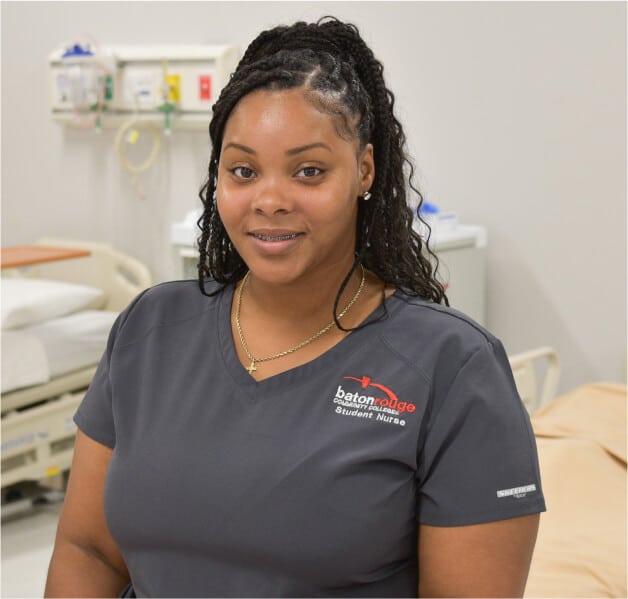
“People need to get to work, and some students can’t afford to be in a multi-year program,” said Smith, who serves on the American Association of Community Colleges board of directors. Through the One Door framework, “Students can embed short-term credits in the curricula to start work immediately. If they want to get to a pay increase, they can start at the spot they left off at and get that degree.”
Siloed credits do more than just derail student momentum; they can discourage learners from completing their programs altogether, said Smith. For example, licensed practical nurses (LPNs) seeking to become registered nurses (RNs) are often forced to retake basic nursing courses, meaning they pay out of pocket for material they already know.
Workforce training and traditional academia are often linked in principle rather than practice, maintained Smith and fellow advocates for seamless credit pathways. Nor will a non-credit-to-credit system work if students don’t understand the language – some colleges have dropped the term “non-credit,” opting to use “workforce education” or “professional development.”
At a minimum, colleges must simplify how they talk about this work, else they lose prospective students to costlier, lower-quality alternatives, said Gary Girard, vice president of community and workforce education at Nebraska’s Metropolitan Community College (MCC).
“You’d have an individual department trying to shepherd a student, but it was a case-by-case process, and it wasn’t a clear process,” Girard said. “Many students came to us for job skills, but the separation (into a degree) was not apparent. But what if six months down the road, they wanted to pursue further education? Even when learners have earned valuable industry credentials and workforce skills, there has not always been a clear connection between those accomplishments and degree pathways. This creates frustration, increases costs, and can slow educational progress.”
A shift to ‘learning for all’
MCC, the state’s second-largest postsecondary institution, offers more than 200 degrees and certificate programs.In 2022, the college adopted Path Forward, a guided pathways-like model to improve efficiency and student onboarding. The initiative grouped curriculum into academic focus areas, or AFAs, to help students streamline their options and select a specific program of study.
Prior to Path Forward, MCC encouraged undecided students to major in general studies. While this declaration qualified them for federal financial aid, the degree still had the lowest completion rate on campus. Today, undecided learners can declare a career exploration degree, with the goal of moving from their chosen AFA into a specific degree or certificate.
Recalibrating pathways allowed MCC to align its classroom options while building momentum for the federal Workforce Pell grant program. Four non-credit MCC programs were selected to jumpstart the effort: commercial driver’s license (CDL), CompTIA+, phlebotomy technician and pharmacy technician.
Related article: How a Nebraska college got a leg up on Workforce Pell
The college’s Workforce Pell readiness stems, in part, from Career Forward, a program launched in 2022 using $9 million in pandemic-era American Rescue Plan Act funding. The strategy provides financial support for both short-term training and credentialing in high-demand industries, Girard noted.
Together, these efforts led MCC to establish Credential College, an alternative to traditional degree tracks that prepares students for high-skilled careers both during enrollment and after graduation. Following a successful pilot at an Omaha high school, Credential College expanded to other high schools in the MCC service footprint.
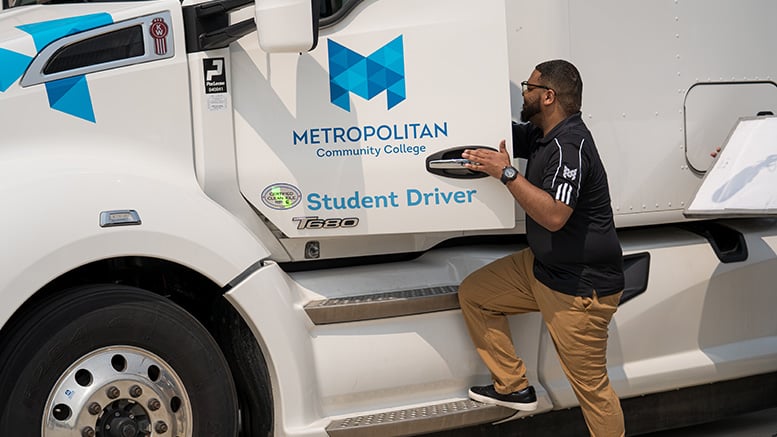
Although the program primarily serves the 37% of Nebraska high school graduates not bound for a four-year college, all credentials stack into higher-level degrees for when and if a student returns. Flexibility is the watchword for a competency-based curricula that lets learners find paid work while earning additional credentials, Girard said.
“It shifts the paradigm for students from ‘college for all’ to ‘learning for all,’” he said.
By structuring its coursework into clearer pathways, MCC is powering Nebraska toward its target of 70% postsecondary attainment for adults ages 25 to 34. Completion rates in select workforce programs have already topped 80%, Girard added.
Building on what works
North Carolina’s Vance-Granville Community College (VGCC) is a largely rural-serving institution. Though VGCC’s footprint reaches into the Raleigh area, its main campus in Vance serves a community where one in five residents lives in persistent poverty, said President Rachel Desmarais.
Workforce preparedness is key to VGCC’s mission. In February, the college secured a $750,000 grant from the Golden LEAF Foundation for construction of the Center for Advanced Manufacturing & Applied Technology (CAMAT). With a concentration on advanced manufacturing, logistics, transportation and skilled trades, the facility can bolster what had been a thriving region for production, Desmarais said.
CAMAT will be joined by the Transportation Training & Technology Center, future home to CDLs in heavy equipment operations and diesel mechanics. The new facilities will debut in a time that, until recently, offered few viable options between workforce training and traditional academic degree programs, Desmarais said.
For VGCC, the turning point came through a capacity-building grant from the Ascendium Education Group, aimed at closing equity gaps and boosting graduation rates among underserved students.
“Wasting credits was a big concern alongside our guided pathways efforts,” Desmarais said. “Let’s think about how non-credit classes are taught as well.”
Nowadays, credit and non-credit welding students share the same shop floor, giving undecided participants an up-close look at a career before they fully commit, she said.
“It exposes students on each trajectory to other students, and why they’re on that trajectory,” she continued. “It’s also lower stakes for students who want to try before they buy. For undecided students, it’s a good way to meet immediate needs while leaving the door open (for a credit-based welding program).”
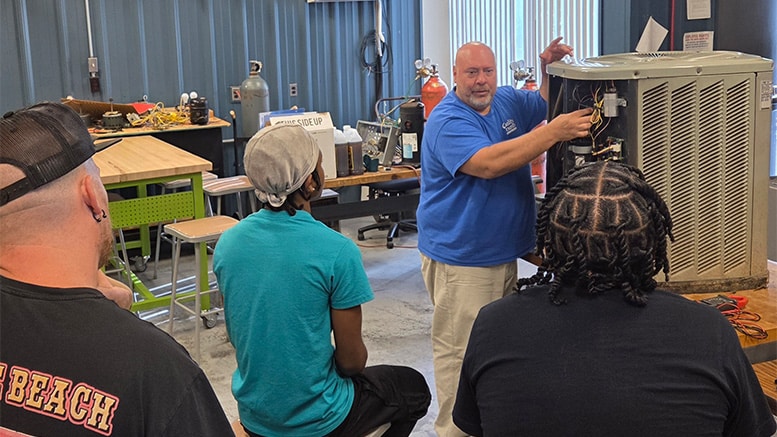
VGCC continues to align its non-credit training with degree-friendly technology programs. In addition to welding, learners can earn a BioWork Process Technician certificate that leads to manufacturing and pharmaceutical research degrees at two state universities. Desmarais said these options are made clear during admissions onboarding, part of a “one front door” process where long-term success comes first.
“The student does not have to declare whether they are credit or non-credit; we will just talk to you about your career goals,” Desmarais said. “We’ve made it a ‘no-no’ to say what your major is. It’s what you want to do, and what is your immediate situation. We are getting that information from the jump.”
Mind the gap
As community colleges modernize, the rift between their academic and workforce divisions becomes even more glaring, said Annie Phillips, director of the Education Strategy Group, a consulting firm that works with K-12, higher education, business and civic leaders to improve educational attainment.
“It’s called a ‘divide’ because college funding is tied to the for-credit side,” Phillips said. “There are many systems and structures in place to create two colleges in one, but they operate unequally.”
Updating these pathways addresses students who are rarely your typical 18-year-old living in a dorm. When institutions dissolve the barrier between non-credit training and credit degrees, a working parent can complete a six-week certification, then later earn an associate degree without starting from square one.
Linking workforce training to degree programs unlocks federal financial aid, enabling students to pursue advanced credentials on a flexible timeline, Phillips said. Meanwhile, institutions like San Jacinto College (Texas) have dedicated liaisons that drive faculty collaboration and smooth the road to graduation, she added.
“For learners, it’s the ability to pursue options for more reliable economic outcomes,” Phillips said. “Any college starting this work should have a ‘one college promise’ in their strategic plan. The work becomes part of your culture, and permeates into all you do. Leaders can think alignment is just about credit articulation, but it takes more than that to create (an alignment) model.”
Smith, the BRCC chancellor, said academic counselors must get comfortable advising students with degree ambitions, but who aren’t quite ready to tackle credit-bearing coursework.
“Advisors aren’t used to talking to non-credit students, but they need the same attention as for-credit students,” he said. “They will require even more attention as the needs of employers continue to change.”