What would make a talented 22-year-old raised in rural North Carolina choose to build a career close to home? I would argue our community colleges may be at the center of that decision.

When a community college builds a high-wage welding, healthcare or advanced manufacturing pipeline tied to a local employer, it does not just fill a job opening. It changes a young person’s decision about whether to stay or go.
Similar to public two-year colleges in other states, North Carolina’s community colleges are critical to not only developing but retaining talent in our rural areas. When students realize there are well-paying jobs available locally – with no expensive four-year degree or moving truck required – they are more likely to plant roots, changing generations.
Wages that change the calculus
There is a common misperception that “real money” can only be made in the bigger cities. The reality is that community college grads in high-demand fields don’t have to choose between staying near family or setting out to start a career that pays; they can enjoy both with a career within driving distance of where they already live.
According to Mountain Area Careers, more than 700 manufacturers operate across Buncombe, Henderson, Madison and Transylvania counties alone, employing more than 20,300 people.
Western North Carolina’s advanced manufacturing sector has also experienced significant growth, adding approximately 5,000 of these careers since 2010. In Henderson County alone, the Henderson County Partnership for Economic Development reports an average advanced manufacturing salary of $67,000, highlighting the strong career potential available to our college’s graduates.
Healthcare is another prime example. With healthcare systems serving as some of the largest employers in western North Carolina, students pursuing two-year healthcare degrees have access to a wide range of high-demand, family-sustaining careers. Graduates in fields such as surgical technology, nursing, respiratory therapy, radiography, medical laboratory technology, emergency medical services and other allied health professions are well-positioned for competitive wages and strong employment opportunities.
According to market data from ZipRecruiter accessed in July 2026, average annual salary estimates for healthcare roles in the Hendersonville vicinity range from $37,928 for certified nursing assistants to $119,443 for nurse practitioners. Within regional clinical teams, registered nurses (RNs) average $80,560, Licensed practical nurses (LPNs) average $56,972, Medical assistants (MAs) average $39,621, and surgical technicians earn a competitive salary of $92,540. Community colleges like Blue Ridge provide proven pathways toward all of these professions and more, preparing students to enter the healthcare workforce and advance over time.
When rural salaries in high-demand jobs begin to approach urban salaries for similar roles, new graduates feel far less pressure to move away from their hometowns.
Employer partnerships as retention infrastructure
The best way to connect young people with these rewarding careers? Affordable, high-value community college credentials are an important first step, but they are only part of the equation.
To prepare students for long-term success, community colleges build strong partnerships with regional employers that connect classroom learning with real-world experience. At Blue Ridge, we maintain over 600 such relationships at all times. Because students can pursue higher education or credentials close to home, these partnerships also strengthen their ties to local
industries and communities. The result is a workforce pipeline that benefits students, employers and the region alike.
At Blue Ridge, these public-private partnerships give students invaluable hands-on experience in professional settings. Through Apprenticeship Blue Ridge, for example, students can earn while they learn in fields such as automotive, construction, electrical, plumbing, mechatronics and HVAC. This year, strong partnerships are enabling our electrical apprentices to learn in the classroom, earn on the job and build the skills, experience and professional connections that launch rewarding, well-paying careers in the electrical trade.
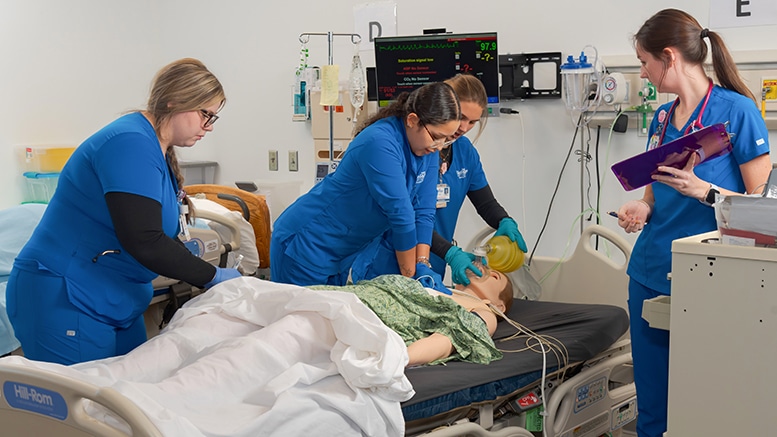
This model extends across nearly every program area at Blue Ridge, with healthcare again serving as an excellent example. Our Allied Health programs partner with local healthcare providers such as UNC Health Pardee, AdventHealth Hendersonville and HCA/Mission Health to provide practical clinical experience, allowing students to work alongside professionals in real healthcare settings while earning their certifications. After graduation, many of these students continue their careers with the same local healthcare providers where they trained.
These relationships have to be built with intention. This year, community college leaders and employers came together to create Good Jobs Western North Carolina, an initiative focused on creating high-quality jobs and building workforce pipelines. Together, we are examining both the workforce gaps we see today and anticipate over the next decade, as well as the throughput of our institutions — that is, how effectively we guide students from entry through successful completion and employment in critical sectors.
Through in-person workshops, employers and college representatives come together to discuss shared goals, identify talent needs, pursue funding opportunities and implement additional partnerships. Collectively, these efforts will guide our strategies to strengthen the talent pipeline and address workforce gaps. Good Jobs WNC is just one solution to solving the “brain drain” problem.
Changing perceptions on rural jobs
Careers in rural areas can be just as rewarding as those in major cities, but that fact is irrelevant if young job seekers don’t know the career opportunities exist. National research shows that only 49% of Gen Zers living in rural areas believe they can find a good job in their community.
This perception leads many young people to relocate, even if they would have landed a rewarding and stable job in their home communities.
North Carolina, however, is making strides in proving this perception outdated. In Blue Ridge’s service area, Henderson County saw a 22% growth in jobs between 2013-2023, and Transylvania County saw a 16% growth in this time. Employment across western North Carolina is likewise projected to continue growing over the next decade in several industries, such as healthcare, construction, skilled trades, professional services and advanced manufacturing.
Statewide, in partnership with the North Carolina Community College system, the governor’s Council on Workforce and Apprenticeships has made it a goal to double the number of registered apprentices, a move which will enable more young people to enter the skilled trades in their communities.
There are many professions in rural communities that do require a bachelor’s or advanced degree, and community colleges like Blue Ridge also provide affordable, efficient pathways toward those credentials. Through Career and College Promise for high schoolers, strategic transfer programs and guaranteed admission agreements with major four-year universities, students can begin their education close to home before completing their studies elsewhere.
By starting locally, students save tens of thousands of dollars while building relationships with faculty, employers and mentors, ultimately establishing professional connections in their home communities. Those local networks increase the likelihood that graduates return after earning their advanced degrees, bringing valuable skills and expertise back home.
In North Carolina and nationwide, community colleges play a vital part in talent retention and growth for rural counties. For rural students, a community college education is far more than a fallback. It’s the clearest path to positive generational change and building a better life in their home communities.